Florida SS.8.CG.1.1
The Standard
- SS.8.CG.1
- Demonstrate an understanding of the origins and purposes of government, law, and the American political system.
Compare the views of Patriots, Loyalists, and other colonists on limits of government authority, unalienable rights, and resistance to tyranny.
Florida Next Generation Sunshine State Standards for Social Studies
Teacher's field guide
What This Standard Means
What Students Need to Do
- Students compare why Patriots, Loyalists, and colonists who took neither side disagreed about British rule. They explain how each group viewed government power, rights, and resistance.
What Mastery Looks Like
- A student can explain why a Patriot might support independence while a Loyalist might oppose rebellion. They can describe why a colonist might stay neutral and use a source to support each explanation.
Common Misconceptions
- Students may think all colonists wanted independence or that Loyalists did not care about rights. They may also assume that people who stayed neutral had no opinion, rather than reasons to avoid taking a side.
How to Assess It
- Give students three short statements, one from each viewpoint. Ask them to identify each speaker and write one sentence explaining each choice.
Lesson moves
Ways to Teach It
Give pairs three viewpoint cards and a copy of the Declaration of Independence; have them mark which claims each speaker might accept or reject.
Ask students to write a Loyalist reply to the claim that rebellion was the only way to protect colonists' rights.
Play a sorting game with six claims about taxes, rights, and rebellion; students match each claim to a viewpoint and defend one match.
Use a merchant's unpaid bills and a British trade permit to ask why independence might threaten that person's livelihood.
Free download
Printable SS.8.CG.1.1 Worksheet
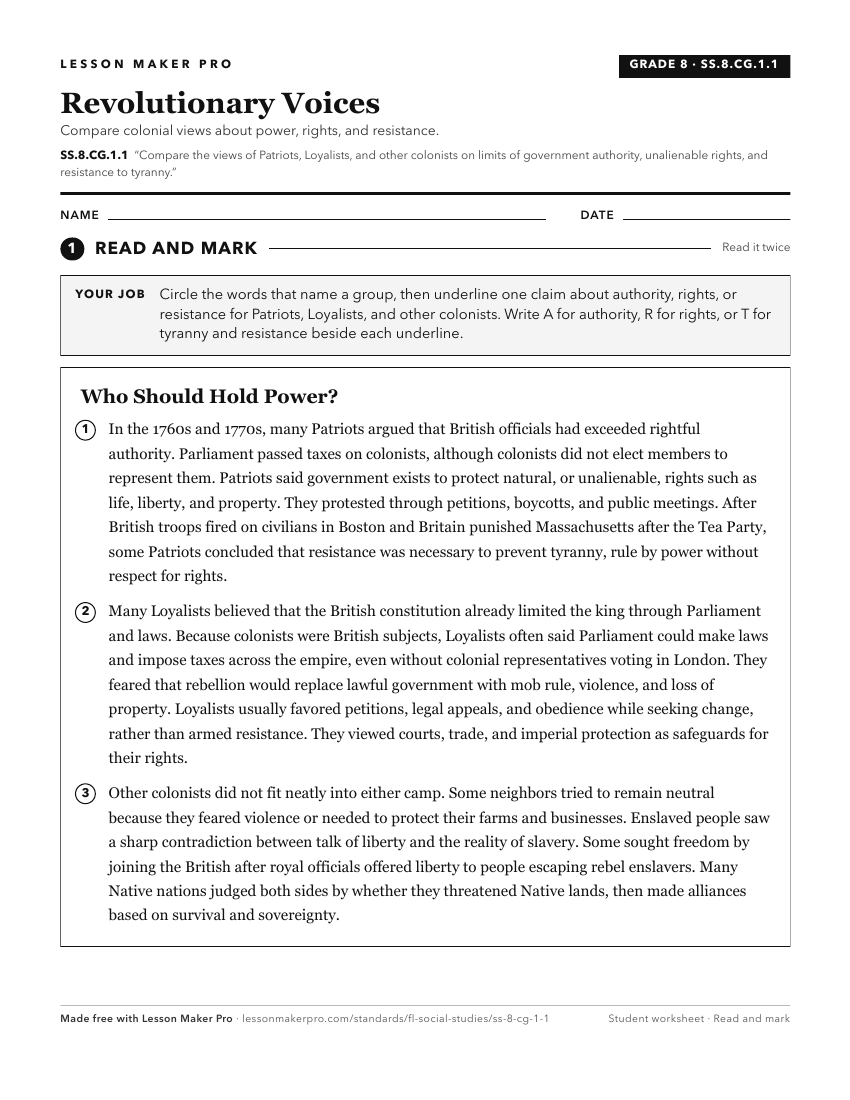
A ready-to-print activity worksheet aligned to SS.8.CG.1.1, with an answer key for the teacher on its own page. No account needed.
PDF, US Letter, prints cleanly in black and white.
Download the worksheetKeep exploring
Related Standards
- SS.7.CG.1.3
Trace the impact that the Magna Carta, Mayflower Compact, English Bill of Rights and Thomas Paine's Common Sense had on colonists' views of government.
- SS.5.CG.2.1
Discuss the political ideas of Patriots, Loyalists, and other colonists about the American Revolution.
- SS.5.A.5.8
Evaluate the personal and political hardships resulting from the American Revolution.
- SS.8.A.3.8
Examine individuals and groups that affected political and social motivations during the American Revolution.
Turn this exact standard into a lesson
Grade, subject, topic, and the complete standard are prefilled. Create one free, no account needed.
Also for this standard:Make a WorksheetMake a QuizMake a Sub Lesson