Florida SS.8.A.4.5
The Standard
- SS.8.A.4
- Demonstrate an understanding of the domestic and international causes, course, and consequences of westward expansion.
Explain the causes, course, and consequences of the 19th century transportation revolution on the growth of the nation's economy.
Florida Next Generation Sunshine State Standards for Social Studies
Teacher's field guide
What This Standard Means
What Students Need to Do
- Students explain why farmers, merchants, and growing cities needed cheaper, faster ways to move goods and people. They trace how roads, steamboats, canals, and railroads linked regions and expanded trade.
What Mastery Looks Like
- Students can place the National Road, steamboats, Erie Canal, and early railroads in sequence and explain why each spread. They connect lower shipping costs to wider markets, regional specialization, town growth, migration, and new jobs.
Common Misconceptions
- Students may assume railroads appeared first or immediately replaced canals and steamboats. They may describe faster travel without explaining how lower costs, reliable routes, and larger markets changed the economy.
How to Assess It
- Give students four terms: Erie Canal, railroad, lower shipping costs, and western farm growth. Ask them to write a three-sentence cause and effect explanation using all four.
Lesson moves
Ways to Teach It
Give pairs a blank U.S. map, route cards, and yarn to trace roads, canals, rivers, and rail lines connecting farms to markets.
Ask students to write: Which changed trade more, the Erie Canal or early railroads, and what evidence supports your claim?
Run a route challenge where teams choose transport cards to move goods, then compare cost, speed, capacity, and seasonal limits.
Have students compare a local highway or port with the Erie Canal by listing who gains, who pays, and how businesses change.
Free download
Printable SS.8.A.4.5 Worksheet
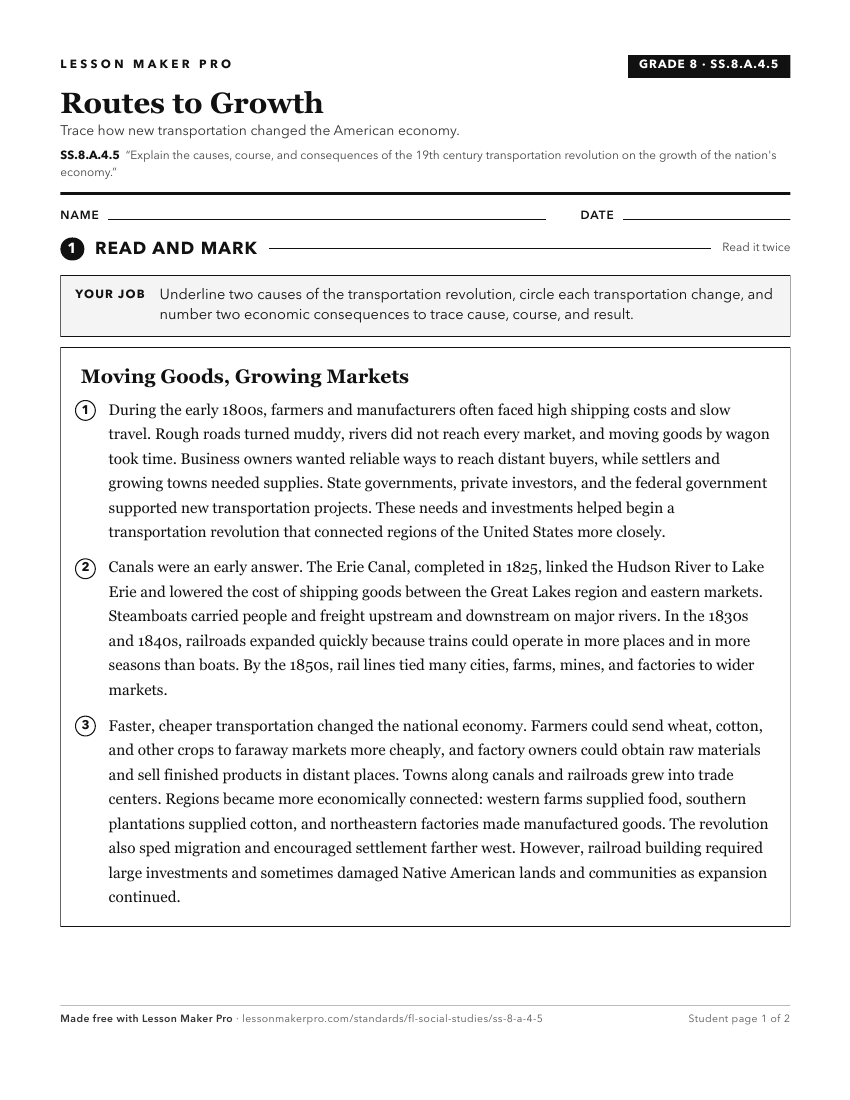
A ready-to-print activity worksheet aligned to SS.8.A.4.5, with an answer key for the teacher on its own page. No account needed.
PDF, US Letter, prints cleanly in black and white.
Download the worksheetKeep exploring
Related Standards
- SS.5.A.6.3
Examine 19th century advancements (e.g., canals, roads, steamboats, flat boats, overland wagons, Pony Express, railroads) in transportation and communication.
- SS.8.A.3.6
Examine the causes, course, and consequences of the American Revolution.
- SS.8.A.4.7
Explain the causes, course, and consequences (e.g., industrial growth, subsequent effect on children and women) of New England's textile industry.
- SS.8.A.5.1
Explain the causes, course, and consequences of the Civil War (e.g., sectionalism, slavery, states' rights, balance of power in the Senate).
Turn this exact standard into a lesson
Grade, subject, topic, and the complete standard are prefilled. Create one free, no account needed.
Also for this standard:Make a WorksheetMake a QuizMake a Sub Lesson