Florida SS.8.A.1.7
The Standard
- SS.8.A.1
- Use research and inquiry skills to analyze American History using primary and secondary sources.
View historic events through the eyes of those who were there as shown in their art, writings, music, and artifacts.
Florida Next Generation Sunshine State Standards for Social Studies
Teacher's field guide
What This Standard Means
What Students Need to Do
- Students examine art, letters, songs, and objects from a historical period to infer how people experienced an event. They support each inference with source details and consider whose viewpoint is represented.
What Mastery Looks Like
- Students can explain a person’s likely beliefs, feelings, or experiences using specific evidence from a source. They can also name limits, bias, or missing viewpoints.
Common Misconceptions
- Students may treat every source as a complete, neutral record or confuse an inference with a visible fact. They may also assume one person’s viewpoint represents everyone living at that time.
How to Assess It
- Show Paul Revere’s Boston Massacre engraving. Ask students what it suggests about colonial views, which two details support their answer, and what limitation matters.
Lesson moves
Ways to Teach It
Set up stations with a letter, painting, song lyrics, and artifact photo; students record one observation and one inference at each.
Ask students whose experience a source reveals and whose is missing, then require two source details in a short written response.
Play Evidence or Inference: teams label statements about a historical image, then revise unsupported inferences using visible details.
Students bring or photograph a family object and write what a future historian could learn, and what the object cannot prove.
Free download
Printable SS.8.A.1.7 Worksheet
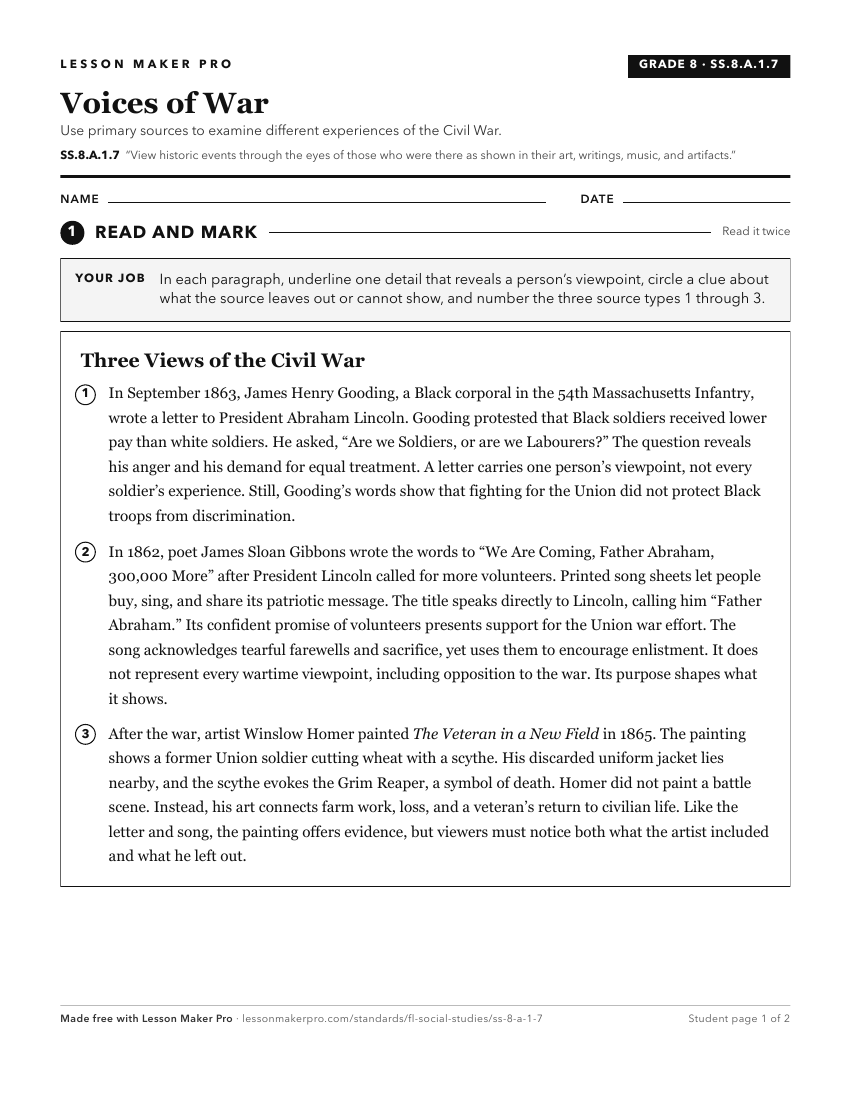
A ready-to-print activity worksheet aligned to SS.8.A.1.7, with an answer key for the teacher on its own page. No account needed.
PDF, US Letter, prints cleanly in black and white.
Download the worksheetKeep exploring
Related Standards
- SS.1.A.2.1
Understand that history tells the story of people and events of other times and places.
- SS.8.A.4.3
Examine the experiences and perspectives of significant individuals and groups during this era of American History.
- SS.8.A.1.6
Compare interpretations of key events and issues throughout American History.
- SS.8.G.6.2
Illustrate places and events in U.S. history through the use of narratives and graphic representations.
Turn this exact standard into a lesson
Grade, subject, topic, and the complete standard are prefilled. Create one free, no account needed.
Also for this standard:Make a WorksheetMake a QuizMake a Sub Lesson