Florida SS.68.AA.1.3
The Standard
- SS.68.AA.1
- Understand the causes, courses, and consequences of the slave trade in the colonies.
Examine the evolution of the labor force in the use of indentured servitude contracts.
Florida Next Generation Sunshine State Standards for Social Studies
Teacher's field guide
What This Standard Means
What Students Need to Do
- Students read indenture contracts and identify service length, work duties, penalties, and promised benefits. They explain why colonists used these contracts and how colonial labor shifted toward racialized, lifelong slavery.
What Mastery Looks Like
- Students can use contract clauses as evidence about a servant’s rights and limits. They can distinguish indentured labor from chattel slavery and explain how the colonial labor force changed over time.
Common Misconceptions
- Students may assume indentured servants and enslaved people had the same legal status. They may also assume every servant chose freely, received land, or completed the contract under fair conditions.
How to Assess It
- Exit ticket: A 1650 worker signs a seven-year labor contract, while a 1705 law treats enslaved Africans as property for life. Explain two differences and what changed.
Lesson moves
Ways to Teach It
In pairs, annotate a replica indenture contract with colored pencils for service length, labor duties, penalties, and promised freedom dues.
Discuss: Was signing an indenture contract a fully free choice? Cite two clauses and one fact about the servant’s circumstances.
Teams sort labor scenario cards by indentured, enslaved, or free, then arrange them on a colonial timeline and defend two choices.
Compare one indenture clause with a modern employment contract, listing differences in pay, duration, exit rights, and legal protection.
Free download
Printable SS.68.AA.1.3 Worksheet
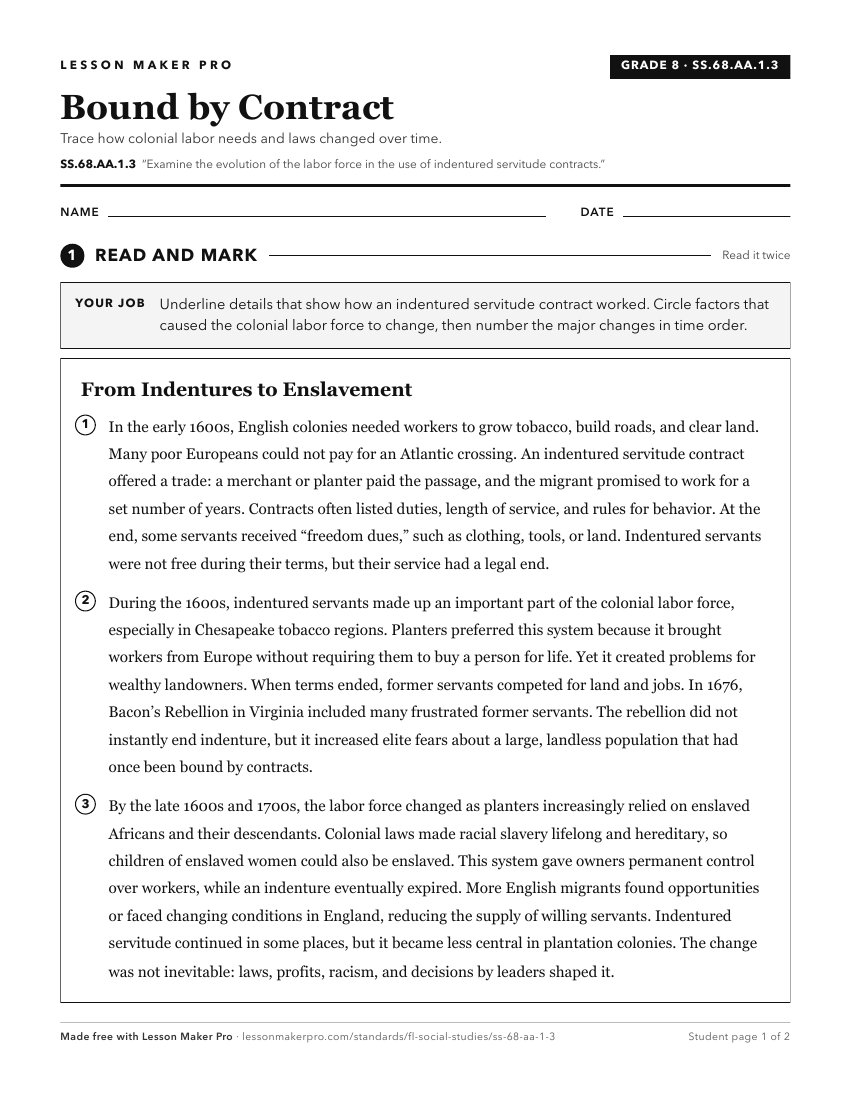
A ready-to-print activity worksheet aligned to SS.68.AA.1.3, with an answer key for the teacher on its own page. No account needed.
PDF, US Letter, prints cleanly in black and white.
Download the worksheetKeep exploring
Related Standards
- SS.8.A.2.3
Differentiate economic systems of New England, Middle, and Southern colonies including indentured servants and slaves as labor sources.
- SS.68.AA.2.3
Examine the various duties and trades performed by slaves (e.g., agricultural work, painting, carpentry, tailoring, domestic service, blacksmithing, transportat...
- SS.8.A.4.10
Analyze the impact of technological advancements on the agricultural economy and slave labor.
- SS.8.A.3.15
Examine this time period (1763-1815) from the perspective of historically under-represented groups (e.g., children, indentured servants, Native Americans, slave...
Turn this exact standard into a lesson
Grade, subject, topic, and the complete standard are prefilled. Create one free, no account needed.
Also for this standard:Make a WorksheetMake a QuizMake a Sub Lesson