Florida SS.8.A.4.10
The Standard
- SS.8.A.4
- Demonstrate an understanding of the domestic and international causes, course, and consequences of westward expansion.
Analyze the impact of technological advancements on the agricultural economy and slave labor.
Florida Next Generation Sunshine State Standards for Social Studies
Teacher's field guide
What This Standard Means
What Students Need to Do
- Students trace how inventions such as the cotton gin changed cotton production, profits, land use, and labor demand. They explain cause-and-effect links using historical evidence.
What Mastery Looks Like
- Students can build a clear causal chain from faster cotton processing to plantation expansion and increased demand for enslaved field labor. They can support the chain with production data, maps, or written sources.
Common Misconceptions
- Students may assume a labor-saving machine reduced slavery. They may think the cotton gin picked cotton rather than removed seeds. Some overlook how transportation improvements helped plantation owners reach larger markets.
How to Assess It
- Use this exit prompt: “Why did the cotton gin increase demand for enslaved labor even though it saved labor?” Require a three-step causal chain.
Lesson moves
Ways to Teach It
Give pairs cotton balls mixed with large beads, time hand separation, repeat with a fork model, and graph the difference in output.
Ask students to explain why faster cotton processing increased enslaved field labor, using a three-step causal chain.
Teams race to arrange cards linking the cotton gin, cheaper processing, plantation expansion, cotton output, and demand for enslaved labor.
Provide a short article on warehouse automation, then have students compare its labor effects with those of the cotton gin.
Free download
Printable SS.8.A.4.10 Worksheet
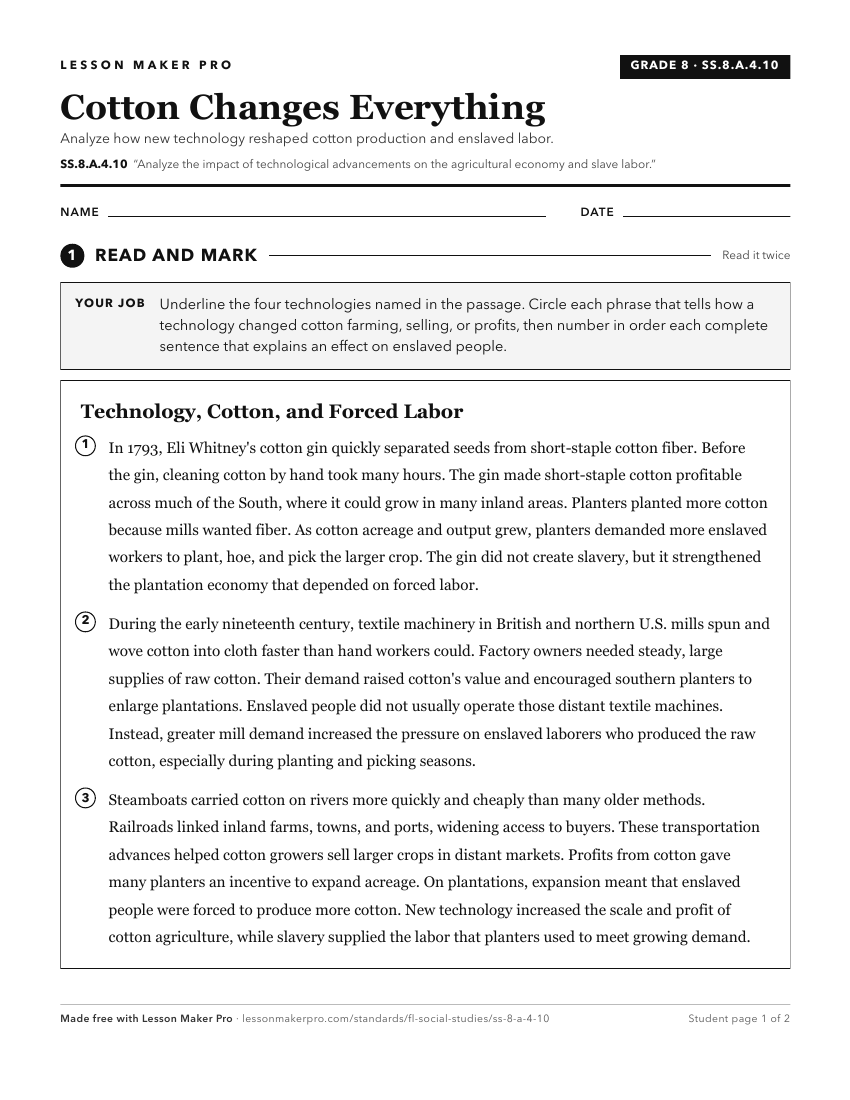
A ready-to-print activity worksheet aligned to SS.8.A.4.10, with an answer key for the teacher on its own page. No account needed.
PDF, US Letter, prints cleanly in black and white.
Download the worksheetKeep exploring
Related Standards
- SS.8.A.2.3
Differentiate economic systems of New England, Middle, and Southern colonies including indentured servants and slaves as labor sources.
- SS.8.A.4.11
Examine the aspects of slave culture including plantation life, resistance efforts, and the role of the slaves' spiritual system.
- SS.68.AA.2.3
Examine the various duties and trades performed by slaves (e.g., agricultural work, painting, carpentry, tailoring, domestic service, blacksmithing, transportat...
- SS.5.E.1.3
Trace the development of technology and the impact of major inventions on business productivity during the early development of the United States.
Turn this exact standard into a lesson
Grade, subject, topic, and the complete standard are prefilled. Create one free, no account needed.
Also for this standard:Make a WorksheetMake a QuizMake a Sub Lesson