Florida SS.5.E.1.2
The Standard
Describe a market economy and give examples of how the colonial and early American economy exhibited these characteristics.
Florida Next Generation Sunshine State Standards for Social Studies
Teacher's field guide
What This Standard Means
What Students Need to Do
- Students explain how buyers and sellers exchange goods and services in a market economy. They use examples from colonial and early American life, such as farmers selling crops and craftspeople selling what they made.
What Mastery Looks Like
- A student can describe a colonial farmer choosing what to grow and selling extra crops to earn money. They can explain that buyers chose what to purchase, while noting that British trade rules limited some colonial choices.
Common Misconceptions
- Students may think colonists only bartered and never used money. They may also think every colonial trade was a free choice, overlooking British rules about where some goods could be sold.
How to Assess It
- Exit ticket: A colonial shoemaker makes three pairs of shoes to sell. Name one choice the shoemaker makes, one choice a buyer makes, and one way this shows a market economy.
Lesson moves
Ways to Teach It
Give pairs paper crop and tool cards, then have them trade to meet a printed list of household needs.
Ask students to write: Why might a colonial farmer grow extra wheat instead of only enough for the family?
Play a shopkeeper round with price tags: students choose purchases using five paper coins, then explain their choices.
Show a local farmers market flyer and ask students to match one seller's choice to a colonial farmer's choice.
Free download
Printable SS.5.E.1.2 Worksheet
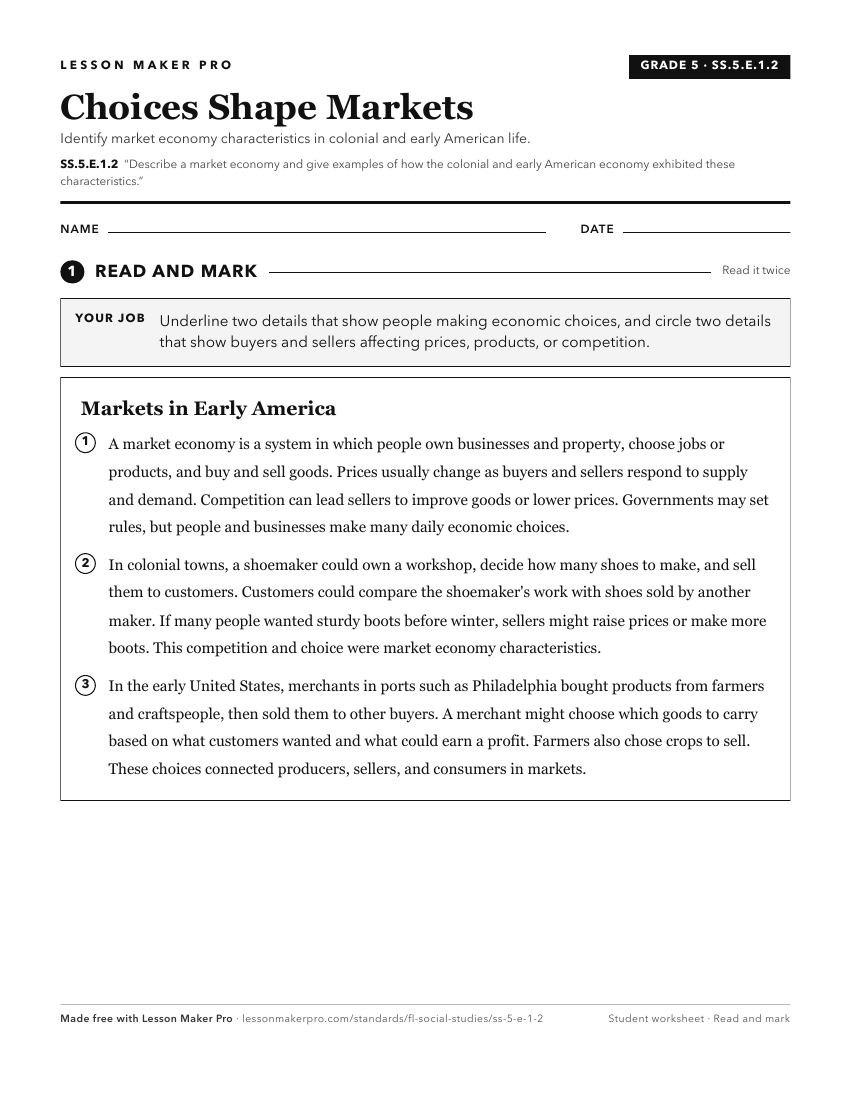
A ready-to-print activity worksheet aligned to SS.5.E.1.2, with an answer key for the teacher on its own page. No account needed.
PDF, US Letter, prints cleanly in black and white.
Download the worksheetKeep exploring
Related Standards
- SS.6.E.1.2
Describe and identify traditional and command economies as they appear in different civilizations.
- SS.7.E.1.3
Review the concepts of supply and demand, choice, scarcity, and opportunity cost as they relate to the development of the mixed market economy in the United Sta...
- SS.7.E.1.1
Explain how the principles of a market and mixed economy helped to develop the United States into a democratic nation.
- SS.5.E.1
Market Economy
Turn this exact standard into a lesson
Grade, subject, topic, and the complete standard are prefilled. Create one free, no account needed.
Also for this standard:Make a WorksheetMake a QuizMake a Sub Lesson