Florida SS.5.A.6.8
The Standard
- SS.5.A.6
- Growth and Westward Expansion
Describe the causes and effects of the Missouri Compromise.
Florida Next Generation Sunshine State Standards for Social Studies
Teacher's field guide
What This Standard Means
What Students Need to Do
- Students explain why Missouri’s request for statehood threatened the balance between free and slave states. They identify the agreement’s main terms and explain how it reduced tension only temporarily.
What Mastery Looks Like
- Students can use a map to identify Maine, Missouri, and the 36°30′ boundary. They can connect the agreement to Senate balance, slavery’s expansion, and growing sectional conflict.
Common Misconceptions
- Students may think the agreement ended slavery or settled the conflict permanently. They may also confuse which state entered as free and which entered as slave.
How to Assess It
- On an exit ticket, ask: Why did Congress act in 1820, what three rules did it adopt, and what happened afterward?
Lesson moves
Ways to Teach It
Give pairs a blank 1820 map, colored pencils, and state cards to mark Maine, Missouri, and the 36°30′ boundary.
Ask: Why did Congress accept an agreement that satisfied neither side, and why did the conflict return?
Teams sort ten event cards into causes, terms, and effects, then defend one disputed card with evidence.
Compare the Senate balance in 1820 with a tied class vote, then discuss how adding one voter can change the outcome.
Free download
Printable SS.5.A.6.8 Worksheet
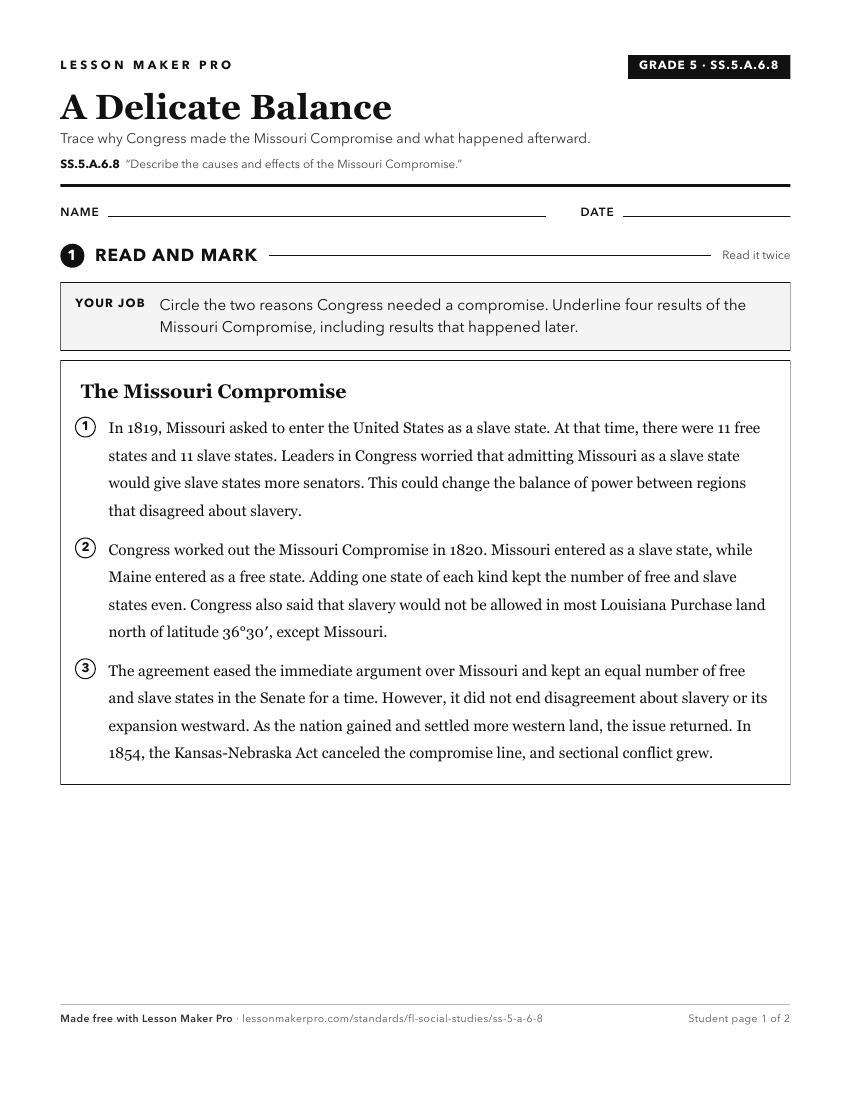
A ready-to-print activity worksheet aligned to SS.5.A.6.8, with an answer key for the teacher on its own page. No account needed.
PDF, US Letter, prints cleanly in black and white.
Download the worksheetKeep exploring
Related Standards
- SS.5.A.6.1
Describe the causes and effects of the Louisiana Purchase.
- SS.68.AA.2.1
Explain early congressional actions regarding the institution of slavery (i.e., Northwest Ordinance of 1787, Three-Fifths Compromise, Act Prohibiting Importatio...
- SS.8.A.4.2
Describe the debate surrounding the spread of slavery into western territories and Florida.
- SS.8.A.5.1
Explain the causes, course, and consequences of the Civil War (e.g., sectionalism, slavery, states' rights, balance of power in the Senate).
Turn this exact standard into a lesson
Grade, subject, topic, and the complete standard are prefilled. Create one free, no account needed.
Also for this standard:Make a WorksheetMake a QuizMake a Sub Lesson