Florida SS.5.A.4.5
The Standard
- SS.5.A.4
- Colonization of North America
Explain the importance of Triangular Trade linking Africa, the West Indies, the British Colonies, and Europe.
Florida Next Generation Sunshine State Standards for Social Studies
Teacher's field guide
What This Standard Means
What Students Need to Do
- Students trace Atlantic trade routes and identify what moved between Europe, Africa, the Caribbean, and the colonies. They explain how trade created wealth while relying on the forced labor and suffering of enslaved Africans.
What Mastery Looks Like
- Students can label the major routes and match goods or people to each route. They can explain how sugar, molasses, manufactured goods, raw materials, and slavery connected colonial economies.
Common Misconceptions
- Students may think the routes formed one exact triangle or that every ship visited all four regions. They may describe enslaved Africans as ordinary workers or voluntary immigrants rather than people captured, sold, and forced to labor.
How to Assess It
- Give students a blank Atlantic map. Ask them to draw and label three trade routes, name one item carried on each, and explain why the system mattered.
Lesson moves
Ways to Teach It
Give pairs a map, yarn, and cargo cards to build routes among Europe, Africa, the Caribbean, and the colonies.
Ask students to write: Who gained wealth from Atlantic trade, and who paid the greatest human cost?
Teams match route cards, cargo cards, and destination cards, then correct one inaccurate trade map.
Examine a bag of sugar and trace how colonial sugar production connected plantations, enslaved labor, merchants, and consumers.
Free download
Printable SS.5.A.4.5 Worksheet
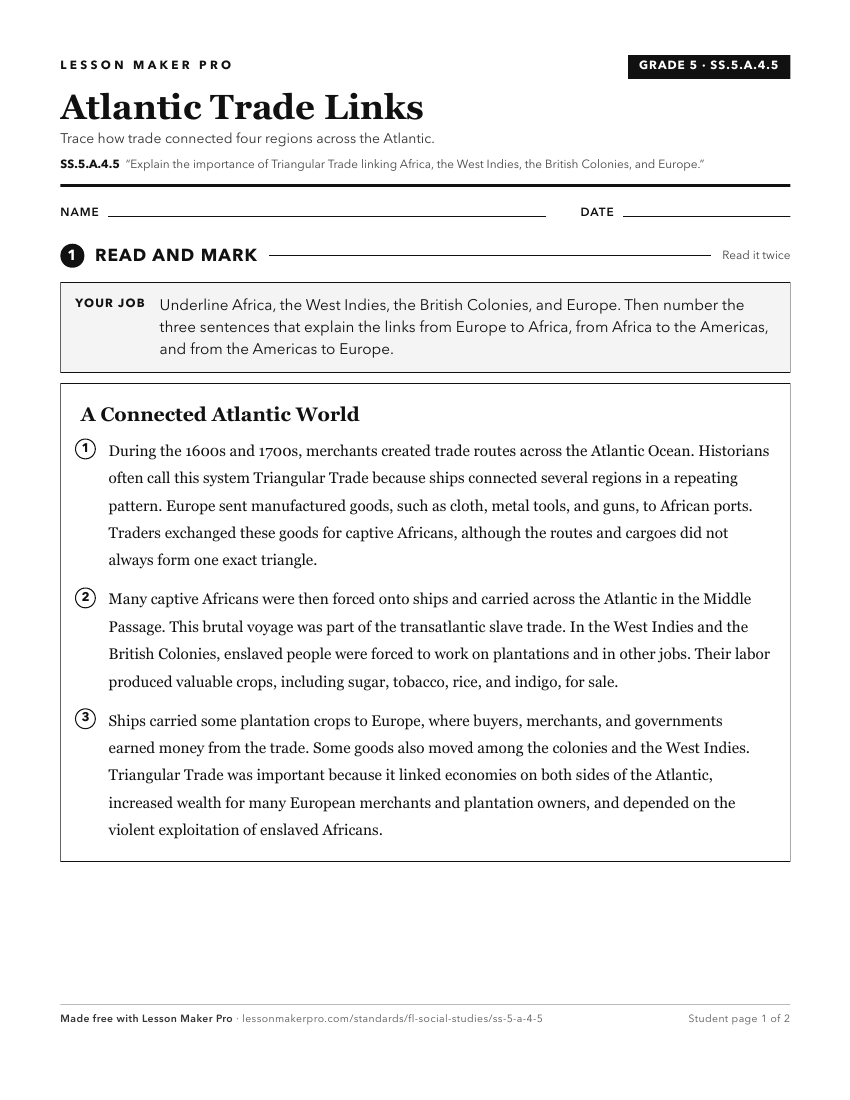
A ready-to-print activity worksheet aligned to SS.5.A.4.5, with an answer key for the teacher on its own page. No account needed.
PDF, US Letter, prints cleanly in black and white.
Download the worksheetKeep exploring
Related Standards
- SS.68.AA.1.1
Identify Afro-Eurasian trade routes and methods prior to the development of the Atlantic slave trade.
- SS.68.AA.1.2
Describe the contact of European explorers with systematic slave trading in Africa.
- SS.6.W.4.10
Explain the significance of the silk roads and maritime routes across the Indian Ocean to the movement of goods and ideas among Asia, East Africa, and the Medit...
- SS.68.AA.1
Understand the causes, courses, and consequences of the slave trade in the colonies.
Turn this exact standard into a lesson
Grade, subject, topic, and the complete standard are prefilled. Create one free, no account needed.
Also for this standard:Make a WorksheetMake a QuizMake a Sub Lesson