Florida SS.5.A.4.1
The Standard
- SS.5.A.4
- Colonization of North America
Identify the economic, political, and socio-cultural motivation for colonial settlement.
Florida Next Generation Sunshine State Standards for Social Studies
Teacher's field guide
What This Standard Means
What Students Need to Do
- Students explain why people and governments supported English settlements in North America. They sort reasons into money and trade, land and political power, and religion or community life.
What Mastery Looks Like
- A student can explain that Jamestown investors hoped to make money and that England established Georgia partly to protect its southern colonies. They can also explain that many Plymouth settlers wanted to practice their religion together.
Common Misconceptions
- Students may think every settler came for religious freedom, or that a colony had only one reason for being founded. They may also mix up a government's goal, such as gaining territory, with a settler's goal, such as owning land.
How to Assess It
- Give students three cards labeled Jamestown investors, Plymouth settlers, and England's leaders planning Georgia. Ask them to write one likely goal for each and label it economic, political, or socio-cultural.
Lesson moves
Ways to Teach It
Give pairs a map and three colony cards for Jamestown, Plymouth, and Georgia, then have them place each card and write one reason for settlement.
Ask students to write: Why might an investor and a family joining the same colony give different reasons for going?
Play a sorting game with cards reading earn money from tobacco, protect the southern border, and worship together, then have students defend each choice.
Show a local real estate ad, a place of worship notice, and a town boundary map, then ask which settlement motives each resembles.
Free download
Printable SS.5.A.4.1 Worksheet
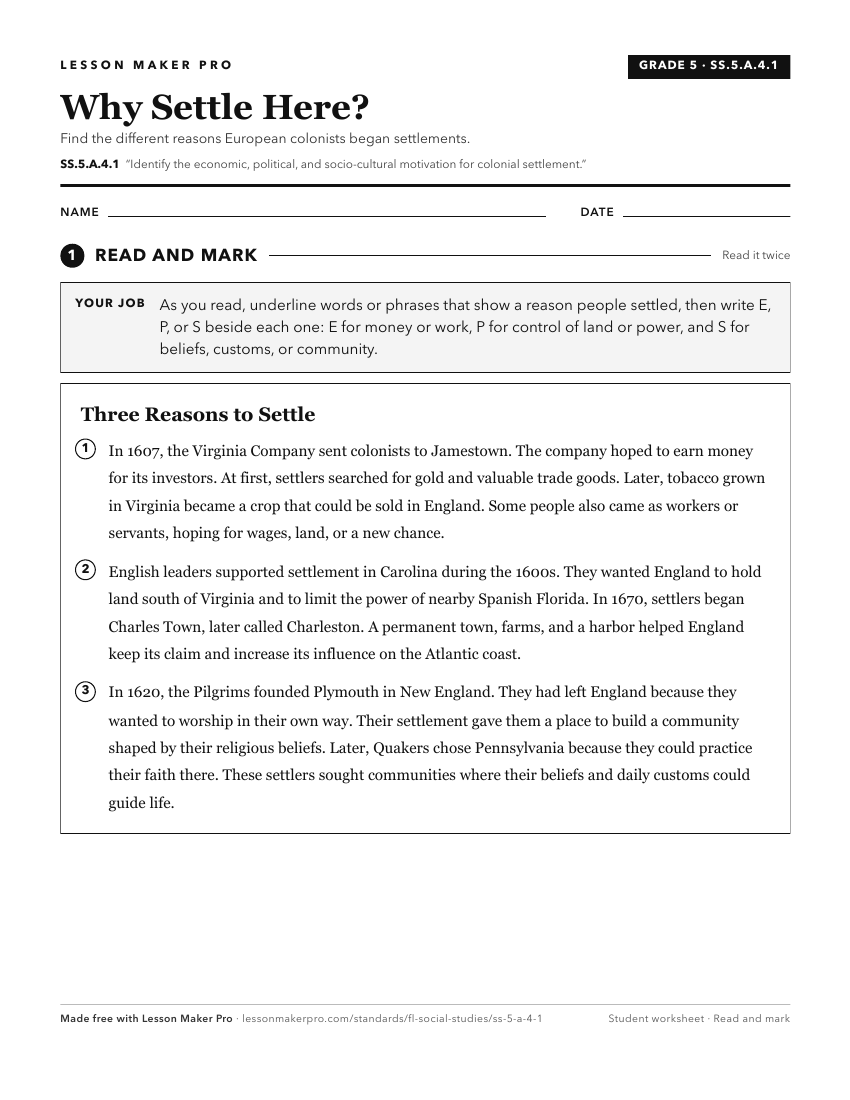
A ready-to-print activity worksheet aligned to SS.5.A.4.1, with an answer key for the teacher on its own page. No account needed.
PDF, US Letter, prints cleanly in black and white.
Download the worksheetKeep exploring
Related Standards
- SS.3.G.4.1
Explain how the environment influences settlement patterns in the United States, Canada, Mexico, and the Caribbean.
- SS.8.A.2.4
Identify the impact of key colonial figures on the economic, political, and social development of the colonies.
- SS.8.A.2
Examine the causes, course, and consequences of British settlement in the American colonies.
- SS.8.A.2.5
Discuss the impact of colonial settlement on Native American populations.
Turn this exact standard into a lesson
Grade, subject, topic, and the complete standard are prefilled. Create one free, no account needed.
Also for this standard:Make a WorksheetMake a QuizMake a Sub Lesson