Florida SS.3.G.3.2
The Standard
- SS.3.G.3
- Physical Systems
Describe the natural resources in the United States, Canada, Mexico, and the Caribbean.
Florida Next Generation Sunshine State Standards for Social Studies
Teacher's field guide
What This Standard Means
What Students Need to Do
- Students identify resources from land and water, including forests, freshwater, fertile soil, fish, minerals, oil, and natural gas. They connect examples to each region and compare shared resources.
What Mastery Looks Like
- A student names at least two accurate resources for each region and locates the regions on a map. They make an accurate comparison between two regions using resource examples.
Common Misconceptions
- Students may list cars, canned food, or tourism instead of the natural materials those depend on. They may treat a resource as exclusive to one place or treat the Caribbean as one country.
How to Assess It
- Give students a four-part exit ticket, one part for each region. They list two resources per region, then underline one resource shared by two regions.
Lesson moves
Ways to Teach It
Use an outline map and picture cards for oil, forests, freshwater, minerals, fertile soil, and fish; students place copies in every matching region.
Ask: Which two regions share a resource, and how might people use it? Students answer with evidence from a resource map.
Play resource clue bingo: call large forests or oil, and students cover a region where the class atlas shows that resource.
Match a wooden desk, metal can, fish package, and gas receipt to natural resources, then name regions that produce each resource.
Free download
Printable SS.3.G.3.2 Worksheet
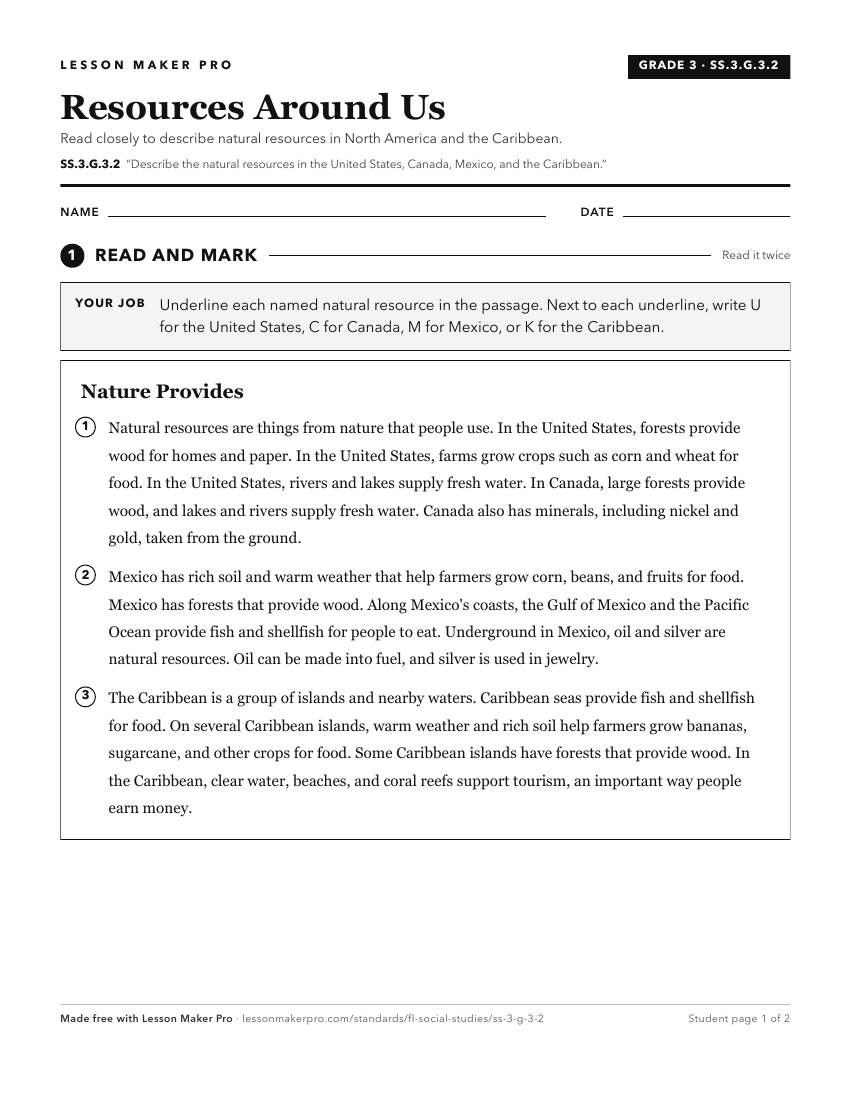
A ready-to-print activity worksheet aligned to SS.3.G.3.2, with an answer key for the teacher on its own page. No account needed.
PDF, US Letter, prints cleanly in black and white.
Download the worksheetKeep exploring
Related Standards
- SS.3.G.3.1
Describe the climate and vegetation in the United States, Canada, Mexico, and the Caribbean.
- SS.7.G.3.1
Use maps to describe the location, abundance, and variety of natural resources in North America.
- SS.3.G.2.5
Identify natural and man-made landmarks in the United States, Canada, Mexico, and the Caribbean.
- SS.3.G.2.4
Describe the physical features of the United States, Canada, Mexico, and the Caribbean.
Turn this exact standard into a lesson
Grade, subject, topic, and the complete standard are prefilled. Create one free, no account needed.
Also for this standard:Make a WorksheetMake a QuizMake a Sub Lesson