Florida SS.1.CG.1.2
The Standard
- SS.1.CG.1
- Foundations of Government, Law, and the American Political System
Describe how the absence of rules and laws impacts individuals and the community.
Florida Next Generation Sunshine State Standards for Social Studies
Teacher's field guide
What This Standard Means
What Students Need to Do
- Students explain what may happen when people share spaces or materials without agreed rules. They identify effects on safety, fairness, and cooperation.
What Mastery Looks Like
- Given a classroom, playground, or neighborhood example, students name a likely problem and who would be affected. They explain the cause and effect clearly.
Common Misconceptions
- Students may think having no rules means everyone can have more fun. They may also think one person's unsafe or unfair choice affects only that person.
How to Assess It
- Exit ticket: Draw a playground with no rules. Label one problem and complete, “Without rules, people might...”
Lesson moves
Ways to Teach It
Run a block-building challenge without turn-taking rules, then repeat with two agreed rules and compare the results.
Ask, “What would happen if our cafeteria had no rules?” and have students draw and explain one likely result.
Play a matching game where students pair no-rule picture cards with effects such as injury, confusion, unfairness, or damaged property.
Walk through the school and choose one posted rule, then discuss what could happen if everyone ignored it.
Free download
Printable SS.1.CG.1.2 Worksheet
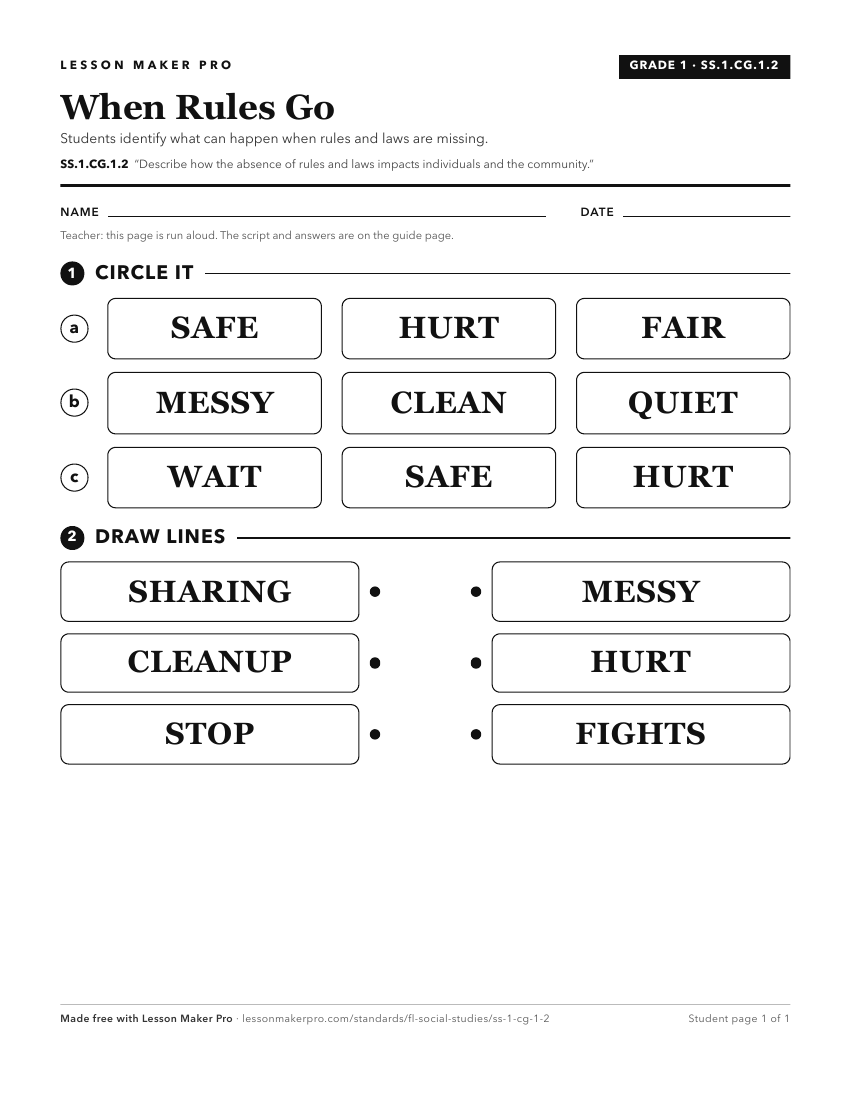
A ready-to-print activity worksheet aligned to SS.1.CG.1.2, with an answer key for the teacher on its own page. No account needed.
PDF, US Letter, prints cleanly in black and white.
Download the worksheetKeep exploring
Related Standards
- SS.1.CG.1.1
Explain the purpose of rules and laws in the home, school, and community.
- SS.6.HC.1
Explain the failures of ancient communal systems.
- SS.8.CG.1.3
Explain the importance of the rule of law in the United States' constitutional republic.
- SS.7.CG.1.11
Define the rule of law and recognize its influence on the development of legal, political, and governmental systems in the United States.
Turn this exact standard into a lesson
Grade, subject, topic, and the complete standard are prefilled. Create one free, no account needed.
Also for this standard:Make a WorksheetMake a QuizMake a Sub Lesson