Florida SC.K.P.10.1
The Standard
Observe that things that make sound vibrate.
Florida Next Generation Sunshine State Standards for Science
Teacher's field guide
What This Standard Means
What Students Need to Do
- Students listen to an object producing sound and look for small, quick movements. They describe what they see or feel while the sound is happening.
What Mastery Looks Like
- A student can make an object produce sound and point out its back-and-forth motion. The student can give examples such as a plucked rubber band or tapped drumhead.
Common Misconceptions
- Students may think only loud objects move, or that every vibration is easy to see. They may also confuse shaking an object with the smaller motion that produces its sound.
How to Assess It
- Give each student a rubber band stretched over a box. Ask, “What happens to the rubber band when you pluck it and hear a sound?”
Lesson moves
Ways to Teach It
Stretch rubber bands over boxes, pluck them, and have students watch and gently touch the moving bands.
Ask students to draw a sound-making object and add motion lines to show which part moves.
Play a sorting game with picture cards, matching each sound source to the part that moves.
Place fingers gently on the throat while humming, then discuss where movement can be felt during speaking or singing.
Free download
Printable SC.K.P.10.1 Worksheet
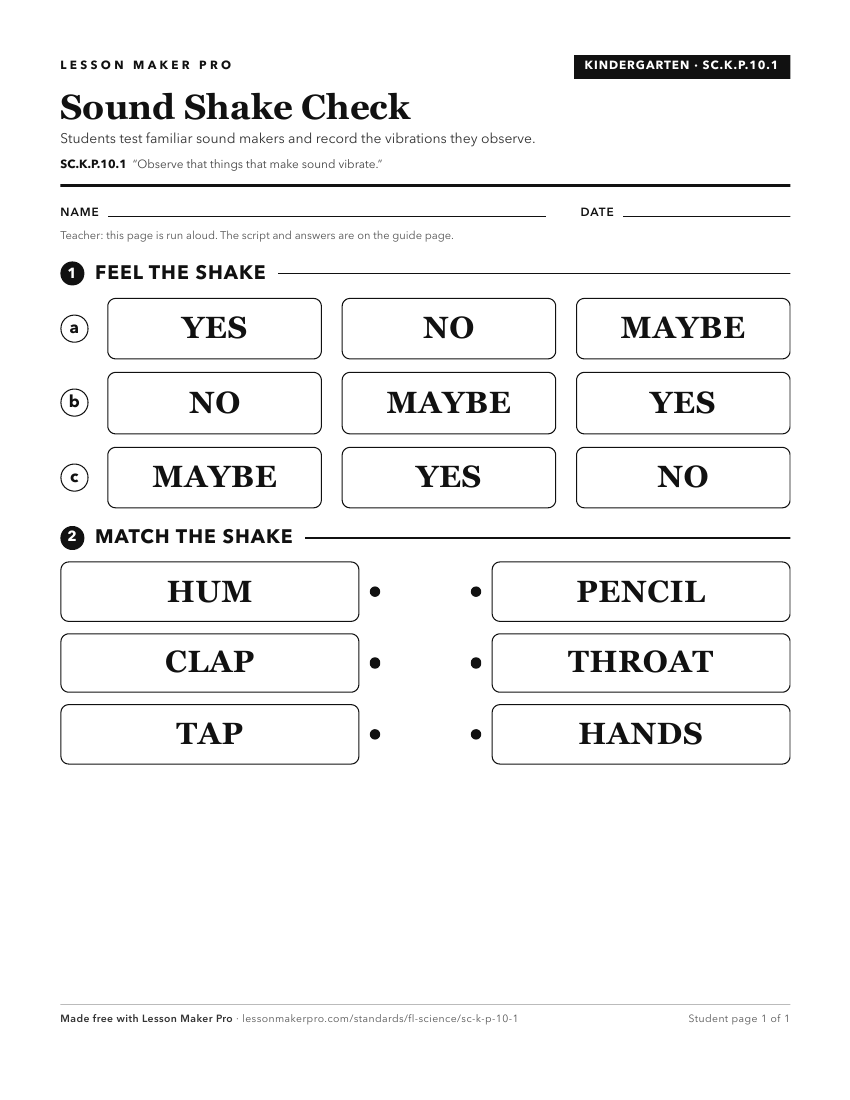
A ready-to-print activity worksheet aligned to SC.K.P.10.1, with an answer key for the teacher on its own page. No account needed.
PDF, US Letter, prints cleanly in black and white.
Download the worksheetKeep exploring
Related Standards
- SC.4.P.10.3
Investigate and explain that sound is produced by vibrating objects and that pitch depends on how fast or slow the object vibrates.
- SC.3.P.11.1
Investigate, observe, and explain that things that give off light often also give off heat.
- SC.4.P.10.1
Observe and describe some basic forms of energy, including light, heat, sound, electrical, and the energy of motion.
- SC.7.P.10.3
Recognize that light waves, sound waves, and other waves move at different speeds in different materials.
Turn this exact standard into a lesson
Grade, subject, topic, and the complete standard are prefilled. Create one free, no account needed.
Also for this standard:Make a WorksheetMake a QuizMake a Sub Lesson