Florida SC.4.P.10.3
The Standard
Investigate and explain that sound is produced by vibrating objects and that pitch depends on how fast or slow the object vibrates.
Florida Next Generation Sunshine State Standards for Science
Teacher's field guide
What This Standard Means
What Students Need to Do
- Students make objects vibrate and observe the sounds they produce. They compare vibration rates and connect faster motion with higher pitch and slower motion with lower pitch.
What Mastery Looks Like
- A student can use a ruler, rubber band, or tuning fork to show how vibration creates sound. They can predict pitch from vibration rate and explain their evidence.
Common Misconceptions
- Students often confuse pitch with volume, saying a louder sound has a higher pitch. They may credit the hit or pluck instead of the continued vibration. Some link slower vibration with higher pitch.
How to Assess It
- Exit ticket: Two rubber bands vibrate 20 and 40 times each second. Explain what causes their sound and identify which has the higher pitch.
Lesson moves
Ways to Teach It
Stretch rubber bands at different tensions over a box, pluck each one, and record the visible motion and pitch.
After tapping a tuning fork and touching it to water, ask, "What evidence connects its motion to the sound?"
Give pairs cards showing fast or slow vibrations to match with high or low pitch, then have them justify each match.
Compare a loose and tight guitar string, then explain how musicians change pitch while tuning.
Free download
Printable SC.4.P.10.3 Worksheet
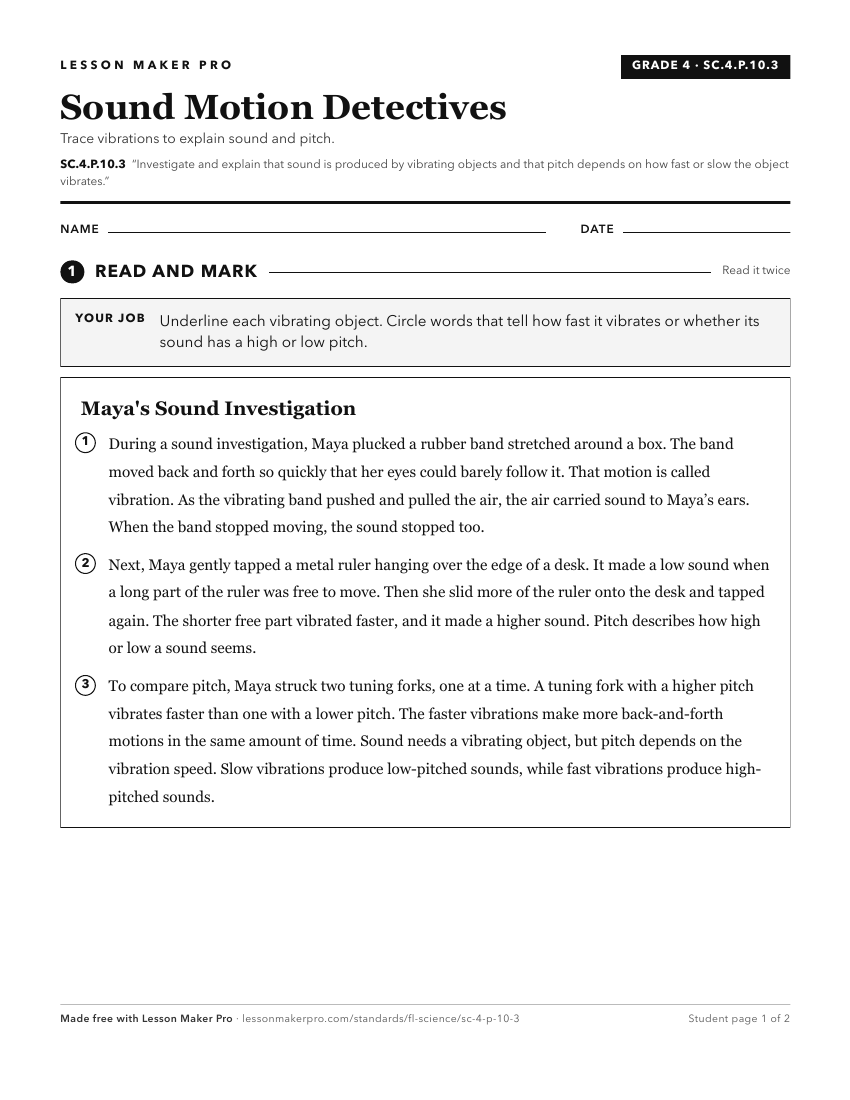
A ready-to-print activity worksheet aligned to SC.4.P.10.3, with an answer key for the teacher on its own page. No account needed.
PDF, US Letter, prints cleanly in black and white.
Download the worksheetKeep exploring
Related Standards
- SC.4.P.12.2
Investigate and describe that the speed of an object is determined by the distance it travels in a unit of time and that objects can move at different speeds.
- SC.5.P.10.4
Investigate and explain that electrical energy can be transformed into heat, light, and sound energy, as well as the energy of motion.
- SC.5.P.10.2
Investigate and explain that energy has the ability to cause motion or create change.
- SC.K.P.10.1
Observe that things that make sound vibrate.
Turn this exact standard into a lesson
Grade, subject, topic, and the complete standard are prefilled. Create one free, no account needed.
Also for this standard:Make a WorksheetMake a QuizMake a Sub Lesson