Florida SC.K.E.5.6
The Standard
Observe that some objects are far away and some are nearby as seen from Earth.
Florida Next Generation Sunshine State Standards for Science
Teacher's field guide
What This Standard Means
What Students Need to Do
- Students observe objects from one viewing spot and decide which are nearby and which are far away. They use position words to compare the objects.
What Mastery Looks Like
- A student can identify a nearby object and a faraway object in a real setting or picture. The student explains the choice using the viewing spot.
Common Misconceptions
- Students may think every small object is far away and every large object is nearby. They may also forget that distance is judged from where the observer stands.
How to Assess It
- From the student's seat, ask, “Name one object that is nearby and one that is far away. How do you know?”
Lesson moves
Ways to Teach It
Place classroom objects at different distances from a floor marker, then have students stand on the marker and sort them as near or far.
Show a playground picture and ask, “Which object seems nearest to the child, and which seems farthest? What clues helped you decide?”
Play Near or Far Corners by naming visible objects and having students move to the matching labeled corner.
Look through a classroom window and list one nearby object and one faraway object that people might use or visit.
Free download
Printable SC.K.E.5.6 Worksheet
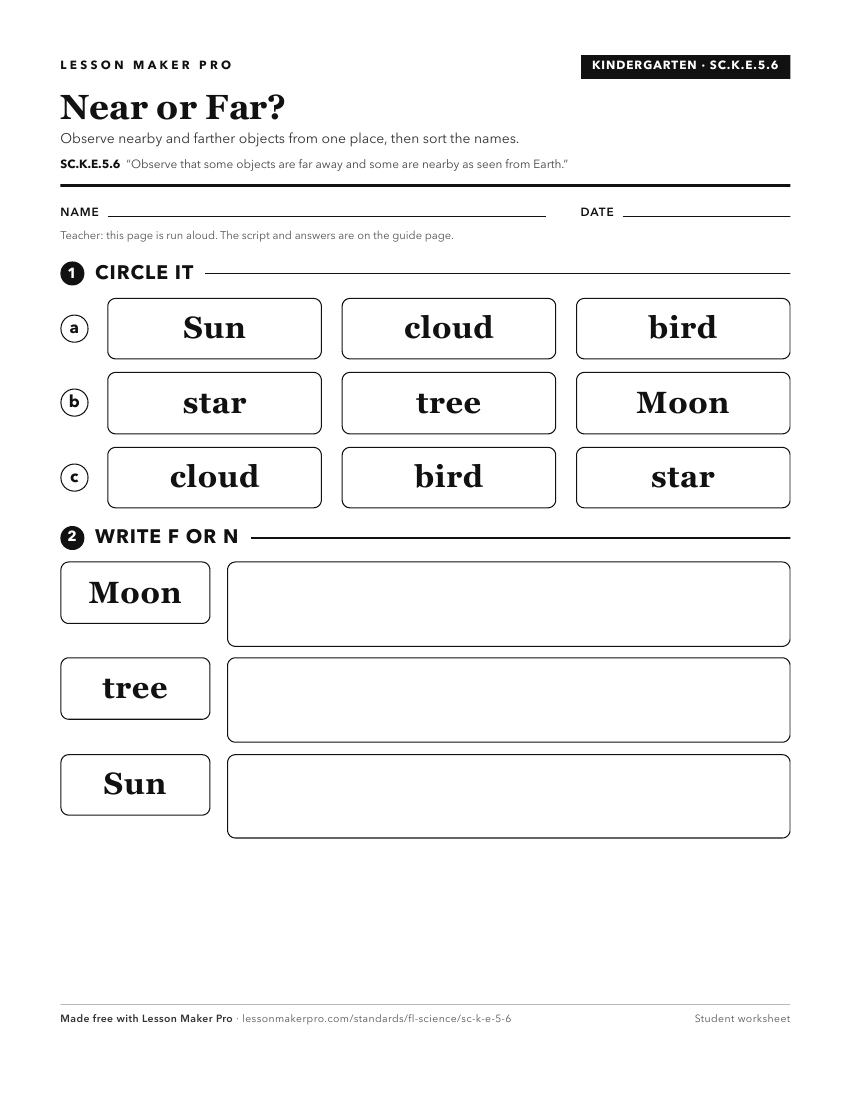
A ready-to-print activity worksheet aligned to SC.K.E.5.6, with an answer key for the teacher on its own page. No account needed.
PDF, US Letter, prints cleanly in black and white.
Download the worksheetKeep exploring
Related Standards
- SC.3.E.5.3
Recognize that the Sun appears large and bright because it is the closest star to Earth.
- SC.8.E.5.1
Recognize that there are enormous distances between objects in space and apply our knowledge of light and space travel to understand this distance.
- SC.3.E.5.1
Explain that stars can be different; some are smaller, some are larger, and some appear brighter than others; all except the Sun are so far away that they look ...
- SC.K.E.5.5
Observe that things can be big and things can be small as seen from Earth.
Turn this exact standard into a lesson
Grade, subject, topic, and the complete standard are prefilled. Create one free, no account needed.
Also for this standard:Make a WorksheetMake a QuizMake a Sub Lesson