Florida SC.7.N.3.1
The Standard
Recognize and explain the difference between theories and laws and give several examples of scientific theories and the evidence that supports them.
Florida Next Generation Sunshine State Standards for Science
Teacher's field guide
What This Standard Means
What Students Need to Do
- Students distinguish a scientific theory, which explains how or why phenomena occur, from a scientific law, which describes a consistent pattern. They identify examples and connect each theory to observations, experiments, or other supporting evidence.
What Mastery Looks Like
- Students correctly classify examples as theories or laws and explain their reasoning without treating one as stronger than the other. They name several theories, such as cell theory and plate tectonics, and cite supporting evidence for each.
Common Misconceptions
- Students may think a theory is an unsupported guess or that theories become laws after enough testing. They may also think laws explain why something happens, rather than describing what consistently happens.
How to Assess It
- Use this exit ticket: “Explain one difference between a theory and a law. Name two scientific theories and give one piece of evidence supporting each.”
Lesson moves
Ways to Teach It
Have students sort theory, law, example, and evidence cards into matched groups, then defend one match to a partner.
Ask students to write a response to: “Can a scientific theory become a law? Explain using one example.”
Run an evidence-match relay where teams pair cell theory, plate tectonics, and germ theory with observation and experiment cards.
Give students a news headline using “theory” casually, then have them rewrite it using the scientific meaning and add needed evidence.
Free download
Printable SC.7.N.3.1 Worksheet
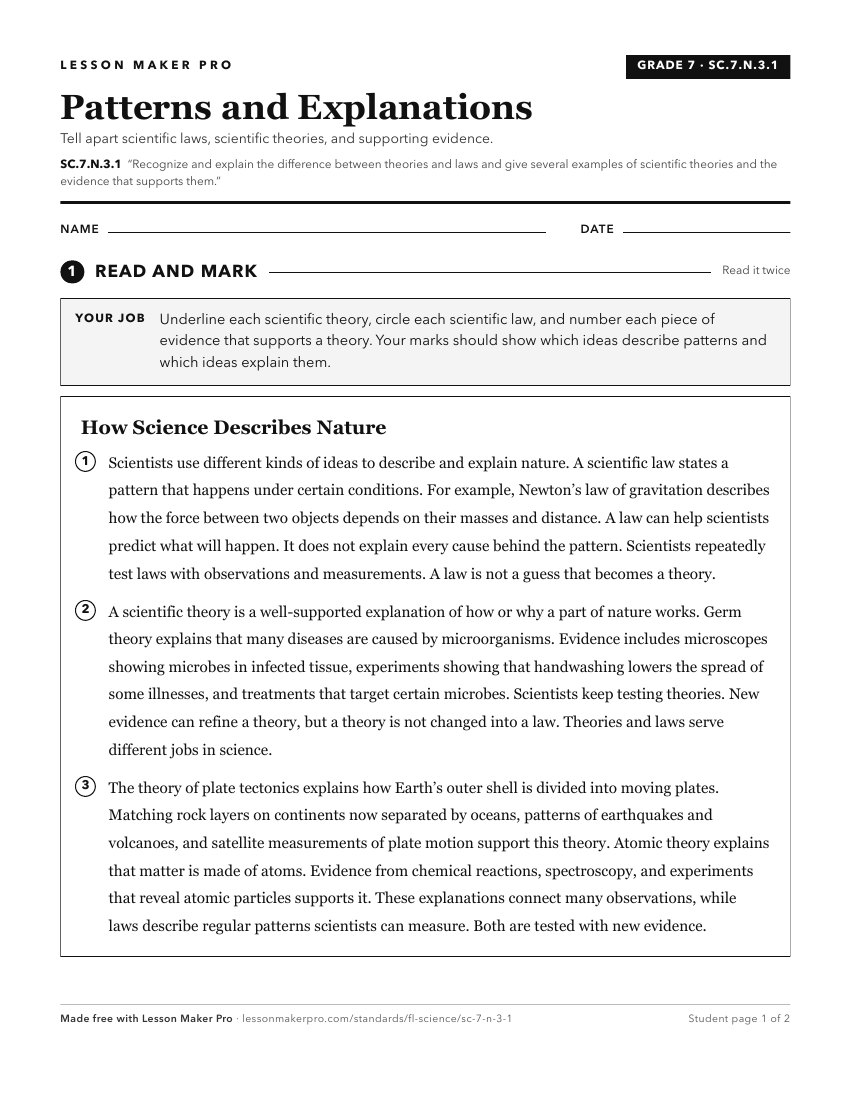
A ready-to-print activity worksheet aligned to SC.7.N.3.1, with an answer key for the teacher on its own page. No account needed.
PDF, US Letter, prints cleanly in black and white.
Download the worksheetKeep exploring
Related Standards
- SC.6.N.3.2
Recognize and explain that a scientific law is a description of a specific relationship under given conditions in the natural world. Thus, scientific laws are d...
- SC.6.N.3.3
Give several examples of scientific laws.
- SC.4.N.1.7
Recognize and explain that scientists base their explanations on evidence.
- SC.6.N.3.1
Recognize and explain that a scientific theory is a well-supported and widely accepted explanation of nature and is not simply a claim posed by an individual. T...
Turn this exact standard into a lesson
Grade, subject, topic, and the complete standard are prefilled. Create one free, no account needed.
Also for this standard:Make a WorksheetMake a QuizMake a Sub Lesson