Florida SC.6.N.3.3
The Standard
Give several examples of scientific laws.
Florida Next Generation Sunshine State Standards for Science
Teacher's field guide
What This Standard Means
What Students Need to Do
- Students name several accepted scientific laws, such as Newton’s laws of motion, conservation of mass, and the law of reflection. They briefly state the pattern each law describes.
What Mastery Looks Like
- A student can give at least three accurate examples from different areas of science. The student can explain each example without confusing laws with theories, hypotheses, or classroom rules.
Common Misconceptions
- Students may think a theory becomes a law after enough proof, or that scientific laws explain why events happen. They may also confuse scientific laws with legal rules or personal opinions.
How to Assess It
- Give this exit ticket: “Name three scientific laws and write one sentence describing what each law predicts or summarizes.”
Lesson moves
Ways to Teach It
Shine a flashlight at a mirror, measure the incoming and reflected angles, then connect the results to the law of reflection.
Ask students to explain why a scientific theory does not graduate into a law, using one example of each.
Give teams cards naming laws, theories, hypotheses, and models, then have them sort the cards and defend two choices.
Have students identify scientific laws shown when riding a bicycle, including Newton’s laws of motion and conservation of energy.
Free download
Printable SC.6.N.3.3 Worksheet
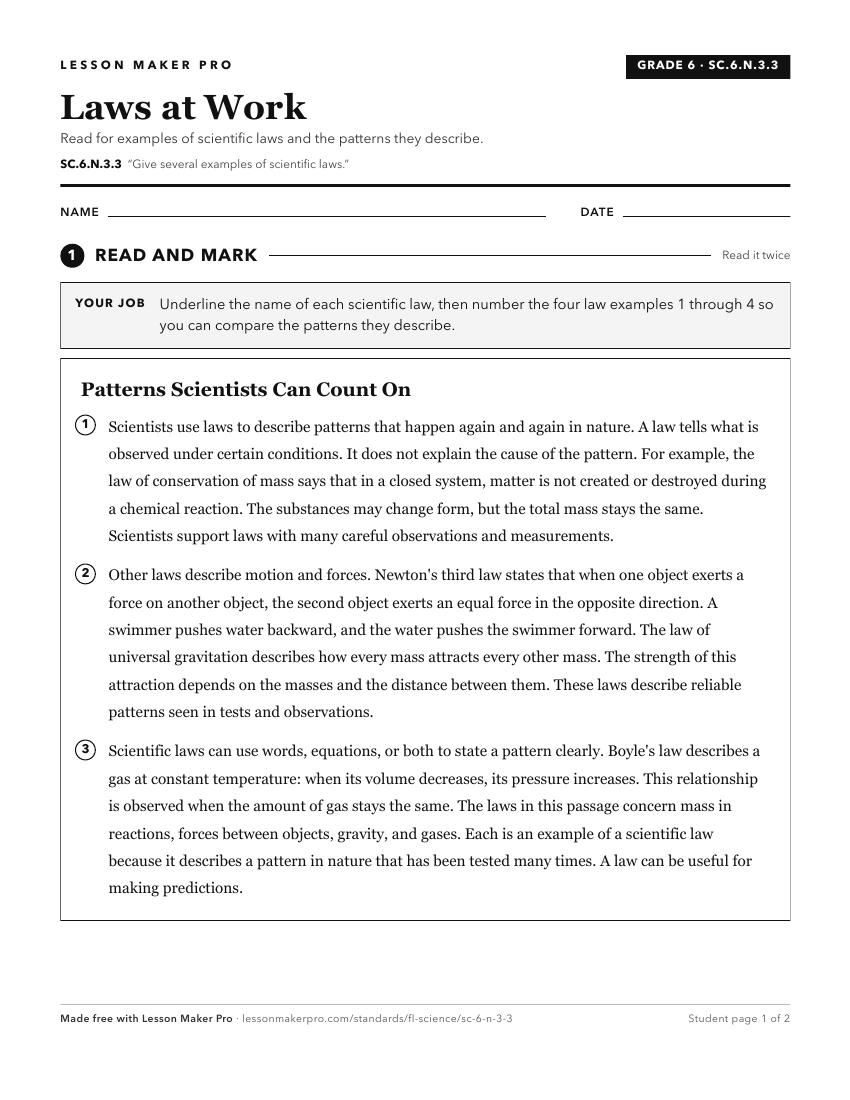
A ready-to-print activity worksheet aligned to SC.6.N.3.3, with an answer key for the teacher on its own page. No account needed.
PDF, US Letter, prints cleanly in black and white.
Download the worksheetKeep exploring
Related Standards
- SC.7.E.6.4
Explain and give examples of how physical evidence supports scientific theories that Earth has evolved over geologic time due to natural processes.
- SC.7.N.1.5
Describe the methods used in the pursuit of a scientific explanation as seen in different fields of science such as biology, geology, and physics.
- SC.6.N.3.2
Recognize and explain that a scientific law is a description of a specific relationship under given conditions in the natural world. Thus, scientific laws are d...
- SC.7.N.3.1
Recognize and explain the difference between theories and laws and give several examples of scientific theories and the evidence that supports them.
Turn this exact standard into a lesson
Grade, subject, topic, and the complete standard are prefilled. Create one free, no account needed.
Also for this standard:Make a WorksheetMake a QuizMake a Sub Lesson