Florida SC.7.L.17.3
The Standard
Describe and investigate various limiting factors in the local ecosystem and their impact on native populations, including food, shelter, water, space, disease, parasitism, predation, and nesting sites.
Florida Next Generation Sunshine State Standards for Science
Teacher's field guide
What This Standard Means
What Students Need to Do
- Students identify limiting factors in a local ecosystem and explain how each can change a native population. They use observations or data to investigate effects over time.
What Mastery Looks Like
- A student can examine a graph, field count, or scenario and name the factor limiting population growth. They can support a cause-and-effect claim with evidence and predict what may happen next.
Common Misconceptions
- Students often treat every population decline as a food shortage and confuse a predator with a parasite. They may overlook shelter, space, disease, water, and nesting sites when explaining population changes.
How to Assess It
- Exit ticket: Beach development removes shorebird nesting areas, but food and water remain stable. Name the limiting factor and predict the population effect.
Lesson moves
Ways to Teach It
Survey four schoolyard quadrats, tally food, water, shelter, and nesting sites, then predict which native animal each area could support.
Write a claim explaining which factor would most limit rabbits in a crowded field with plentiful grass but few hiding places.
Use animal tokens, resource cards, and event cards to model population changes caused by drought, disease, predation, and habitat loss.
Compare a local development map with native species habitat data, then identify which resources or spaces may become limited.
Free download
Printable SC.7.L.17.3 Worksheet
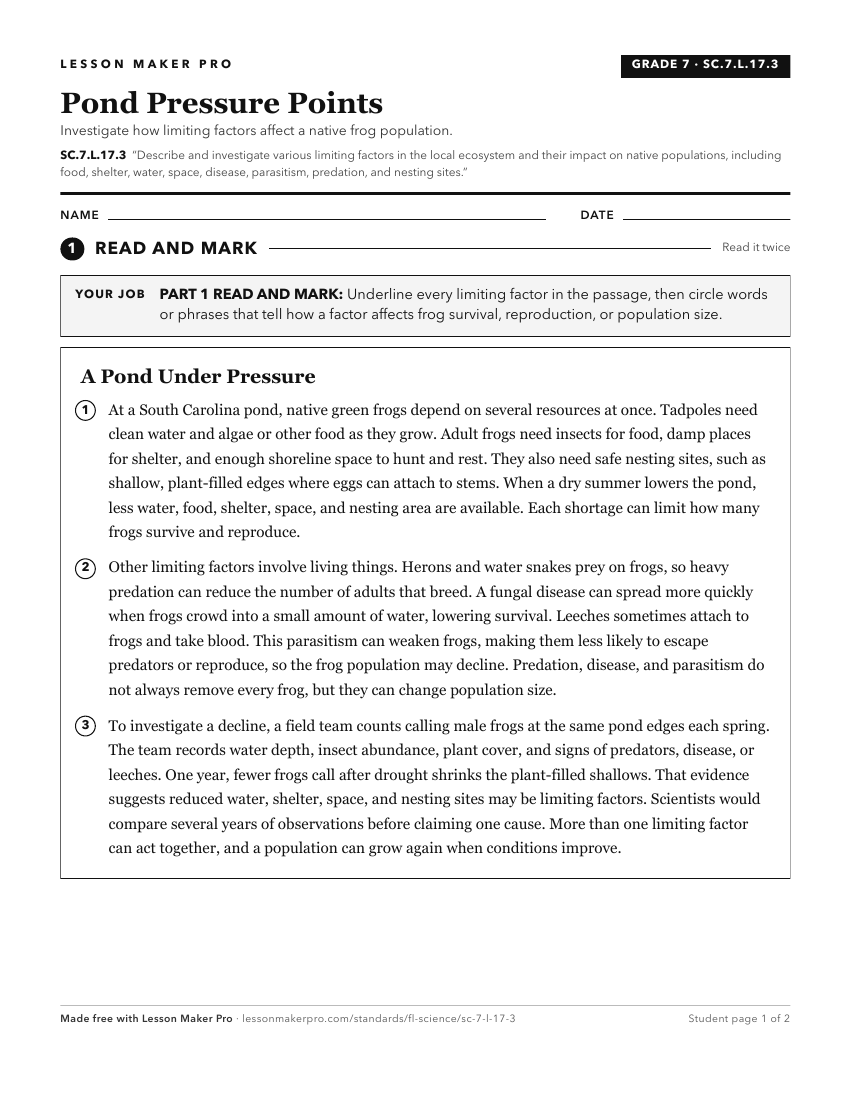
A ready-to-print activity worksheet aligned to SC.7.L.17.3, with an answer key for the teacher on its own page. No account needed.
PDF, US Letter, prints cleanly in black and white.
Download the worksheetKeep exploring
Related Standards
- SC.7.L.15.3
Explore the scientific theory of evolution by relating how the inability of a species to adapt within a changing environment may contribute to the extinction of...
- SC.7.L.17.2
Compare and contrast the relationships among organisms such as mutualism, predation, parasitism, competition, and commensalism.
- SC.7.E.6.6
Identify the impact that humans have had on Earth, such as deforestation, urbanization, desertification, erosion, air and water quality, changing the flow of wa...
- SC.2.L.17.2
Recognize and explain that living things are found all over Earth, but each is only able to live in habitats that meet its basic needs.
Turn this exact standard into a lesson
Grade, subject, topic, and the complete standard are prefilled. Create one free, no account needed.
Also for this standard:Make a WorksheetMake a QuizMake a Sub Lesson