Florida SC.7.L.16.4
The Standard
Recognize and explore the impact of biotechnology (cloning, genetic engineering, artificial selection) on the individual, society and the environment.
Florida Next Generation Sunshine State Standards for Science
Teacher's field guide
What This Standard Means
What Students Need to Do
- Students explain how cloning, genetic engineering, and artificial selection change organisms or populations. They identify possible benefits, risks, and effects on individuals, society, and the environment.
What Mastery Looks Like
- Students can compare the three methods using accurate examples. They can support a claim about an impact with evidence and explain a possible tradeoff.
Common Misconceptions
- Students may think cloning creates an organism with identical memories or behavior. They may confuse genetic engineering with selective breeding, or assume every biotechnology has only positive or only negative effects.
How to Assess It
- Give students one case, such as genetically engineered pest-resistant corn. Ask them to name the method and explain one individual, societal, or environmental impact.
Lesson moves
Ways to Teach It
Sort case cards about cloned animals, engineered crops, and dog breeds by method, then label one benefit and one risk for each.
Write a claim answering: Should farmers use genetically engineered crops if they reduce pesticide use but may affect nearby plant populations?
Play Biotechnology Tradeoff Match, pairing method cards with likely benefits, risks, and affected groups.
Examine a grocery label for a genetically engineered ingredient, then trace possible effects from the farm to consumers and local ecosystems.
Free download
Printable SC.7.L.16.4 Worksheet
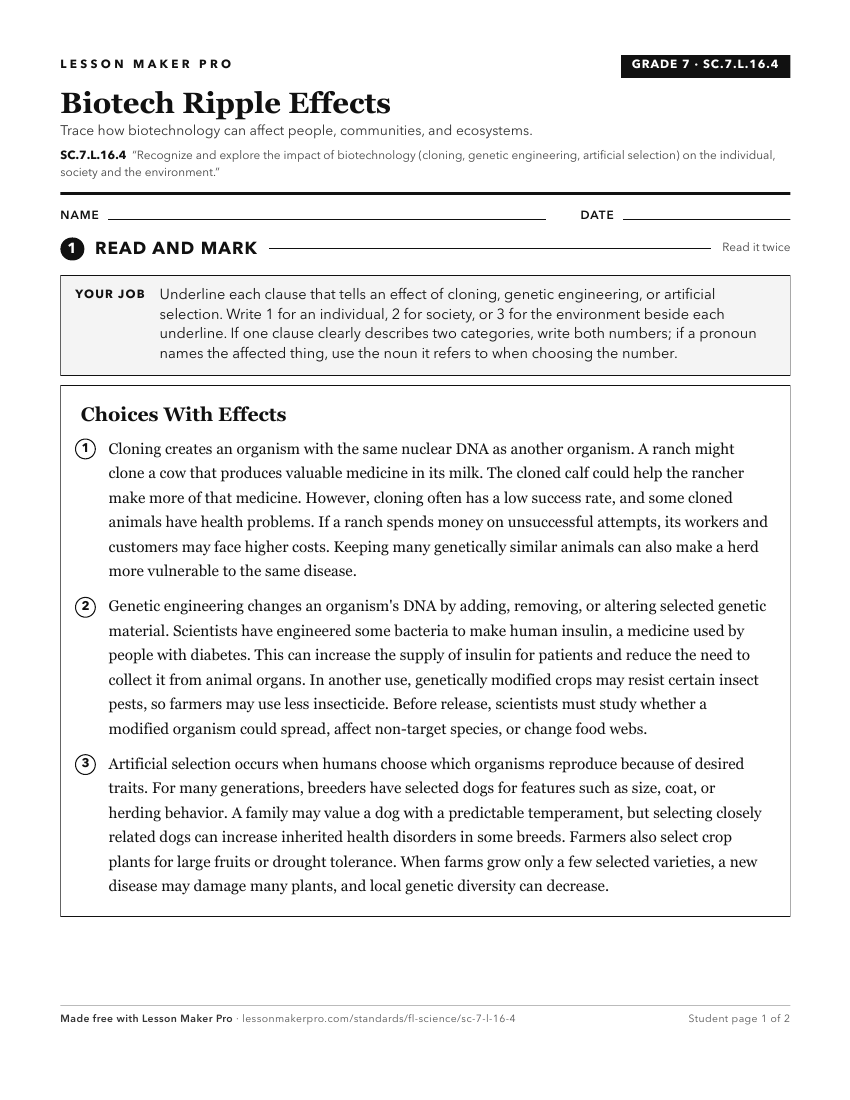
A ready-to-print activity worksheet aligned to SC.7.L.16.4, with an answer key for the teacher on its own page. No account needed.
PDF, US Letter, prints cleanly in black and white.
Download the worksheetKeep exploring
Related Standards
- SC.4.L.17.4
Recognize ways plants and animals, including humans, can impact the environment.
- SC.7.L.17.3
Describe and investigate various limiting factors in the local ecosystem and their impact on native populations, including food, shelter, water, space, disease,...
- SC.7.L.15.2
Explore the scientific theory of evolution by recognizing and explaining ways in which genetic variation and environmental factors contribute to evolution by na...
- SC.7.E.6.6
Identify the impact that humans have had on Earth, such as deforestation, urbanization, desertification, erosion, air and water quality, changing the flow of wa...
Turn this exact standard into a lesson
Grade, subject, topic, and the complete standard are prefilled. Create one free, no account needed.
Also for this standard:Make a WorksheetMake a QuizMake a Sub Lesson