Florida SC.7.E.6.3
The Standard
Identify current methods for measuring the age of Earth and its parts, including the law of superposition and radioactive dating.
Florida Next Generation Sunshine State Standards for Science
Teacher's field guide
What This Standard Means
What Students Need to Do
- Students compare relative dating with radiometric dating. They use rock layer position to order events and isotope decay data to estimate numerical ages.
What Mastery Looks Like
- Given an undisturbed rock diagram, a student correctly identifies the oldest and youngest layers and explains why. Given half-life data, the student estimates a rock's age.
Common Misconceptions
- Students may think deeper layers are always older, even when rocks have been folded, faulted, or overturned. They may think carbon-14 dates all rocks or that radiometric dates are guesses.
How to Assess It
- Give students a four-layer rock diagram and a sample with two half-lives elapsed. Ask them to order the layers and calculate the sample's age.
Lesson moves
Ways to Teach It
Stack colored clay layers, cut the stack, and have students label relative ages before and after tilting or faulting.
Ask students to write: Why can radiometric dating give a numerical age while superposition usually cannot?
Play a card sort matching rock diagrams, oldest-to-youngest sequences, isotope data, and calculated ages.
Use simplified volcanic ash data to determine the age range of a fossil found between two dated ash layers.
Free download
Printable SC.7.E.6.3 Worksheet
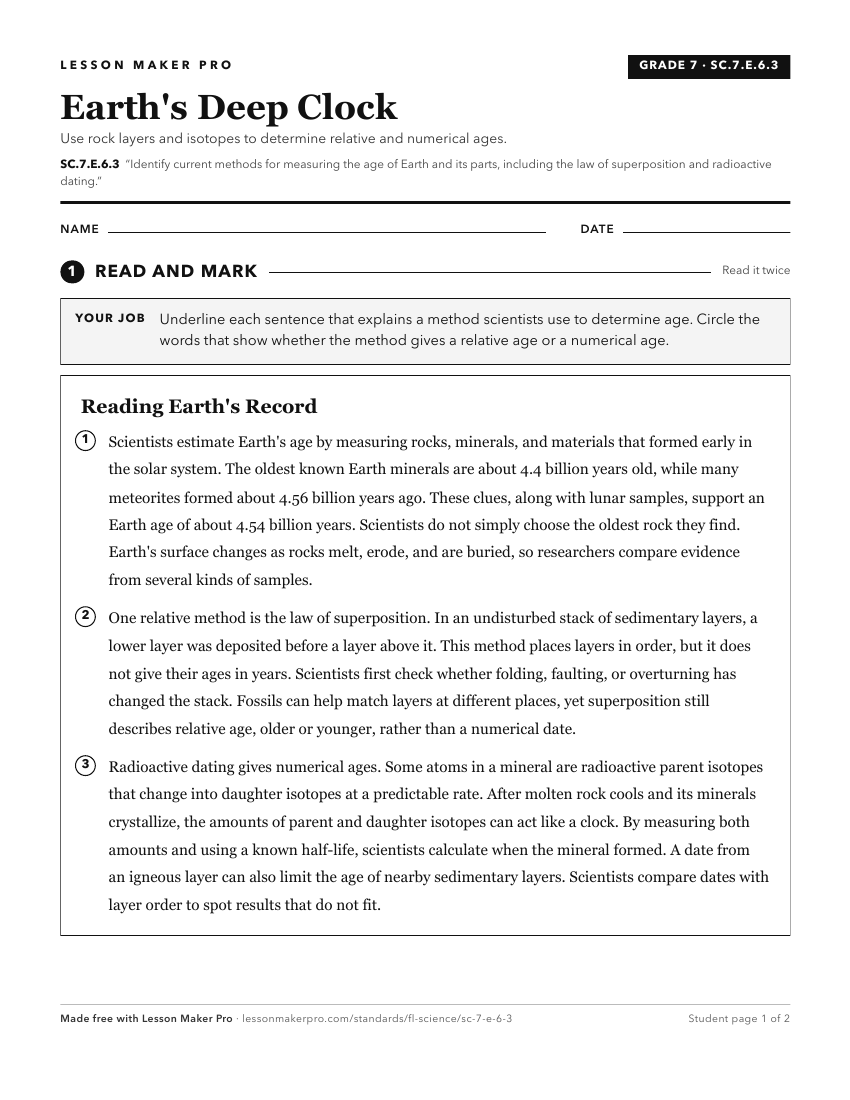
A ready-to-print activity worksheet aligned to SC.7.E.6.3, with an answer key for the teacher on its own page. No account needed.
PDF, US Letter, prints cleanly in black and white.
Download the worksheetKeep exploring
Related Standards
- SC.7.E.6.4
Explain and give examples of how physical evidence supports scientific theories that Earth has evolved over geologic time due to natural processes.
- SC.6.E.7.1
Differentiate among radiation, conduction, and convection, the three mechanisms by which heat is transferred through Earth's system.
- SC.4.E.6.2
Identify the physical properties of common earth-forming minerals, including hardness, color, luster, cleavage, and streak color, and recognize the role of mine...
- SC.7.E.6.2
Identify the patterns within the rock cycle and relate them to surface events (weathering and erosion) and sub-surface events (plate tectonics and mountain buil...
Turn this exact standard into a lesson
Grade, subject, topic, and the complete standard are prefilled. Create one free, no account needed.
Also for this standard:Make a WorksheetMake a QuizMake a Sub Lesson