Florida SC.7.E.6.1
The Standard
Describe the layers of the solid Earth, including the lithosphere, the hot convecting mantle, and the dense metallic liquid and solid cores.
Florida Next Generation Sunshine State Standards for Science
Teacher's field guide
What This Standard Means
What Students Need to Do
- Students place Earth’s main internal layers in order from the surface to the center. They explain that the lithosphere is rigid, the mantle flows slowly, the outer core is liquid metal, and the inner core is solid metal.
What Mastery Looks Like
- Students can draw and label a cross section without a word bank. They accurately compare the layers by location, material, physical state, temperature, density, and movement.
Common Misconceptions
- Students may confuse the crust with the lithosphere or describe the entire mantle as liquid magma. They may think both cores are liquid or assume hotter material must always be liquid.
How to Assess It
- Give students an unlabeled Earth cross section. Ask them to label each layer and add its physical state, main material, and one defining feature.
Lesson moves
Ways to Teach It
Build a cutaway Earth model with colored clay, then label the lithosphere, mantle, liquid outer core, and solid inner core.
Write three sentences comparing two adjacent layers by location, physical state, temperature, density, movement, and material.
Race teams to sort layer cards under location, material, physical state, temperature, and density headings, then correct any mismatches.
Use a seismic wave diagram to explain why S waves stop at the outer core and what that reveals about Earth.
Free download
Printable SC.7.E.6.1 Worksheet
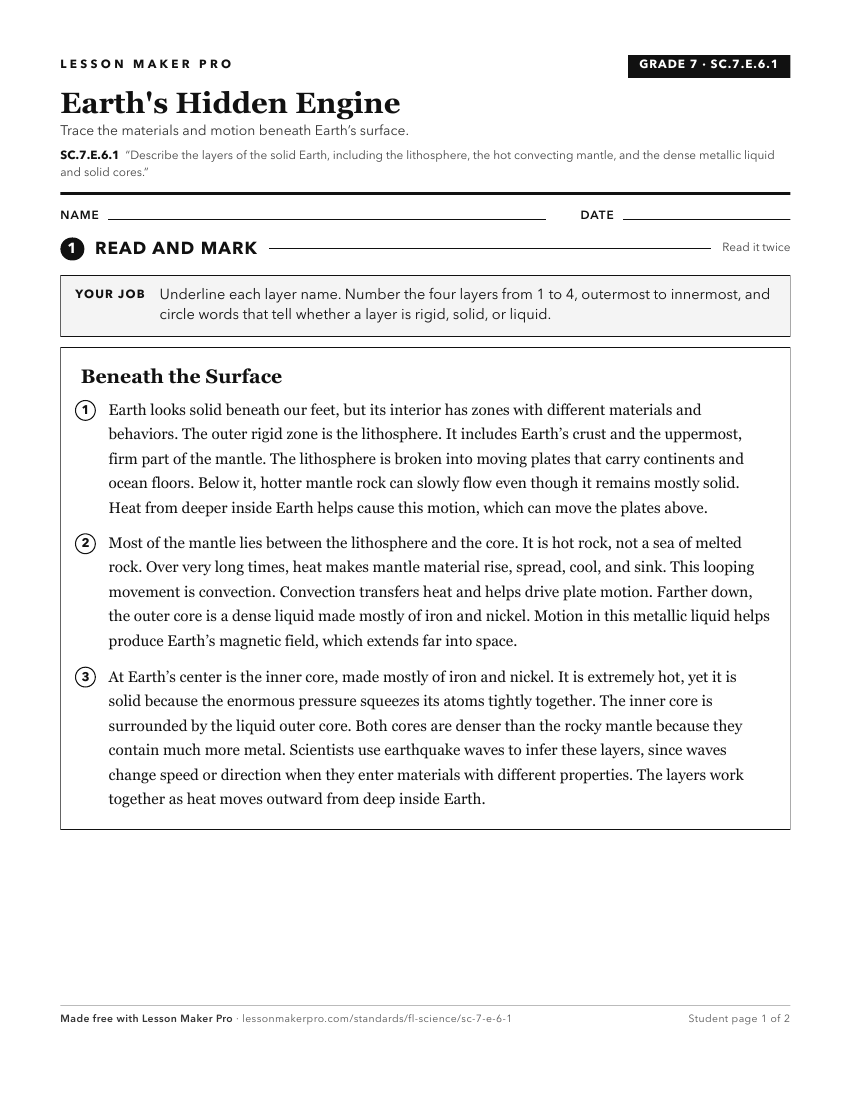
A ready-to-print activity worksheet aligned to SC.7.E.6.1, with an answer key for the teacher on its own page. No account needed.
PDF, US Letter, prints cleanly in black and white.
Download the worksheetKeep exploring
Related Standards
- SC.7.E.6.5
Explore the scientific theory of plate tectonics by describing how the movement of Earth's crustal plates causes both slow and rapid changes in Earth's surface,...
- SC.6.E.7.4
Differentiate and show interactions among the geosphere, hydrosphere, cryosphere, atmosphere, and biosphere.
- SC.6.E.6.1
Describe and give examples of ways in which Earth's surface is built up and torn down by physical and chemical weathering, erosion, and deposition.
- SC.6.E.7.1
Differentiate among radiation, conduction, and convection, the three mechanisms by which heat is transferred through Earth's system.
Turn this exact standard into a lesson
Grade, subject, topic, and the complete standard are prefilled. Create one free, no account needed.
Also for this standard:Make a WorksheetMake a QuizMake a Sub Lesson