Florida SC.6.P.13.1
The Standard
Investigate and describe types of forces including contact forces and forces acting at a distance, such as electrical, magnetic, and gravitational.
Florida Next Generation Sunshine State Standards for Science
Teacher's field guide
What This Standard Means
What Students Need to Do
- Students identify forces acting on an object and sort them by whether objects must touch. They test gravity, magnetism, static electricity, friction, and pushes or pulls, then describe their observations.
What Mastery Looks Like
- A student can inspect a setup, name the force, and state whether touching is required. The student supports the claim with evidence, such as a magnet moving a clip across a gap.
Common Misconceptions
- Students often think gravity acts only on falling objects and that a resting object has no forces on it. They may assume magnets attract every metal or need contact. They may also confuse static electricity with magnetism.
How to Assess It
- Exit ticket: For a book resting on a table and a paper clip pulled by a nearby magnet, name each force and label whether contact is required.
Lesson moves
Ways to Teach It
Set up stations with a ramp block, magnets and clips, a charged balloon, and a dropped ball; students record each force and contact status.
Ask students to explain why a magnet can move a paper clip without touching it, while a hand must touch it to push it.
Play a force-card sort: teams classify pictured events, name the force, and defend whether contact is required.
Examine a bicycle ride and label gravity, tire-road friction, chain tension, and the rider’s push on the pedals.
Free download
Printable SC.6.P.13.1 Worksheet
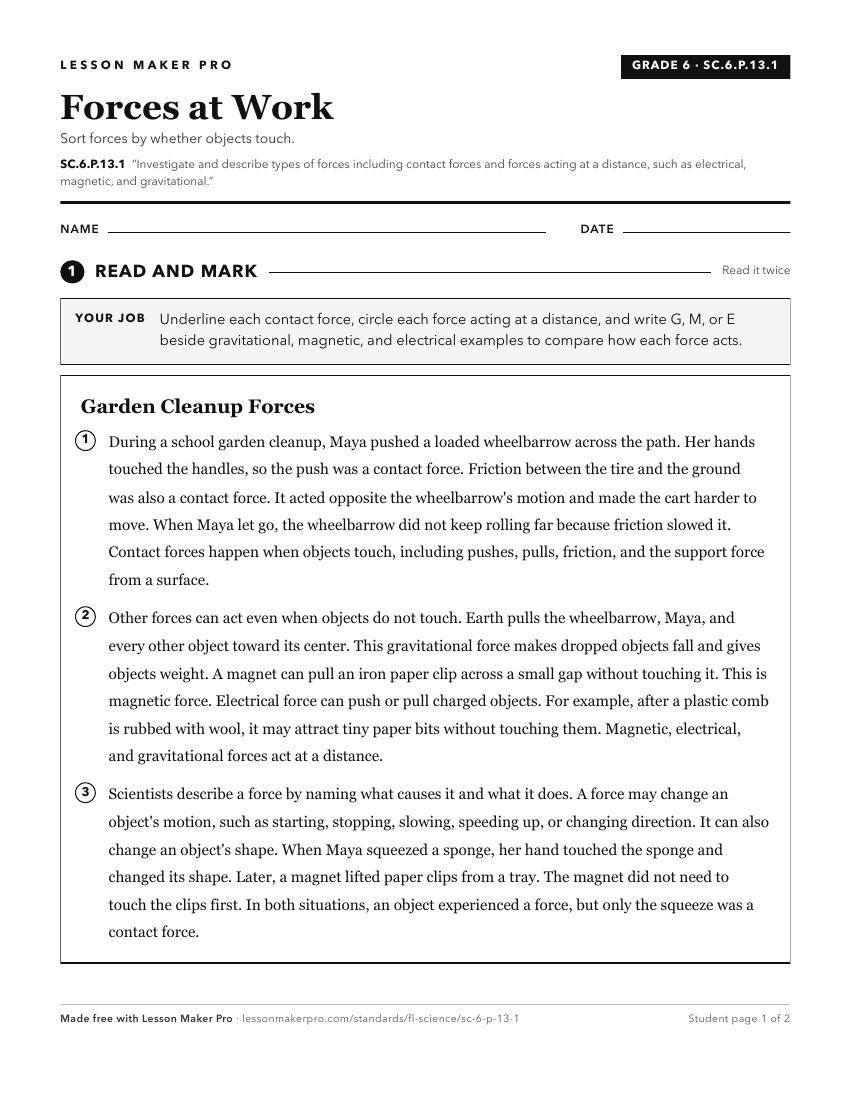
A ready-to-print activity worksheet aligned to SC.6.P.13.1, with an answer key for the teacher on its own page. No account needed.
PDF, US Letter, prints cleanly in black and white.
Download the worksheetKeep exploring
Related Standards
- SC.4.P.8.4
Investigate and describe that magnets can attract magnetic materials and attract and repel other magnets.
- SC.5.P.13.2
Investigate and describe that the greater the force applied to it, the greater the change in motion of a given object.
- SC.5.P.10.1
Investigate and describe some basic forms of energy, including light, heat, sound, electrical, chemical, and mechanical.
- SC.6.P.13.3
Investigate and describe that an unbalanced force acting on an object changes its speed, or direction of motion, or both.
Turn this exact standard into a lesson
Grade, subject, topic, and the complete standard are prefilled. Create one free, no account needed.
Also for this standard:Make a WorksheetMake a QuizMake a Sub Lesson