Florida SC.4.P.8.4
The Standard
Investigate and describe that magnets can attract magnetic materials and attract and repel other magnets.
Florida Next Generation Sunshine State Standards for Science
Teacher's field guide
What This Standard Means
What Students Need to Do
- Students test objects to find which ones a magnet attracts. They also test pairs of magnet poles, observe attraction and repulsion, and describe the pattern.
What Mastery Looks Like
- Students use test results to sort objects as magnetic or not magnetic. They can show that unlike poles attract, like poles repel, and magnets can pull without touching.
Common Misconceptions
- Students may think magnets attract every metal, including aluminum and copper. They may think either end of one magnet attracts either end of another. Some confuse magnetic attraction with objects sticking through glue or static electricity.
How to Assess It
- On an exit ticket, draw an iron nail, an aluminum can tab, and two pairs of labeled magnet poles. Ask students to predict each interaction and explain one prediction.
Lesson moves
Ways to Teach It
Set up trays with magnets, coins, nails, foil, wood, and plastic, then have students test and chart each object's response.
Ask students to write why two magnets sometimes move together and sometimes move apart without touching.
Play a pole matching game where students hold N or S cards and step together for attraction or apart for repulsion.
Inspect a magnetic cabinet latch and identify the magnet, the attracted material, and the job the magnetic force performs.
Free download
Printable SC.4.P.8.4 Worksheet
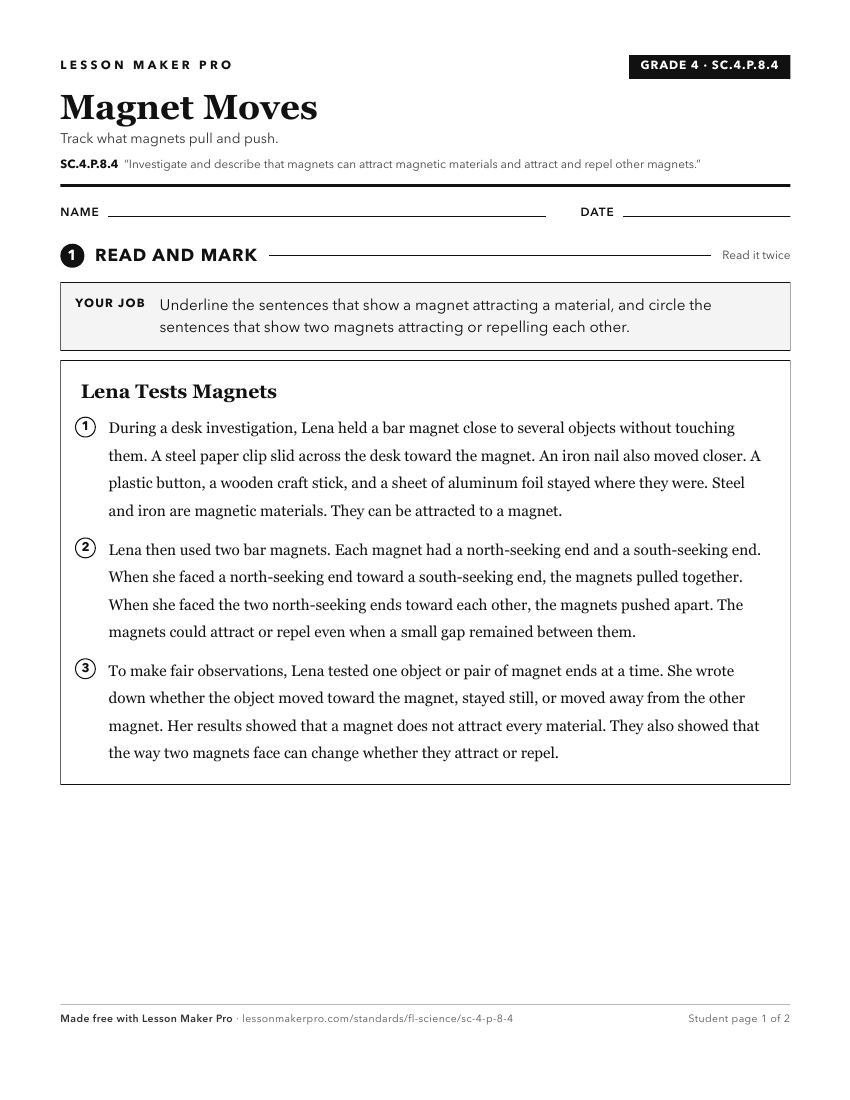
A ready-to-print activity worksheet aligned to SC.4.P.8.4, with an answer key for the teacher on its own page. No account needed.
PDF, US Letter, prints cleanly in black and white.
Download the worksheetKeep exploring
Related Standards
- SC.2.P.13.2
Demonstrate that magnets can be used to make some things move without touching them.
- SC.2.P.8.1
Observe and measure objects in terms of their properties, including size, shape, color, temperature, weight, texture, sinking or floating in water, and attracti...
- SC.6.P.13.1
Investigate and describe types of forces including contact forces and forces acting at a distance, such as electrical, magnetic, and gravitational.
- SC.5.P.10.3
Investigate and explain that an electrically-charged object can attract an uncharged object and can either attract or repel another charged object without any c...
Turn this exact standard into a lesson
Grade, subject, topic, and the complete standard are prefilled. Create one free, no account needed.
Also for this standard:Make a WorksheetMake a QuizMake a Sub Lesson