Florida SC.2.P.13.2
The Standard
Demonstrate that magnets can be used to make some things move without touching them.
Florida Next Generation Sunshine State Standards for Science
Teacher's field guide
What This Standard Means
What Students Need to Do
- Students test how an object responds when a magnet is brought near it. They show that a paper clip or other magnetic object can slide, roll, or lift before contact.
What Mastery Looks Like
- Given a magnet and several objects, a student can identify which objects respond and make one move from a short distance. The student can point out that space remained between the magnet and object when movement began.
Common Misconceptions
- Students may think magnets attract every metal object or every classroom material. They may also think an object moves only after the magnet touches it.
How to Assess It
- Give each student a magnet, paper clip, plastic cube, and wooden craft stick. Ask the student to move one object without contact, then explain why the others did not move.
Lesson moves
Ways to Teach It
Guide a paper clip through a cardboard maze by moving a magnet underneath the cardboard.
Ask students to draw what happened and answer, "What evidence shows the magnet caused the motion?"
Play Predict and Test with coins, clips, foil, craft sticks, and buttons, recording each prediction before using the magnet.
Show a scrapyard crane video, then have students explain how the magnet begins moving steel before contact.
Free download
Printable SC.2.P.13.2 Worksheet
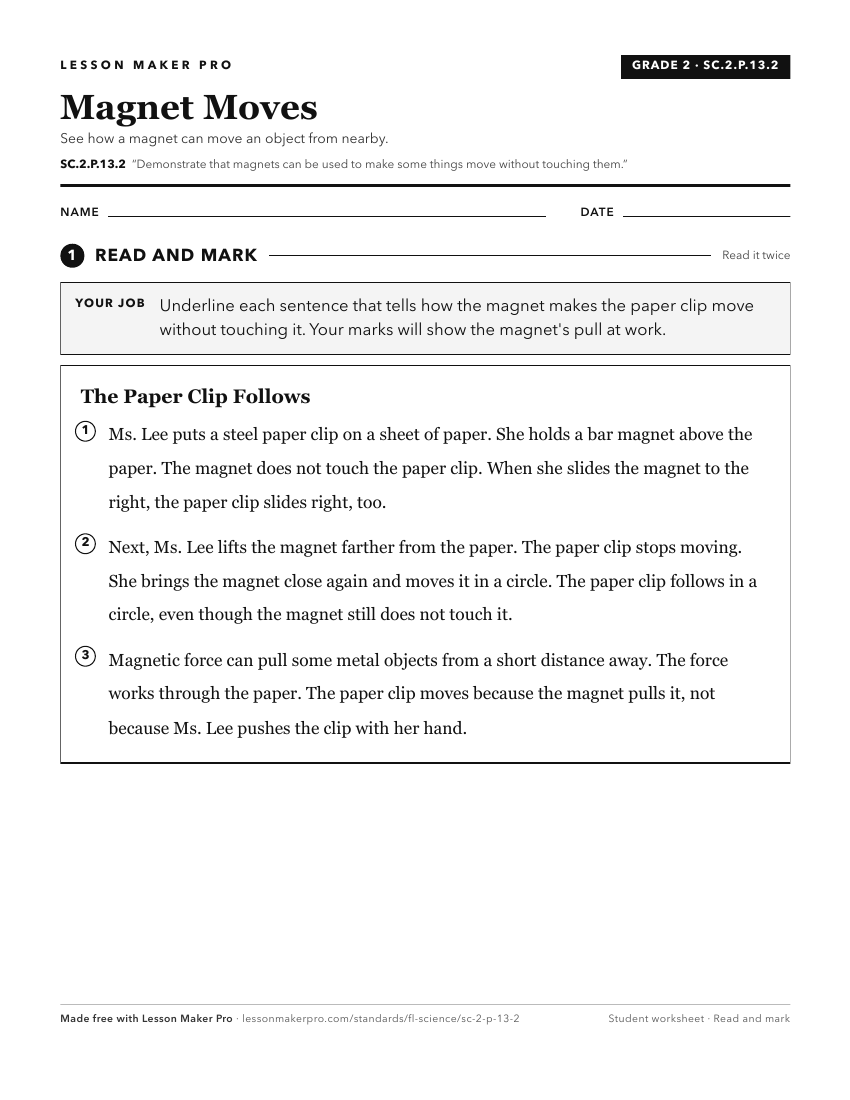
A ready-to-print activity worksheet aligned to SC.2.P.13.2, with an answer key for the teacher on its own page. No account needed.
PDF, US Letter, prints cleanly in black and white.
Download the worksheetKeep exploring
Related Standards
- SC.4.P.8.4
Investigate and describe that magnets can attract magnetic materials and attract and repel other magnets.
- SC.1.P.13.1
Demonstrate that the way to change the motion of an object is by applying a push or a pull.
- SC.5.P.10.3
Investigate and explain that an electrically-charged object can attract an uncharged object and can either attract or repel another charged object without any c...
- SC.5.P.8.3
Demonstrate and explain that mixtures of solids can be separated based on observable properties of their parts such as particle size, shape, color, and magnetic...
Turn this exact standard into a lesson
Grade, subject, topic, and the complete standard are prefilled. Create one free, no account needed.
Also for this standard:Make a WorksheetMake a QuizMake a Sub Lesson