Florida SC.6.E.6.2
The Standard
Recognize that there are a variety of different landforms on Earth's surface such as coastlines, dunes, rivers, mountains, glaciers, deltas, and lakes and relate these landforms as they apply to Florida.
Florida Next Generation Sunshine State Standards for Science
Teacher's field guide
What This Standard Means
What Students Need to Do
- Students identify landforms from photographs, maps, models, and written descriptions. They connect each landform to a Florida example or explain why it is not found in Florida.
What Mastery Looks Like
- Students can distinguish easily confused features, such as a river and a delta or a beach and a dune. They can locate Florida examples and recognize that Florida has no mountains or modern glaciers.
Common Misconceptions
- Students may call every sandy shoreline a dune or mistake a delta for the entire river. They may also assume every listed landform occurs in Florida or that flat land has few landforms.
How to Assess It
- Show photos of a dune, river, delta, lake, and glacier. Ask students to name each, then write one sentence connecting each feature to Florida.
Lesson moves
Ways to Teach It
Build a sand tray with a coastline, dune, river channel, and delta, then slowly pour water through the channel.
Write a response to this prompt: Which Florida landforms are shaped most by moving water, and what evidence supports your answer?
Match landform name cards, photo cards, description cards, and Florida location cards in teams, then check each set with a map.
Examine a satellite image of the Mississippi River delta and a Florida river mouth, then list two similarities and two differences.
Free download
Printable SC.6.E.6.2 Worksheet
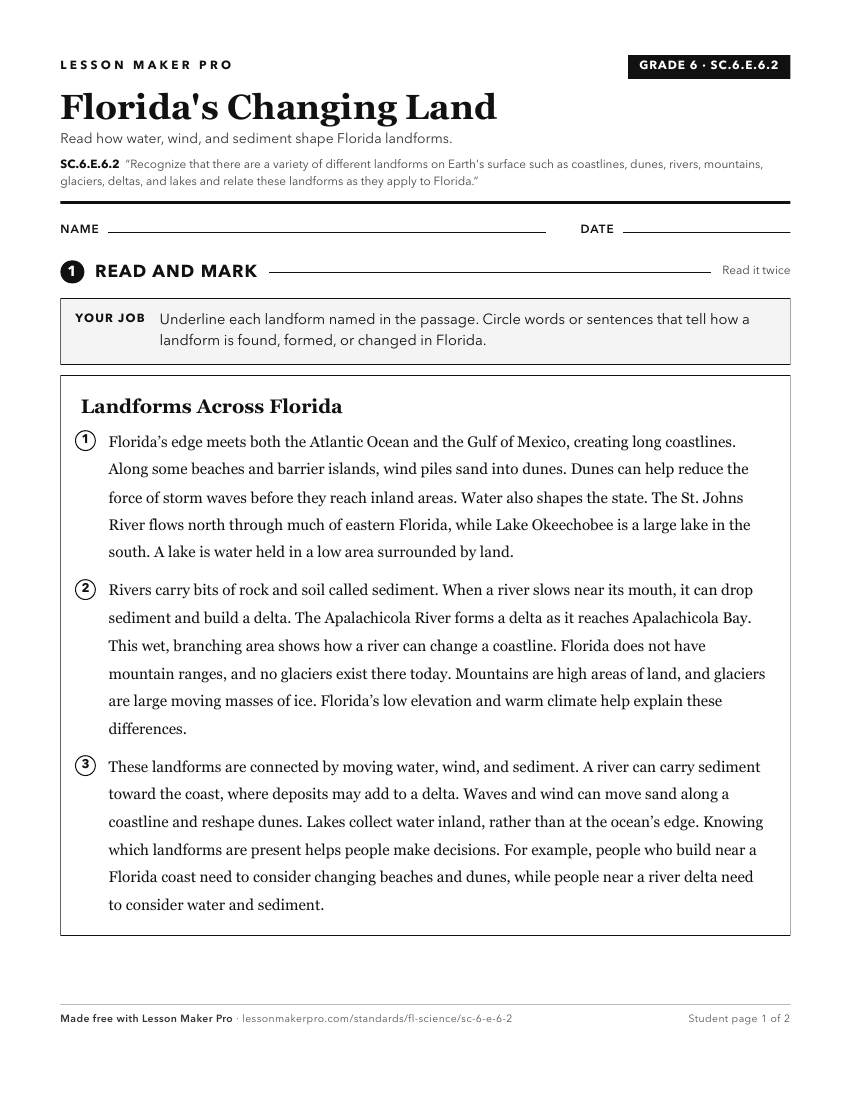
A ready-to-print activity worksheet aligned to SC.6.E.6.2, with an answer key for the teacher on its own page. No account needed.
PDF, US Letter, prints cleanly in black and white.
Download the worksheetKeep exploring
Related Standards
- SC.4.E.6.6
Identify resources available in Florida (water, phosphate, oil, limestone, silicon, wind, and solar energy).
- SC.1.E.6.1
Recognize that water, rocks, soil, and living organisms are found on Earth's surface.
- SC.2.E.6.1
Recognize that Earth is made up of rocks. Rocks come in many sizes and shapes.
- SC.5.E.7.5
Recognize that some of the weather-related differences, such as temperature and humidity, are found among different environments, such as swamps, deserts, and m...
Turn this exact standard into a lesson
Grade, subject, topic, and the complete standard are prefilled. Create one free, no account needed.
Also for this standard:Make a WorksheetMake a QuizMake a Sub Lesson