Florida SC.4.P.8.2
The Standard
Identify properties and common uses of water in each of its states.
Florida Next Generation Sunshine State Standards for Science
Teacher's field guide
What This Standard Means
What Students Need to Do
- Students identify ice, liquid water, and water vapor as forms of the same substance. They describe each form and connect it to common uses.
What Mastery Looks Like
- A student can classify ice cubes, drinking water, and water vapor by state. They explain that ice keeps its shape, liquid water flows, and vapor spreads through air. They match each form to uses such as cooling, washing, or steam cooking.
Common Misconceptions
- Students may think ice, liquid water, and water vapor are different substances. They often call the visible cloud above boiling water water vapor, though it is tiny liquid droplets. Some think water vapor exists only near boiling water.
How to Assess It
- Show pictures of an ice pack, a glass of water, and a food steamer. For each, students name the state, list one property, and explain its use.
Lesson moves
Ways to Teach It
Students observe ice, pour liquid water between containers, and hold a cold metal lid above warm water to gather evidence of invisible water vapor.
Ask, "Why would you choose ice, liquid water, or water vapor for cooling food, washing hands, and steaming vegetables?"
Play a card match by pairing each state card with property and use cards, then have students explain one match to a partner.
Study a cafeteria photo showing an ice bin, sink, and food steamer, then label each form of water and its use.
Free download
Printable SC.4.P.8.2 Worksheet
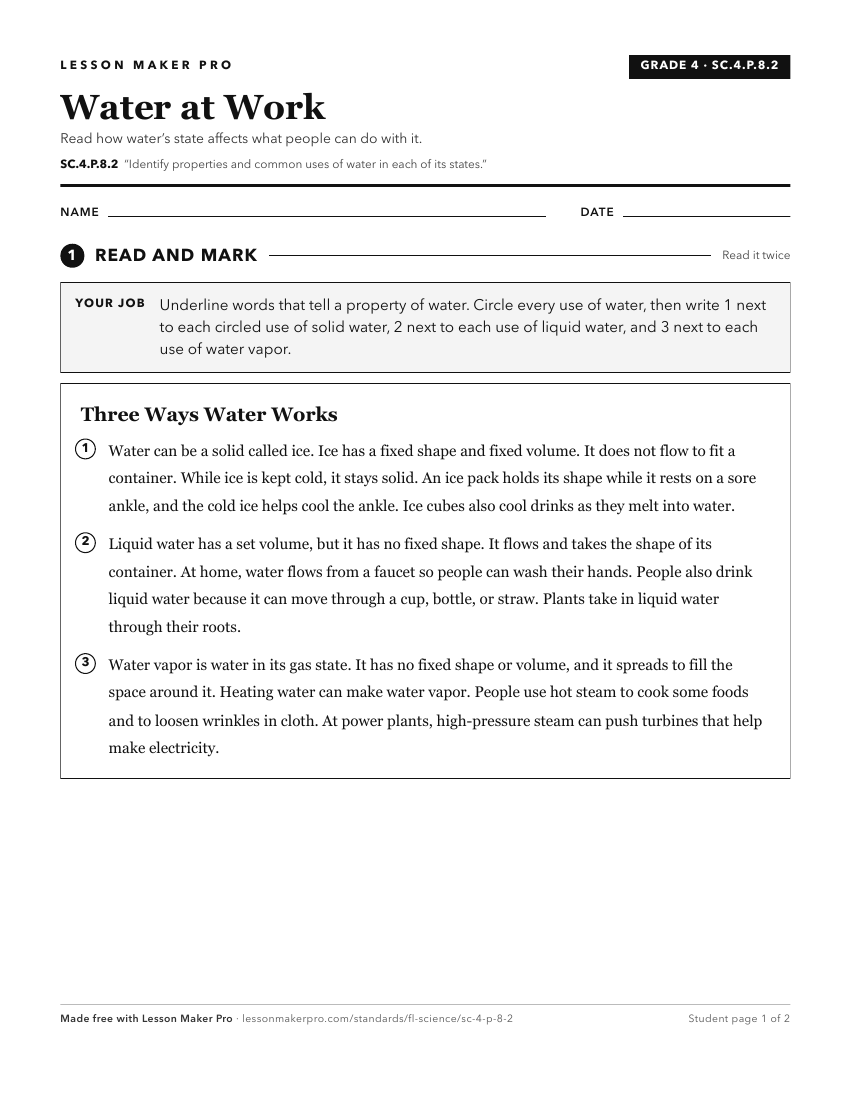
A ready-to-print activity worksheet aligned to SC.4.P.8.2, with an answer key for the teacher on its own page. No account needed.
PDF, US Letter, prints cleanly in black and white.
Download the worksheetKeep exploring
Related Standards
- SC.8.P.8.8
Identify basic examples of and compare and classify the properties of compounds, including acids, bases, and salts.
- SC.3.P.9.1
Describe the changes water undergoes when it changes state through heating and cooling by using familiar scientific terms such as melting, freezing, boiling, ev...
- SC.5.E.7.1
Create a model to explain the parts of the water cycle. Water can be a gas, a liquid, or a solid and can go back and forth from one state to another.
- SC.2.P.8.4
Observe and describe water in its solid, liquid, and gaseous states.
Turn this exact standard into a lesson
Grade, subject, topic, and the complete standard are prefilled. Create one free, no account needed.
Also for this standard:Make a WorksheetMake a QuizMake a Sub Lesson