Florida SC.4.E.5.2
The Standard
Describe the changes in the observable shape of the moon over the course of about a month.
Florida Next Generation Sunshine State Standards for Science
Teacher's field guide
What This Standard Means
What Students Need to Do
- Students track the Moon across several weeks and notice a repeating sequence of phases. They describe how the lighted part appears to grow, become full, then shrink. They use phase names and observations such as crescent, half, and nearly full.
What Mastery Looks Like
- A student can arrange Moon images from new moon through full moon and back to new moon. They correctly label waxing and waning phases. They explain that the Moon stays round while the visible lighted portion changes.
Common Misconceptions
- Students may think Earth’s shadow causes every phase, rather than only a lunar eclipse. They may think the Moon changes physical shape or produces its own light. They often reverse waxing and waning or expect a full cycle each week.
How to Assess It
- Give students eight shuffled Moon phase cards. Ask them to order the cards, label waxing and waning, and write one sentence describing the monthlong pattern.
Lesson moves
Ways to Teach It
Darken the room, use a lamp as the Sun and a foam ball as the Moon, and sketch each visible phase.
Show crescent, quarter, gibbous, and full Moon photos, then ask, “What changes, and what stays the same?”
Play Phase Lineup: teams arrange eight Moon cards in order, then identify which phases are waxing and which are waning.
Use a current Moon calendar to choose three observation nights, then have students predict and later record the Moon’s appearance.
Free download
Printable SC.4.E.5.2 Worksheet
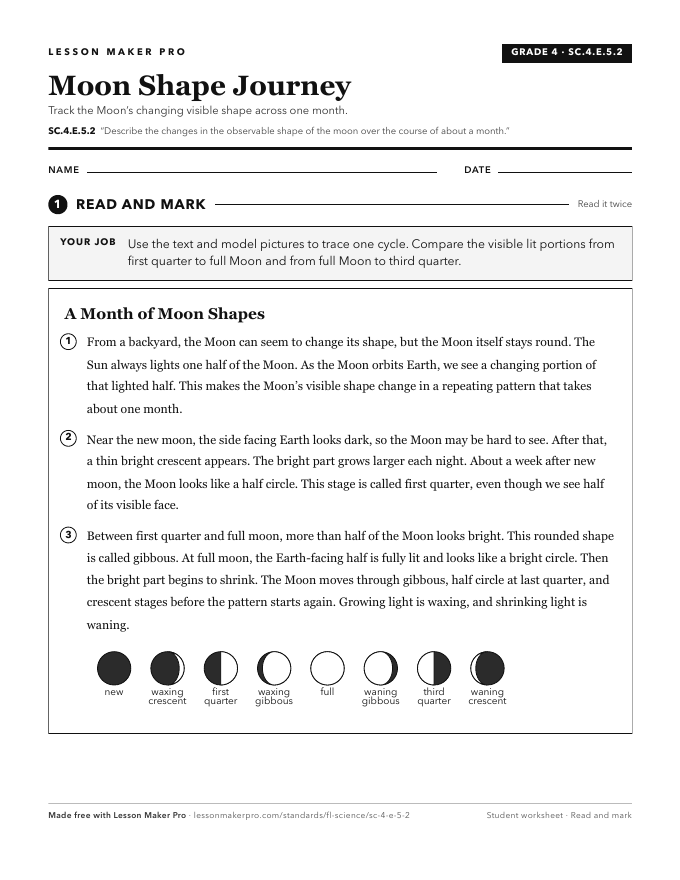
A ready-to-print activity worksheet aligned to SC.4.E.5.2, with an answer key for the teacher on its own page. No account needed.
PDF, US Letter, prints cleanly in black and white.
Download the worksheetKeep exploring
Related Standards
- SC.8.E.5.9
Explain the impact of objects in space on each other including: • the Sun on the Earth including seasons and gravitational attraction • the Moon on the Earth, i...
- SC.4.E.5.1
Observe that the patterns of stars in the sky stay the same although they appear to shift across the sky nightly, and different stars can be seen in different s...
- SC.4.E.5.4
Relate that the rotation of Earth (day and night) and apparent movements of the Sun, Moon, and stars are connected.
- SC.K.E.5.4
Observe that sometimes the Moon can be seen at night and sometimes during the day.
Turn this exact standard into a lesson
Grade, subject, topic, and the complete standard are prefilled. Create one free, no account needed.
Also for this standard:Make a WorksheetMake a QuizMake a Sub Lesson