Florida SC.3.P.10.3
The Standard
Demonstrate that light travels in a straight line until it strikes an object or travels from one medium to another.
Florida Next Generation Sunshine State Standards for Science
Teacher's field guide
What This Standard Means
What Students Need to Do
- Students use a flashlight or ray box to trace light through air. They show that its path stays straight, then stops, bounces, or changes direction when it meets another material.
What Mastery Looks Like
- Given cards with holes, a barrier, or a clear container of water, students predict where the light will appear. They support each prediction with an observation or labeled ray drawing.
Common Misconceptions
- Students may think light curves around barriers or follows the direction their eyes move. They may also think a straw actually bends in water, rather than recognizing that light changes direction between water and air.
How to Assess It
- Give students a two-panel exit ticket. Ask them to draw a flashlight beam through aligned holes, then show what happens when one card moves or the beam enters water.
Lesson moves
Ways to Teach It
Shine a flashlight through three aligned index-card holes, then move one card and observe when the light disappears.
Ask, "Why does a straw look bent in water?" Have students draw and label what happens to the light.
Play Light Path Match by pairing setup cards showing flashlights, water, and barriers with the correct beam-path diagrams.
Test how a car headlight beam changes when it passes through air, fog, or a wet windshield using pictures and predictions.
Free download
Printable SC.3.P.10.3 Worksheet
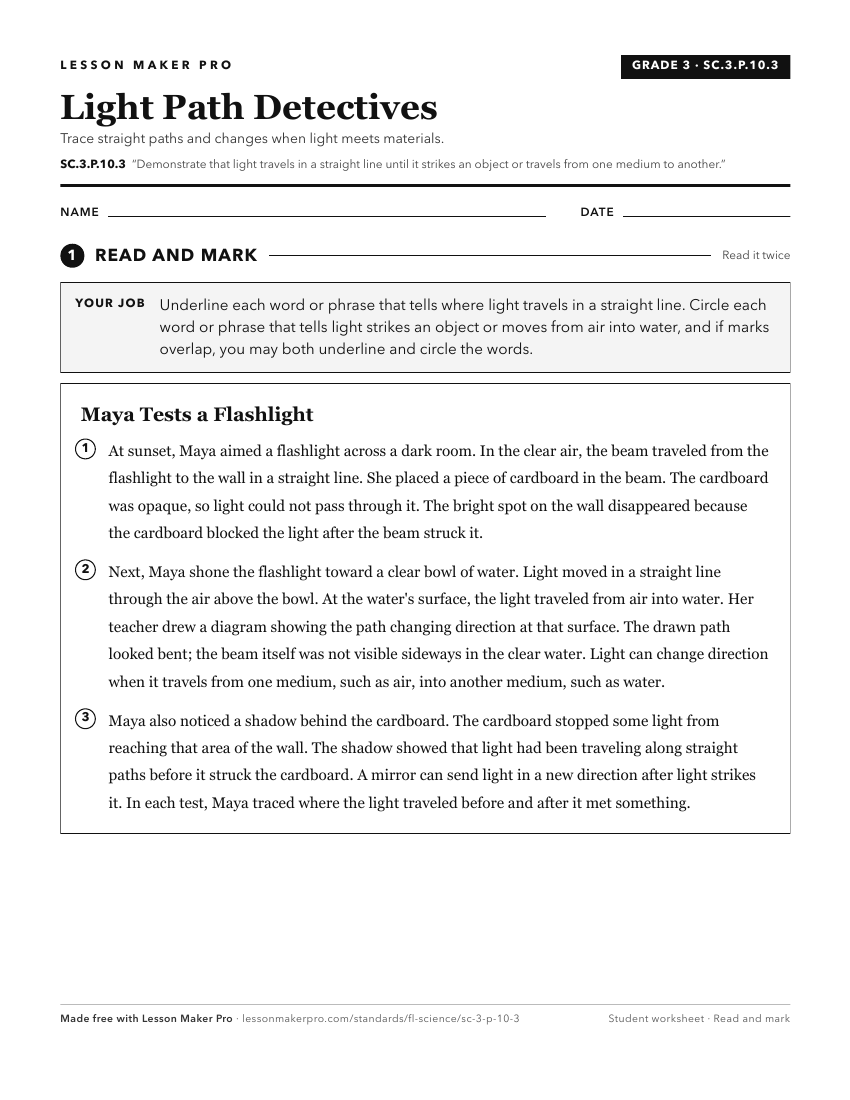
A ready-to-print activity worksheet aligned to SC.3.P.10.3, with an answer key for the teacher on its own page. No account needed.
PDF, US Letter, prints cleanly in black and white.
Download the worksheetKeep exploring
Related Standards
- SC.8.E.5.1
Recognize that there are enormous distances between objects in space and apply our knowledge of light and space travel to understand this distance.
- SC.7.P.10.2
Observe and explain that light can be reflected, refracted, and/or absorbed.
- SC.1.P.12.1
Demonstrate and describe the various ways that objects can move, such as in a straight line, zigzag, back-and-forth, round-and-round, fast, and slow.
- SC.3.P.10.4
Demonstrate that light can be reflected, refracted, and absorbed.
Turn this exact standard into a lesson
Grade, subject, topic, and the complete standard are prefilled. Create one free, no account needed.
Also for this standard:Make a WorksheetMake a QuizMake a Sub Lesson