Florida SC.1.P.12.1
The Standard
Demonstrate and describe the various ways that objects can move, such as in a straight line, zigzag, back-and-forth, round-and-round, fast, and slow.
Florida Next Generation Sunshine State Standards for Science
Teacher's field guide
What This Standard Means
What Students Need to Do
- Students observe an object in motion and tell how it travels. They distinguish the path it follows from how quickly it moves.
What Mastery Looks Like
- A student can move a toy in a named pattern, then describe its path and speed accurately. The student can compare the motions of two objects.
Common Misconceptions
- Students may call every moving object fast, or confuse following a curved path with spinning in place. They may think changing direction always means changing speed.
How to Assess It
- Give each student a toy car and say, “Make it travel slowly in a zigzag, then quickly along a straight path.” Ask students to describe both movements.
Lesson moves
Ways to Teach It
Use toy cars, balls, tops, and ribbon wands at stations, and have students demonstrate a different path or speed at each station.
Show two object motions and ask, “How are their paths alike, and how are their speeds different?”
Play Motion Charades: students draw a path and speed card, move a beanbag to match it, and classmates name both features.
Watch playground motions, then label a swing, merry-go-round, rolling ball, and runner by path and speed.
Free download
Printable SC.1.P.12.1 Worksheet
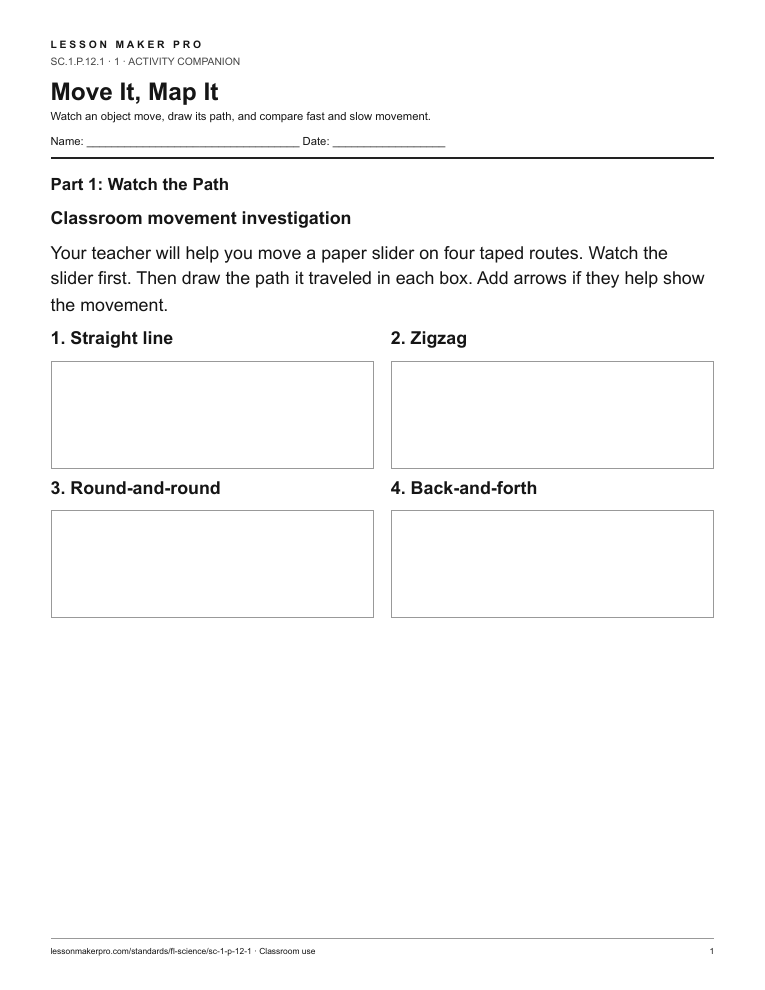
A ready-to-print activity worksheet aligned to SC.1.P.12.1, with an answer key for the teacher on its own page. No account needed.
PDF, US Letter, prints cleanly in black and white.
Download the worksheetKeep exploring
Related Standards
- SC.K.P.12.1
Investigate that things move in different ways, such as fast, slow, etc.
- SC.4.P.12.1
Recognize that an object in motion always changes its position and may change its direction.
- SC.4.P.12.2
Investigate and describe that the speed of an object is determined by the distance it travels in a unit of time and that objects can move at different speeds.
- SC.1.P.13.1
Demonstrate that the way to change the motion of an object is by applying a push or a pull.
Turn this exact standard into a lesson
Grade, subject, topic, and the complete standard are prefilled. Create one free, no account needed.
Also for this standard:Make a WorksheetMake a QuizMake a Sub Lesson