Florida SC.2.L.16.1
The Standard
Observe and describe major stages in the life cycles of plants and animals, including beans and butterflies.
Florida Next Generation Sunshine State Standards for Science
Teacher's field guide
What This Standard Means
What Students Need to Do
- Students observe how a bean plant and butterfly change over time. They name, describe, and sequence the major stages in each life cycle.
What Mastery Looks Like
- Students place life cycle pictures in the correct order and describe what happens at each stage. They explain that adult plants and animals produce offspring that begin the cycle again.
Common Misconceptions
- Students may think a caterpillar and butterfly are different animals, or that a seed is not alive. They may arrange stages as a straight line instead of a repeating cycle.
How to Assess It
- Give students mixed pictures of bean and butterfly life cycles. Ask them to order one cycle and write one change that happens between two stages.
Lesson moves
Ways to Teach It
Plant bean seeds in clear cups, then draw and label changes in a dated observation booklet.
Ask students to write how a seedling and caterpillar are alike and different as young living things.
Play a sequencing relay where teams arrange bean and butterfly stage cards into complete life cycles.
Examine a garden or schoolyard and record evidence of plant growth, eggs, larvae, or adult insects.
Free download
Printable SC.2.L.16.1 Worksheet
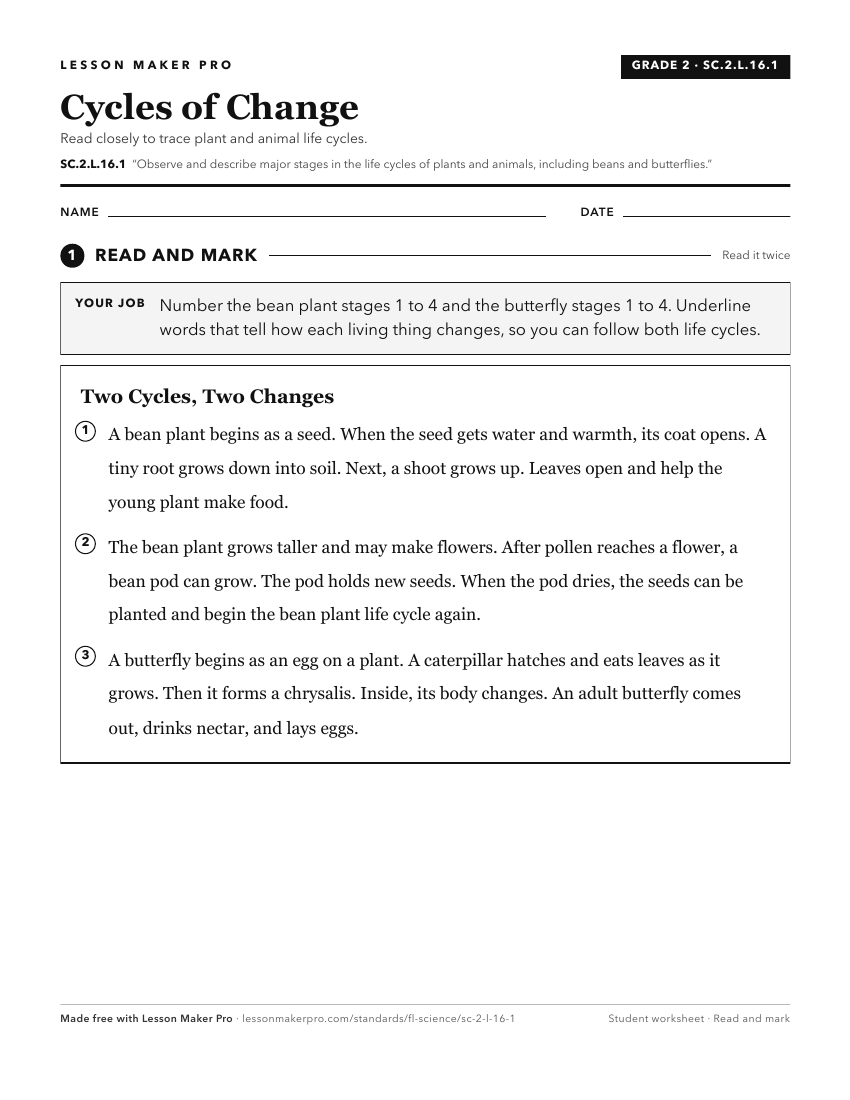
A ready-to-print activity worksheet aligned to SC.2.L.16.1, with an answer key for the teacher on its own page. No account needed.
PDF, US Letter, prints cleanly in black and white.
Download the worksheetKeep exploring
Related Standards
- SC.4.L.16.4
Compare and contrast the major stages in the life cycles of Florida plants and animals, such as those that undergo incomplete and complete metamorphosis, and fl...
- SC.K.L.14.3
Observe plants and animals, describe how they are alike and how they are different in the way they look and in the things they do.
- SC.1.L.14.2
Identify the major parts of plants, including stem, roots, leaves, and flowers.
- SC.1.L.14.1
Make observations of living things and their environment using the five senses.
Turn this exact standard into a lesson
Grade, subject, topic, and the complete standard are prefilled. Create one free, no account needed.
Also for this standard:Make a WorksheetMake a QuizMake a Sub Lesson