Florida B.E.S.T. MA.K.NSO.1.2
The Standard
Given a number from 0 to 20, count out that many objects.
Florida B.E.S.T. Standards for Mathematics
Teacher's field guide
What This Standard Means
What Students Need to Do
- Students read a numeral from 0 through 20 and make a group with that exact number of objects. They count each object once and stop when they reach the target.
What Mastery Looks Like
- A student reads a numeral and builds a matching set without help. The student touches or moves each object once, stops at the target number, and makes an empty set for zero.
Common Misconceptions
- Students may skip objects, count one object twice, or stop at the wrong number. They may also think zero means making a small group instead of an empty set.
How to Assess It
- Show the numeral 14 and ask the student to place exactly 14 counters on a mat. Repeat with 0 to check understanding of an empty set.
Lesson moves
Ways to Teach It
Give students numeral cards and buttons, then have them build each set in a ten-frame or counting mat.
Ask, “How do you know your set matches the numeral?” Have students explain how they counted and where they stopped.
Play Grab and Check: students draw a numeral card, count out cubes, and earn a point if a partner confirms the set.
Set up a pretend snack station where students read order cards and place the matching number of crackers on each plate.
Free download
Printable MA.K.NSO.1.2 Worksheet
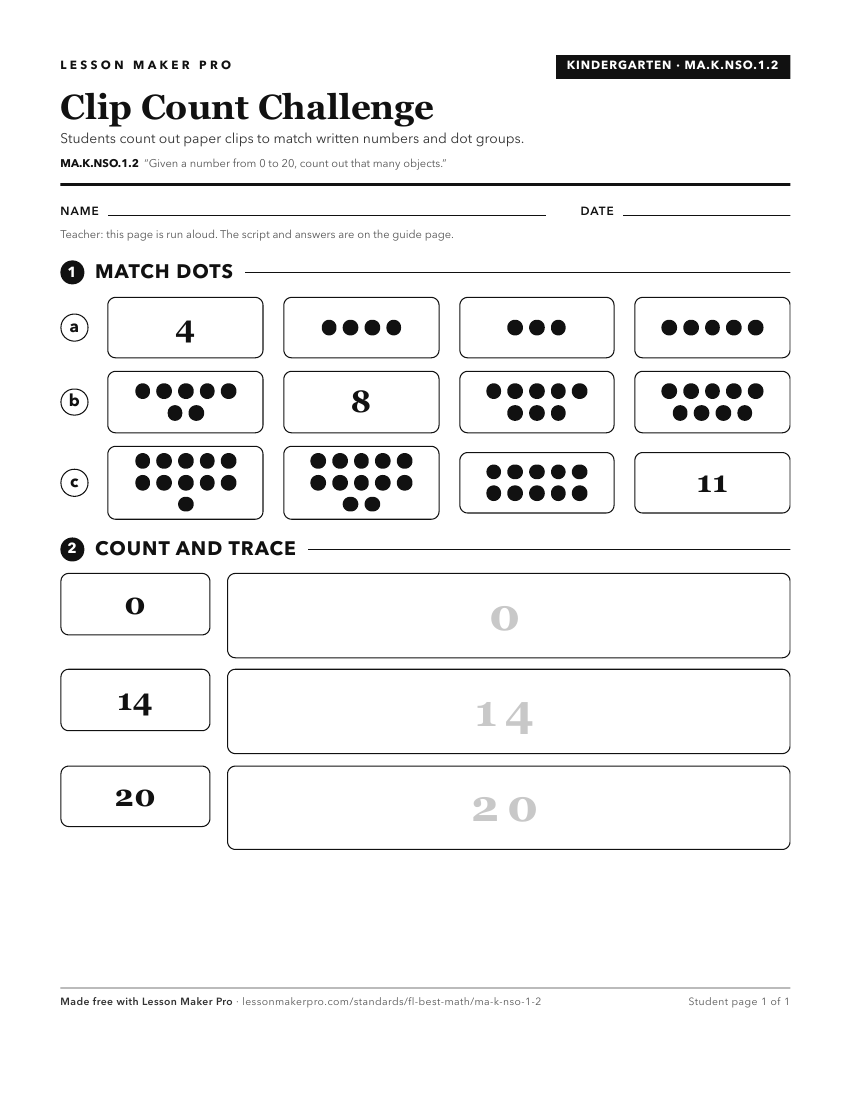
A ready-to-print activity worksheet aligned to MA.K.NSO.1.2, with an answer key for the teacher on its own page. No account needed.
PDF, US Letter, prints cleanly in black and white.
Download the worksheetKeep exploring
Related Standards
- MA.K.NSO.1.4
Compare the number of objects from 0 to 20 in two groups using the terms less than, equal to or greater than.
- MA.K.NSO.2.2
Represent whole numbers from 10 to 20, using a unit of ten and a group of ones, with objects, drawings and expressions or equations.
- MA.K.NSO.1.1
Given a group of up to 20 objects, count the number of objects in that group and represent the number of objects with a written numeral. State the number of obj...
- MA.1.NSO.1.1
Starting at a given number, count forward and backwards within 120 by ones. Skip count by 2s to 20 and by 5s to 100.
Turn this exact standard into a lesson
Grade, subject, topic, and the complete standard are prefilled. Create one free, no account needed.
Also for this standard:Make a WorksheetMake a QuizMake a Sub Lesson