Florida B.E.S.T. MA.K.NSO.1.1
The Standard
Given a group of up to 20 objects, count the number of objects in that group and represent the number of objects with a written numeral. State the number of objects in a rearrangement of that group without recounting.
Florida B.E.S.T. Standards for Mathematics
Teacher's field guide
What This Standard Means
What Students Need to Do
- Students count objects by matching one number word to each object and use the final count as the total. They write the matching numeral and recognize that moving the objects does not change the amount.
What Mastery Looks Like
- A student pairs one number word with each object and identifies the last number said as the total. The student writes the matching numeral and keeps the same total when the objects are rearranged.
Common Misconceptions
- Students may skip objects, count one object twice, or say the last number without understanding it names the whole set. They may also think spreading objects apart changes how many there are.
How to Assess It
- Place 14 counters on a mat. Ask the student to count them, write the numeral, then watch you rearrange them and tell how many remain without recounting.
Lesson moves
Ways to Teach It
Give pairs 20 counters and numeral cards, then have them build, count, and label sets chosen from the cards.
Show a tight group and a spread-out group of the same counters, then ask, “Did the amount change? Explain how you know.”
Play Cover and Count: students count a set, write the total, cover it, and name the total after a partner rearranges it.
Count classroom items such as crayons or glue sticks, record the numeral, then reorganize them and confirm the amount stays the same.
Free download
Printable MA.K.NSO.1.1 Worksheet
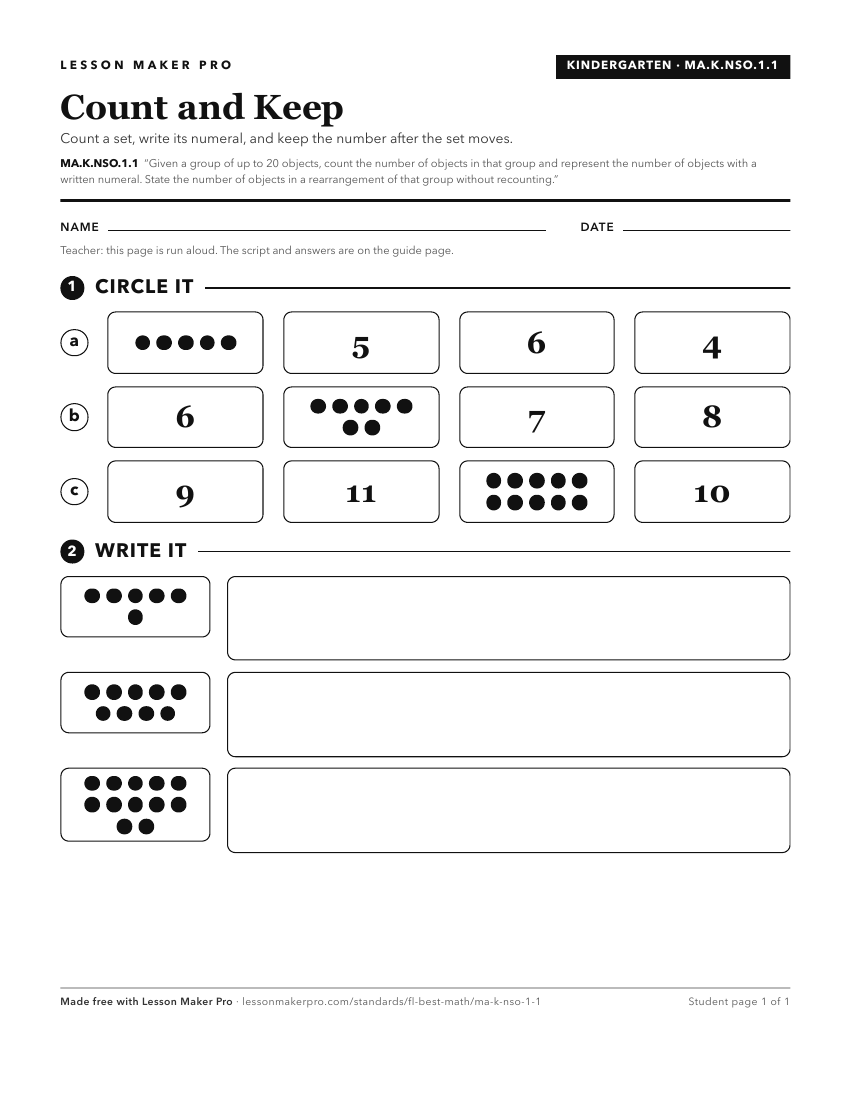
A ready-to-print activity worksheet aligned to MA.K.NSO.1.1, with an answer key for the teacher on its own page. No account needed.
PDF, US Letter, prints cleanly in black and white.
Download the worksheetKeep exploring
Related Standards
- MA.K.NSO.1.4
Compare the number of objects from 0 to 20 in two groups using the terms less than, equal to or greater than.
- MA.2.AR.3.2
Use repeated addition to find the total number of objects in a collection of equal groups. Represent the total number of objects using rectangular arrays and eq...
- MA.K.NSO.2.2
Represent whole numbers from 10 to 20, using a unit of ten and a group of ones, with objects, drawings and expressions or equations.
- MA.K.NSO.1.2
Given a number from 0 to 20, count out that many objects.
Turn this exact standard into a lesson
Grade, subject, topic, and the complete standard are prefilled. Create one free, no account needed.
Also for this standard:Make a WorksheetMake a QuizMake a Sub Lesson