Florida B.E.S.T. MA.912.LT.3.3
The Standard
Decide voting power within a group using weighted voting techniques. Provide real-world examples of weighted voting and its pros and cons.
Florida B.E.S.T. Standards for Mathematics
Teacher's field guide
What This Standard Means
What Students Need to Do
- Students model group decisions with a quota and different vote weights. They calculate each member’s influence, then explain benefits and drawbacks in shareholder, legislative, or council voting.
What Mastery Looks Like
- Given a quota and voter weights, students can list winning coalitions and identify critical voters. They can calculate a Banzhaf power index and use it to judge whether the arrangement is fair.
Common Misconceptions
- Students often assume a voter’s weight equals the voter’s actual power. They may count every member of a winning coalition as critical. They may also miss dummy, dictator, or veto roles, or normalize power values incorrectly.
How to Assess It
- Exit ticket: For [4:3,2,1], list the winning coalitions, mark each critical voter, and report each voter’s normalized Banzhaf power.
Lesson moves
Ways to Teach It
Give teams vote-weight cards and a quota card, then have them build every winning coalition and tag voters whose removal makes it lose.
Ask students to compare shareholder voting with one-person, one-vote, then write one benefit and one drawback of assigning votes by ownership.
Run a coalition race using [7:4,3,2,1], awarding points for each correctly identified critical voter and calculated Banzhaf share.
Use fictional company share totals to design a board vote, then test whether a small shareholder can ever change the outcome.
Free download
Printable MA.912.LT.3.3 Worksheet
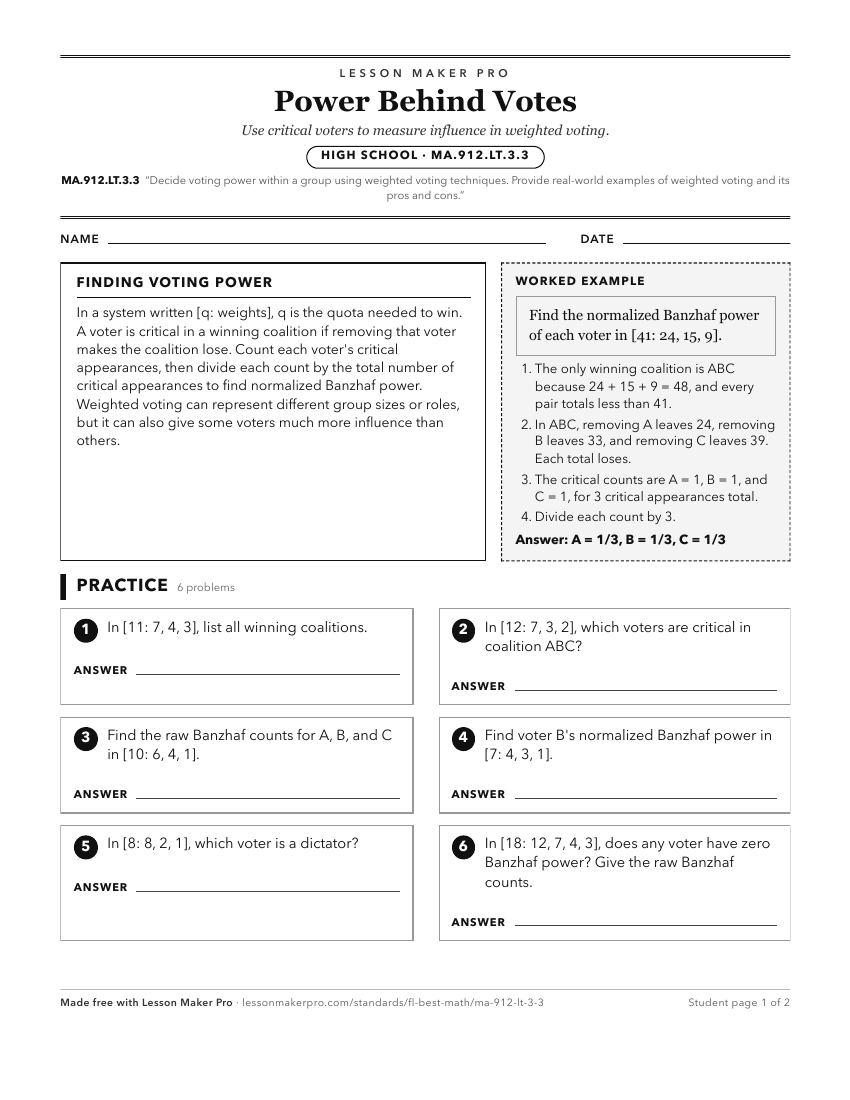
A ready-to-print activity worksheet aligned to MA.912.LT.3.3, with an answer key for the teacher on its own page. No account needed.
PDF, US Letter, prints cleanly in black and white.
Download the worksheetKeep exploring
Related Standards
- MA.912.FL.1.3
Solve real-world problems involving weighted averages using spreadsheets and other technology.
- MA.912.LT.3
Apply techniques from Election Theory and Fair Division Theory to solve problems.
- MA.912.LT.3.1
Define and explain the basic concepts of Election Theory and voting.
- MA.912.LT.3.2
Analyze election data using election theory techniques. Explain how Arrow’s Impossibility Theorem may be related to the fairness of the outcome of the election.
Turn this exact standard into a lesson
Grade, subject, topic, and the complete standard are prefilled. Create one free, no account needed.
Also for this standard:Make a WorksheetMake a QuizMake a Sub Lesson