Florida B.E.S.T. MA.912.LT.3.1
The Standard
Define and explain the basic concepts of Election Theory and voting.
Florida B.E.S.T. Standards for Mathematics
Teacher's field guide
What This Standard Means
What Students Need to Do
- Students identify the parts of an election, including voters, candidates, ballots, and ranked preferences. They distinguish a majority from a plurality and interpret a preference schedule.
What Mastery Looks Like
- Students correctly use terms such as voter, candidate, ballot, preference, plurality, and majority. They can read a preference schedule and explain what the numbers and rankings show.
Common Misconceptions
- Students often treat plurality and majority as the same result. They may count total rankings instead of first-place votes. Some also confuse a ballot with the complete preference schedule.
How to Assess It
- Exit ticket: In a 20-vote election, A gets 9 first-place votes, B gets 7, and C gets 4. Identify the plurality winner and explain whether anyone has a majority.
Lesson moves
Ways to Teach It
Run a mock class election with paper ballots, then sort the votes into a preference schedule and identify plurality and majority results.
Ask students to explain how a candidate can win a plurality without winning a majority, using a three-candidate example.
Give pairs tally cards and ranked ballots, then award points for correctly naming voters, candidates, preferences, plurality, and majority.
Examine a published ranked-choice election tally and have students explain how the ballots record voter preferences.
Free download
Printable MA.912.LT.3.1 Worksheet
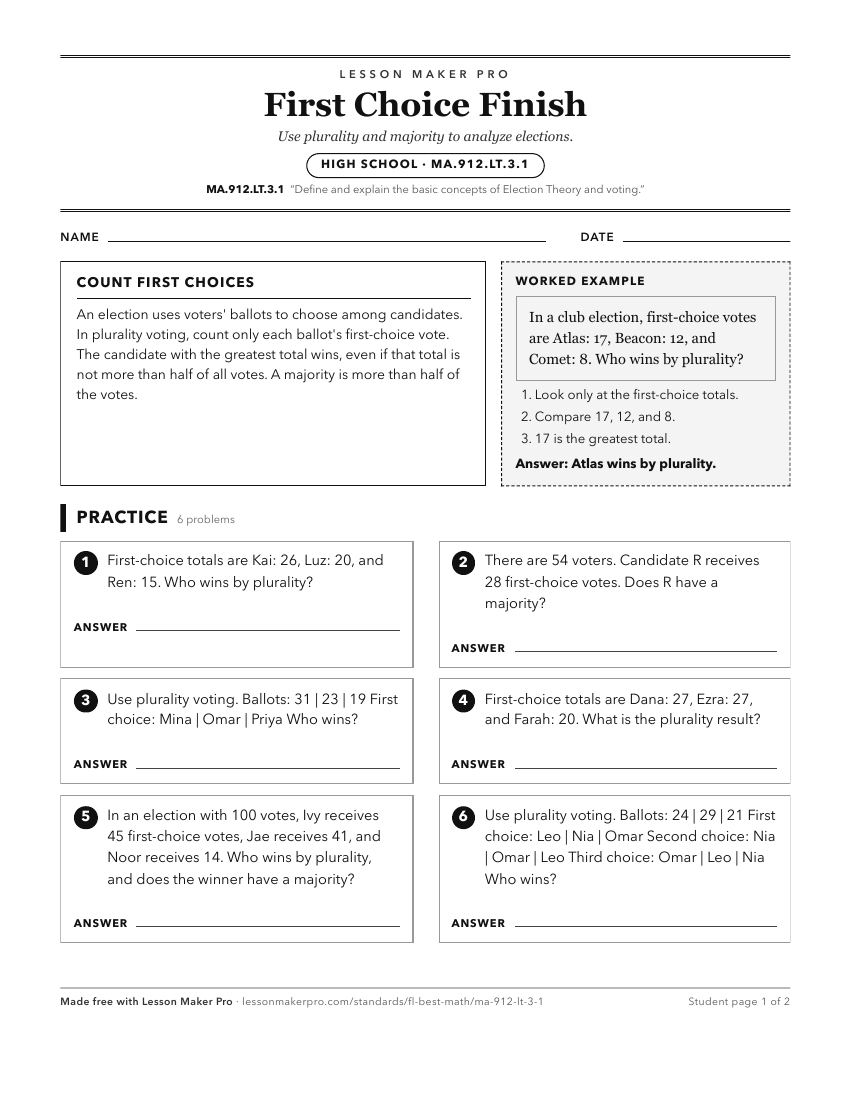
A ready-to-print activity worksheet aligned to MA.912.LT.3.1, with an answer key for the teacher on its own page. No account needed.
PDF, US Letter, prints cleanly in black and white.
Download the worksheetKeep exploring
Related Standards
- MA.912.LT.3.3
Decide voting power within a group using weighted voting techniques. Provide real-world examples of weighted voting and its pros and cons.
- MA.912.LT.3
Apply techniques from Election Theory and Fair Division Theory to solve problems.
- MA.912.LT.2.1
Define and explain the basic concepts of Graph Theory.
- MA.912.LT.3.2
Analyze election data using election theory techniques. Explain how Arrow’s Impossibility Theorem may be related to the fairness of the outcome of the election.
Turn this exact standard into a lesson
Grade, subject, topic, and the complete standard are prefilled. Create one free, no account needed.
Also for this standard:Make a WorksheetMake a QuizMake a Sub Lesson