Florida B.E.S.T. MA.912.LT.2.1
The Standard
Define and explain the basic concepts of Graph Theory.
Florida B.E.S.T. Standards for Mathematics
Teacher's field guide
What This Standard Means
What Students Need to Do
- Students represent objects as vertices and connections as edges. They identify and explain adjacency, degree, paths, cycles, and whether a graph is connected.
What Mastery Looks Like
- Students correctly identify vertices, edges, adjacent vertices, degree, paths, cycles, and connected components in a graph. They describe what each feature means in the situation modeled.
Common Misconceptions
- Students may confuse a vertex with an edge or think crossing edges create a new vertex. They may also count repeated vertices when finding degree or assume every graph is connected.
How to Assess It
- Give students a six-vertex graph. Ask them to label one path, one cycle, two adjacent vertices, and the degree of each vertex.
Lesson moves
Ways to Teach It
Use string and index cards to build a human graph, then identify vertices, edges, degrees, paths, cycles, and connected components.
Show two different drawings of the same graph and ask students to explain in writing why the connections have not changed.
Play Graph Vocabulary Bingo using teacher-read clues such as a vertex with degree three or a path containing four edges.
Map a local bus network as a graph, with stops as vertices and direct routes as edges, then identify paths and cycles.
Free download
Printable MA.912.LT.2.1 Worksheet
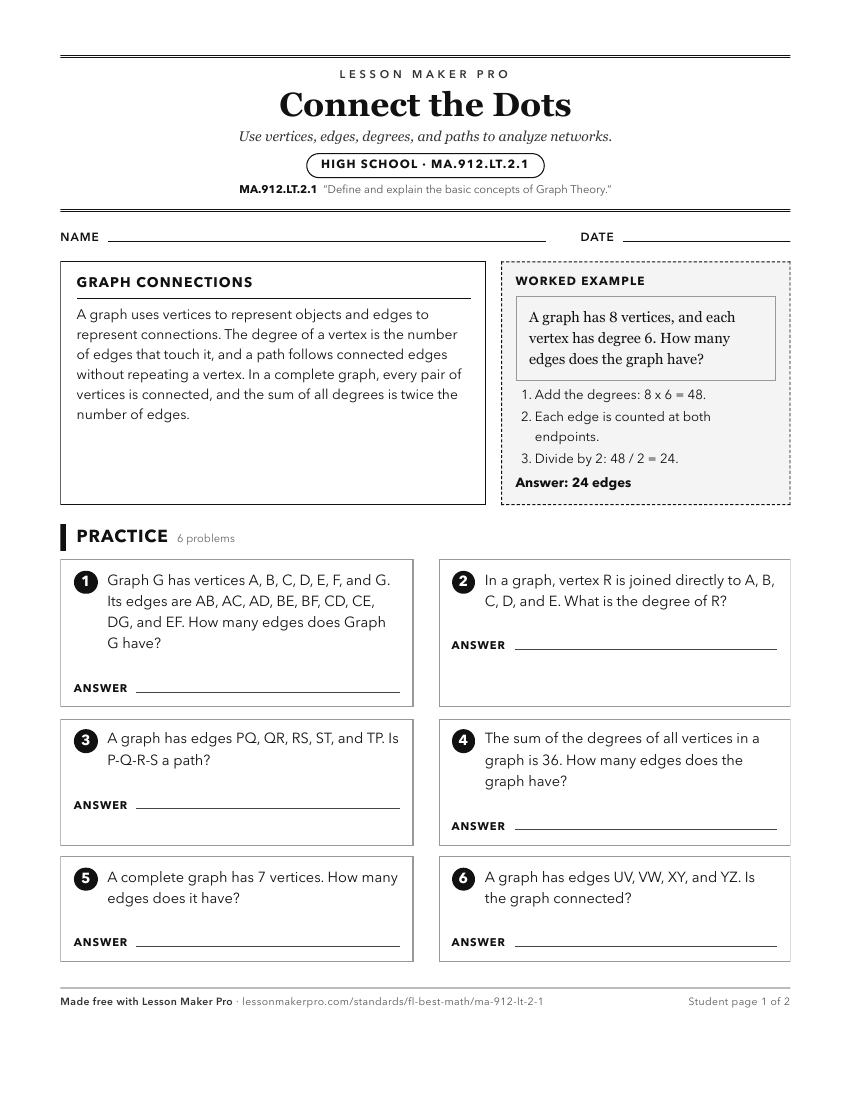
A ready-to-print activity worksheet aligned to MA.912.LT.2.1, with an answer key for the teacher on its own page. No account needed.
PDF, US Letter, prints cleanly in black and white.
Download the worksheetKeep exploring
Related Standards
Turn this exact standard into a lesson
Grade, subject, topic, and the complete standard are prefilled. Create one free, no account needed.
Also for this standard:Make a WorksheetMake a QuizMake a Sub Lesson