Florida B.E.S.T. MA.912.LT.2.4
The Standard
Apply graph coloring techniques to solve problems.
Florida B.E.S.T. Standards for Mathematics
Teacher's field guide
What This Standard Means
What Students Need to Do
- Students model items as vertices and conflicts as edges. They assign colors so connected vertices differ, then determine the fewest colors that satisfy every constraint.
What Mastery Looks Like
- Students can turn a scheduling, map, or conflict problem into a graph. They produce a valid coloring, find the minimum number of colors, and justify their answer using the graph's structure.
Common Misconceptions
- Students may color edges instead of vertices or give connected vertices the same color. They may treat map regions meeting only at one point as adjacent. They may assume a greedy coloring always uses the fewest colors.
How to Assess It
- Give students the cycle A-B-C-D-E-A with an added edge A-C. Ask them to find the minimum coloring and justify why fewer colors cannot work.
Lesson moves
Ways to Teach It
Use course cards as vertices, connect conflicting courses with yarn, then place colored counters to find the fewest time slots.
Have students write why a triangle needs three colors, then discuss whether the same claim holds for every three-vertex graph.
Play a coloring relay where teams color the same projected graph, earning a point only for a valid coloring with fewer colors.
Give an exam schedule with shared-student conflicts and ask students to create the graph and assign the minimum number of periods.
Free download
Printable MA.912.LT.2.4 Worksheet
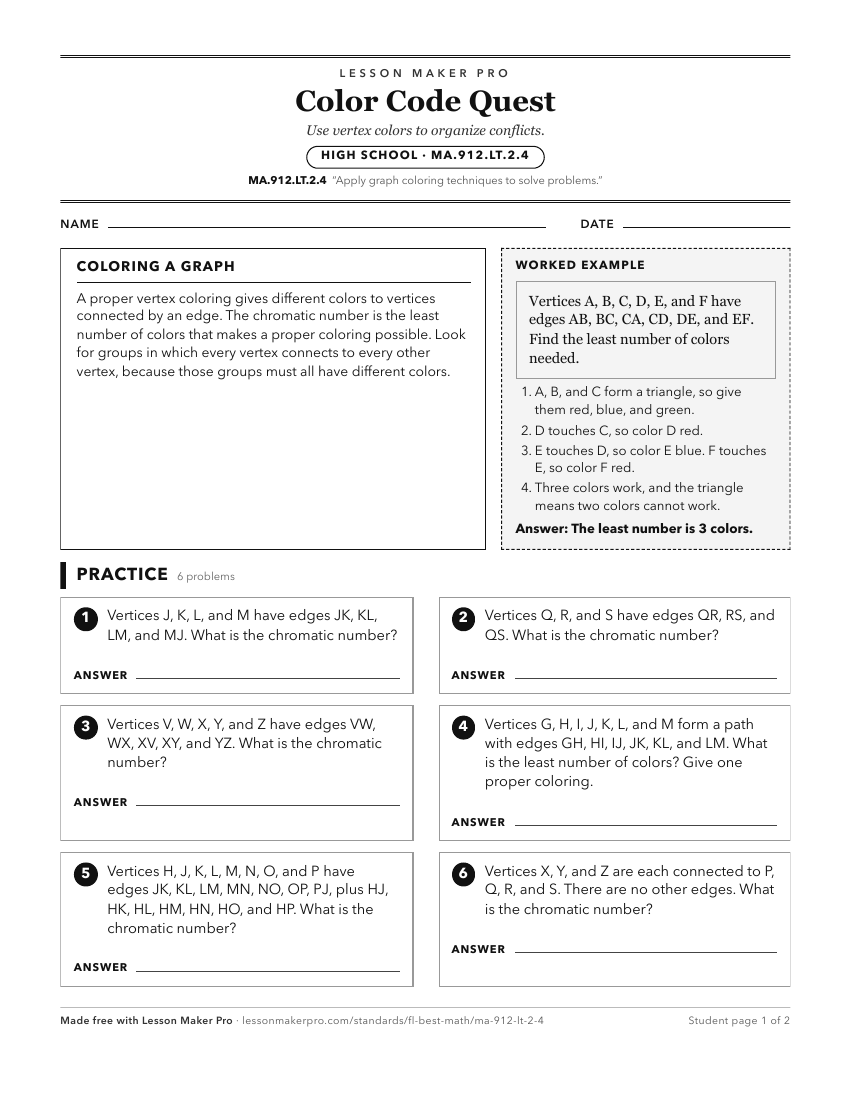
A ready-to-print activity worksheet aligned to MA.912.LT.2.4, with an answer key for the teacher on its own page. No account needed.
PDF, US Letter, prints cleanly in black and white.
Download the worksheetKeep exploring
Related Standards
Turn this exact standard into a lesson
Grade, subject, topic, and the complete standard are prefilled. Create one free, no account needed.
Also for this standard:Make a WorksheetMake a QuizMake a Sub Lesson