Florida B.E.S.T. MA.912.LT.3.2
The Standard
Analyze election data using election theory techniques. Explain how Arrow’s Impossibility Theorem may be related to the fairness of the outcome of the election.
Florida B.E.S.T. Standards for Mathematics
Teacher's field guide
What This Standard Means
What Students Need to Do
- Students organize ranked ballot data and determine winners using methods such as plurality, Borda count, and pairwise comparison. They test outcomes against fairness conditions. They use Arrow’s theorem to explain why no ranked voting method is perfectly fair in every case.
What Mastery Looks Like
- Students correctly find winners using plurality, Borda count, and pairwise comparisons. They compare results and identify a fairness condition that a method may violate. They explain that no ranked voting method with three or more choices meets every fairness condition.
Common Misconceptions
- Students may assume the candidate with the most first-place votes must win under every method. They may treat Arrow’s theorem as proof that all elections are unfair. They also confuse a voting method’s rules with deliberate bias.
How to Assess It
- Give these rankings: 9 voters A>B>C, 6 voters B>C>A, and 5 voters C>B>A. Ask students to find the plurality and Borda winners, then state what Arrow’s theorem suggests about choosing a perfectly fair method.
Lesson moves
Ways to Teach It
Give groups ranked ballot cards to tally with plurality, Borda count, and pairwise comparison, then compare the three winners.
Ask students to write whether changing the winner after removing a losing candidate is fair, and defend their answer.
Run an election-method relay where teams calculate one round each, check another team’s work, and identify any fairness issue.
Use ranked choices for a class event, calculate results with two methods, and explain why the selected option may change.
Free download
Printable MA.912.LT.3.2 Worksheet
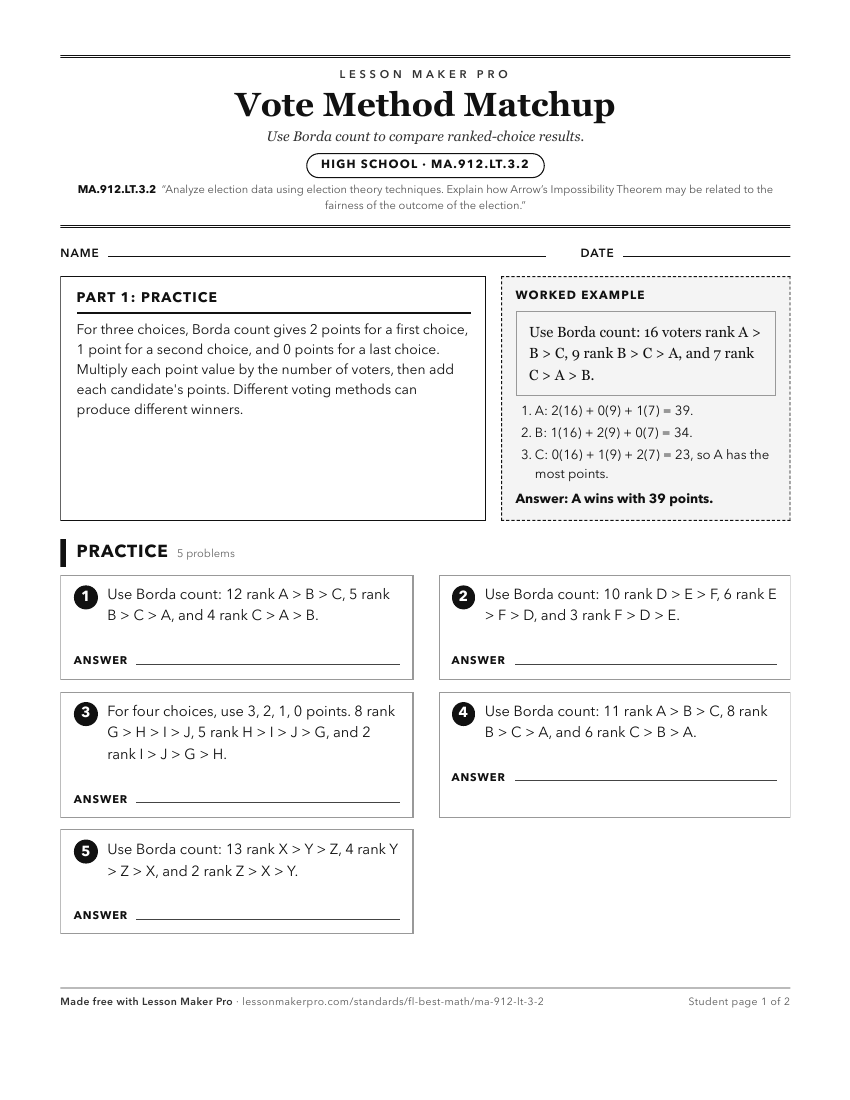
A ready-to-print activity worksheet aligned to MA.912.LT.3.2, with an answer key for the teacher on its own page. No account needed.
PDF, US Letter, prints cleanly in black and white.
Download the worksheetKeep exploring
Related Standards
- MA.912.LT.3.3
Decide voting power within a group using weighted voting techniques. Provide real-world examples of weighted voting and its pros and cons.
- MA.912.LT.3
Apply techniques from Election Theory and Fair Division Theory to solve problems.
- MA.912.LT.3.1
Define and explain the basic concepts of Election Theory and voting.
- MA.912.LT.3.4
Solve problems using fair division and apportionment techniques.
Turn this exact standard into a lesson
Grade, subject, topic, and the complete standard are prefilled. Create one free, no account needed.
Also for this standard:Make a WorksheetMake a QuizMake a Sub Lesson