Florida B.E.S.T. MA.912.DP.5.9
The Standard
Compare two treatments using data from an experiment in which the treatments are assigned randomly.
Florida B.E.S.T. Standards for Mathematics
Teacher's field guide
What This Standard Means
What Students Need to Do
- Students analyze results from an experiment with randomly assigned treatment groups. They compare centers, spreads, proportions, or graph patterns. They decide whether the observed difference supports a treatment effect.
What Mastery Looks Like
- Students identify the treatment groups and response variable. They compare group results using appropriate summaries and graphs. They explain whether the difference supports a causal claim, while allowing for chance variation.
Common Misconceptions
- Students often confuse random assignment with random sampling. They may compare means but ignore spread, overlap, or sample size. They may also claim causation without random assignment or generalize beyond the studied group.
How to Assess It
- Exit ticket: Twenty plants were randomly assigned to fertilizers A and B. Given mean growths of 8.4 cm and 6.1 cm, explain which fertilizer is supported and why random assignment matters.
Lesson moves
Ways to Teach It
Randomly assign paper helicopters to added clips or no clips, conduct drops, then compare mean flight times and dot plots.
Ask students to write why choosing their own treatment could weaken a study, using sleep hours and phone use as an example.
Give teams study cards to sort into causal claim supported or not supported, then underline evidence of random assignment.
Analyze results from a randomized medical trial, comparing recovery rates and discussing what conclusions doctors can reasonably make.
Free download
Printable MA.912.DP.5.9 Worksheet
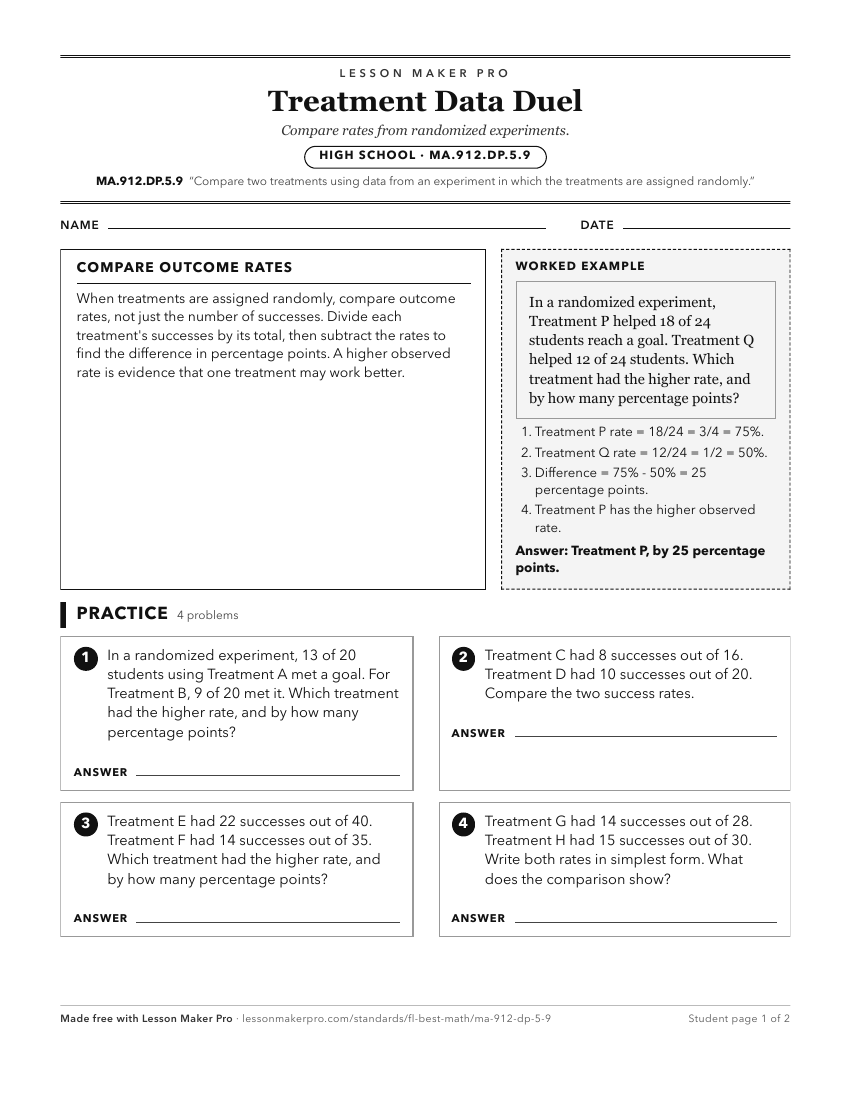
A ready-to-print activity worksheet aligned to MA.912.DP.5.9, with an answer key for the teacher on its own page. No account needed.
PDF, US Letter, prints cleanly in black and white.
Download the worksheetKeep exploring
Related Standards
- MA.912.DP.5.8
Draw inferences about two populations using data and statistical analysis from two random samples.
- MA.912.DP.5.3
Compare and contrast sampling methods.
- MA.912.DP.5.7
Compare and contrast surveys, experiments and observational studies.
- MA.8.DP.2
Represent and find probabilities of repeated experiments.
Turn this exact standard into a lesson
Grade, subject, topic, and the complete standard are prefilled. Create one free, no account needed.
Also for this standard:Make a WorksheetMake a QuizMake a Sub Lesson