Florida B.E.S.T. MA.3.NSO.1.3
The Standard
Plot, order and compare whole numbers up to 10,000.
Florida B.E.S.T. Standards for Mathematics
Teacher's field guide
What This Standard Means
What Students Need to Do
- Students use thousands, hundreds, tens, and ones to decide which whole number is greater or less. They locate numbers on scaled number lines and arrange sets from least to greatest or greatest to least.
What Mastery Looks Like
- Students compare numbers by checking digits from the greatest place value to the least. They place numbers accurately between labeled benchmarks and explain their order using place value or number line position.
Common Misconceptions
- Students may compare from the ones place or focus on the largest-looking digit. They may treat 10,000 as smaller than 9,999 because it contains zeros. On number lines, they often ignore the scale and space numbers evenly.
How to Assess It
- Give students a number line from 0 to 10,000. Ask them to plot 2,450, 3,700, and 9,250, then order the numbers and write two comparisons using symbols.
Lesson moves
Ways to Teach It
Make a floor number line labeled by thousands, then have students stand where their number cards belong and justify each position.
Ask students to explain why 4,206 is greater than 4,026 using the first place where the digits differ.
Play number card war with four-digit numbers, requiring each winner to state the comparison aloud using greater than or less than.
Give students a table of local park attendance totals, then have them rank the parks and identify the greatest difference.
Free download
Printable MA.3.NSO.1.3 Worksheet
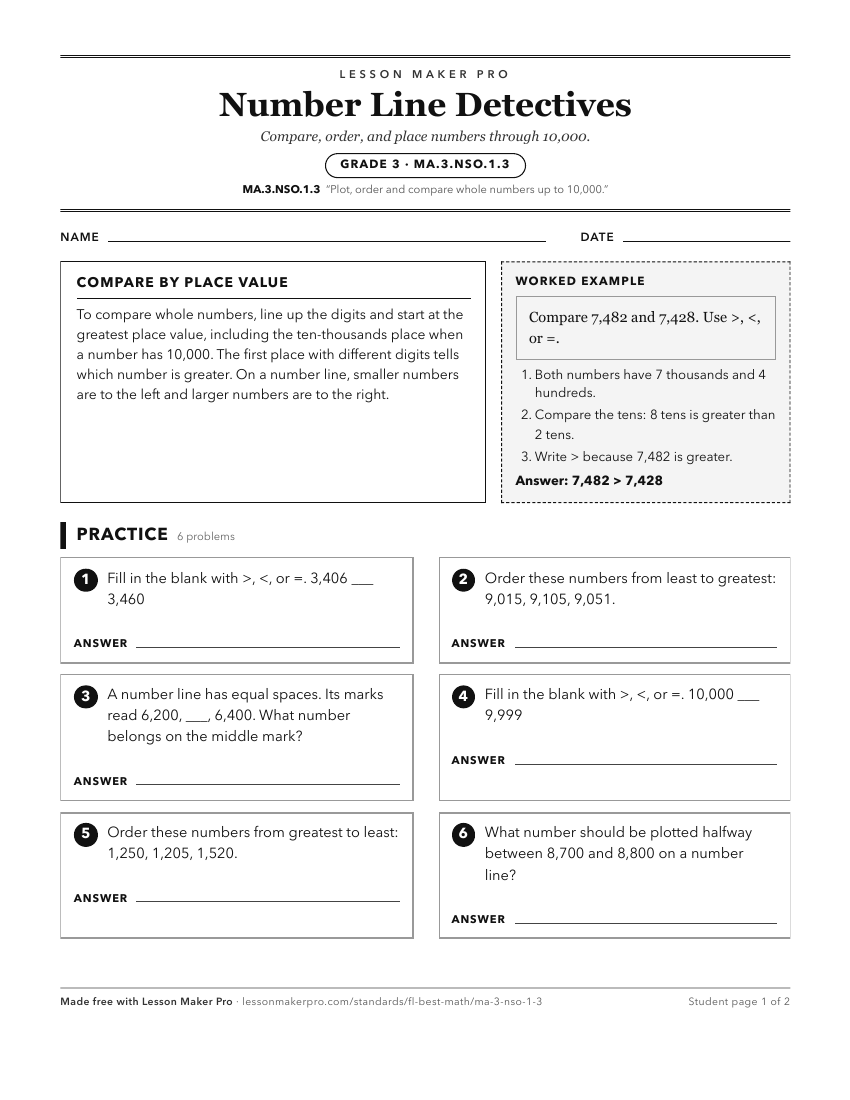
A ready-to-print activity worksheet aligned to MA.3.NSO.1.3, with an answer key for the teacher on its own page. No account needed.
PDF, US Letter, prints cleanly in black and white.
Download the worksheetKeep exploring
Related Standards
Turn this exact standard into a lesson
Grade, subject, topic, and the complete standard are prefilled. Create one free, no account needed.
Also for this standard:Make a WorksheetMake a QuizMake a Sub Lesson