Florida B.E.S.T. MA.2.FR.1.2
The Standard
Partition rectangles into two, three or four equal-sized parts in two different ways showing that equal-sized parts of the same whole may have different shapes.
Florida B.E.S.T. Standards for Mathematics
Teacher's field guide
What This Standard Means
What Students Need to Do
- Students divide a rectangle into halves, thirds, or fourths so every share covers the same amount of space. They make another fair division whose shares look different.
What Mastery Looks Like
- Given matching rectangles, a student can draw more than one fair cutting plan for halves, thirds, or fourths. The student can prove fairness by folding, matching pieces, or counting grid squares.
Common Misconceptions
- Students may think shares from two cutting plans must have the same shape or face the same direction. They may count pieces without checking size, or accept sections that are only nearly equal.
How to Assess It
- Give students two 4-by-8 grid rectangles. Ask them to make four equal shares in each, using different-shaped shares, then explain how the grid proves equality.
Lesson moves
Ways to Teach It
Fold and cut one paper rectangle crosswise; cut an identical rectangle corner to corner, then stack each pair to check equal size.
Show matching rectangles with three vertical strips and three horizontal strips; ask which shares are larger, or whether they are equal, and why.
Play Partition Match by pairing cards that show the same rectangle divided into two, three, or four equal shares using different cuts.
Draw two ways a baker could cut a rectangular pan of brownies into four equal servings, then explain why both plans are fair.
Free download
Printable MA.2.FR.1.2 Worksheet
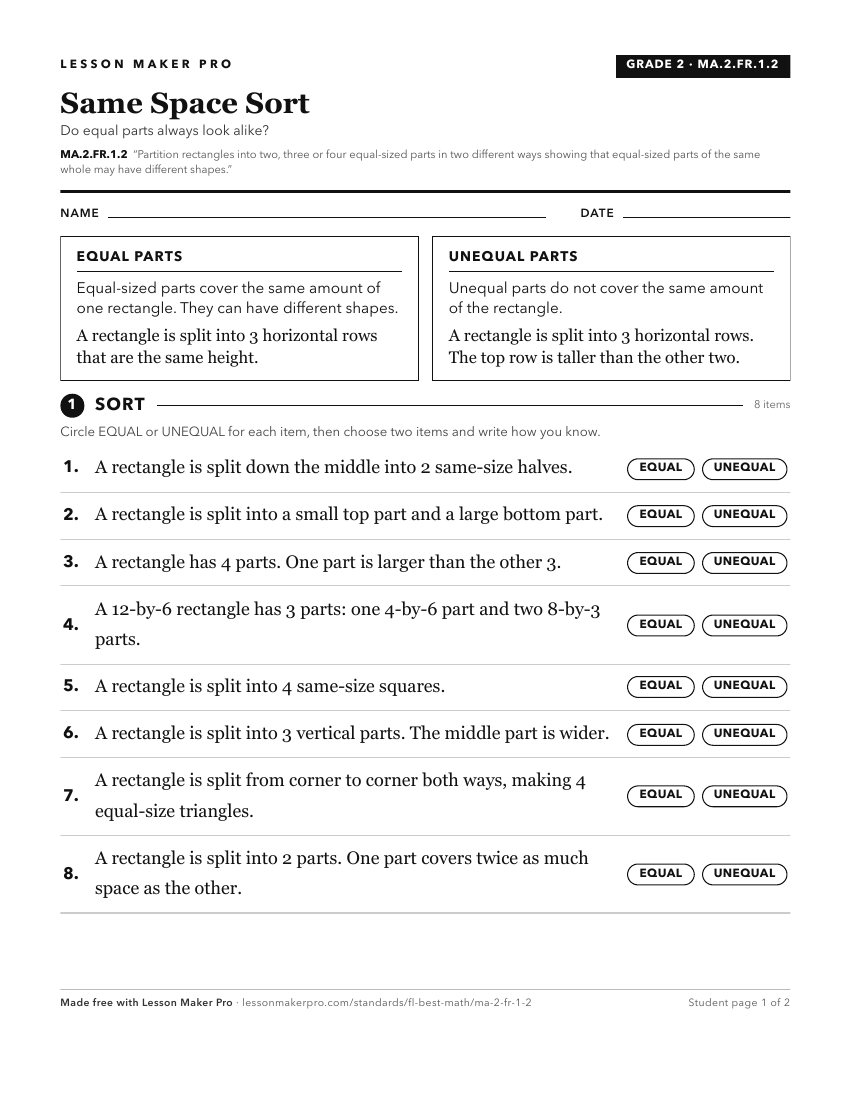
A ready-to-print activity worksheet aligned to MA.2.FR.1.2, with an answer key for the teacher on its own page. No account needed.
PDF, US Letter, prints cleanly in black and white.
Download the worksheetKeep exploring
Related Standards
- MA.1.FR.1.1
Partition circles and rectangles into two and four equal-sized parts. Name the parts of the whole using appropriate language including halves or fourths.
- MA.6.AR.3.3
Extend previous understanding of fractions and numerical patterns to generate or complete a two- or three-column table to display equivalent part-to-part ratios...
- MA.2.FR.1.1
Partition circles and rectangles into two, three or four equal-sized parts. Name the parts using appropriate language, and describe the whole as two halves, thr...
- MA.1.FR.1
Develop an understanding of fractions by partitioning shapes into halves and fourths.
Turn this exact standard into a lesson
Grade, subject, topic, and the complete standard are prefilled. Create one free, no account needed.
Also for this standard:Make a WorksheetMake a QuizMake a Sub Lesson