Florida B.E.S.T. MA.2.FR.1.1
The Standard
Partition circles and rectangles into two, three or four equal-sized parts. Name the parts using appropriate language, and describe the whole as two halves, three thirds or four fourths.
Florida B.E.S.T. Standards for Mathematics
Teacher's field guide
What This Standard Means
What Students Need to Do
- Students split circles and rectangles into two, three, or four equal shares. They name one share as a half, third, or fourth and explain how all shares form one whole.
What Mastery Looks Like
- A student can draw lines that make two, three, or four equal shares in a circle or rectangle. They label each share correctly and state how many make one whole.
Common Misconceptions
- Students may count dividing lines instead of the resulting parts. They may accept unequal shares because the correct number of parts is shown. Some think vertical fourths differ from horizontal fourths.
How to Assess It
- Exit ticket: Divide a rectangle into three equal shares, label each share, and complete, "One whole is made of ___ ___."
Lesson moves
Ways to Teach It
Fold paper circles and rectangles into two, three, or four equal shares, then trace the creases and label each part.
Display one shape with equal thirds and one with unequal sections; ask, "Which can be named thirds, and what proves it?"
Play a card sort with partitioned shapes; place each under halves, thirds, fourths, or not equal and justify the choice.
Draw how to share a rectangular brownie equally among three children, then label each share and explain how they form one whole.
Free download
Printable MA.2.FR.1.1 Worksheet
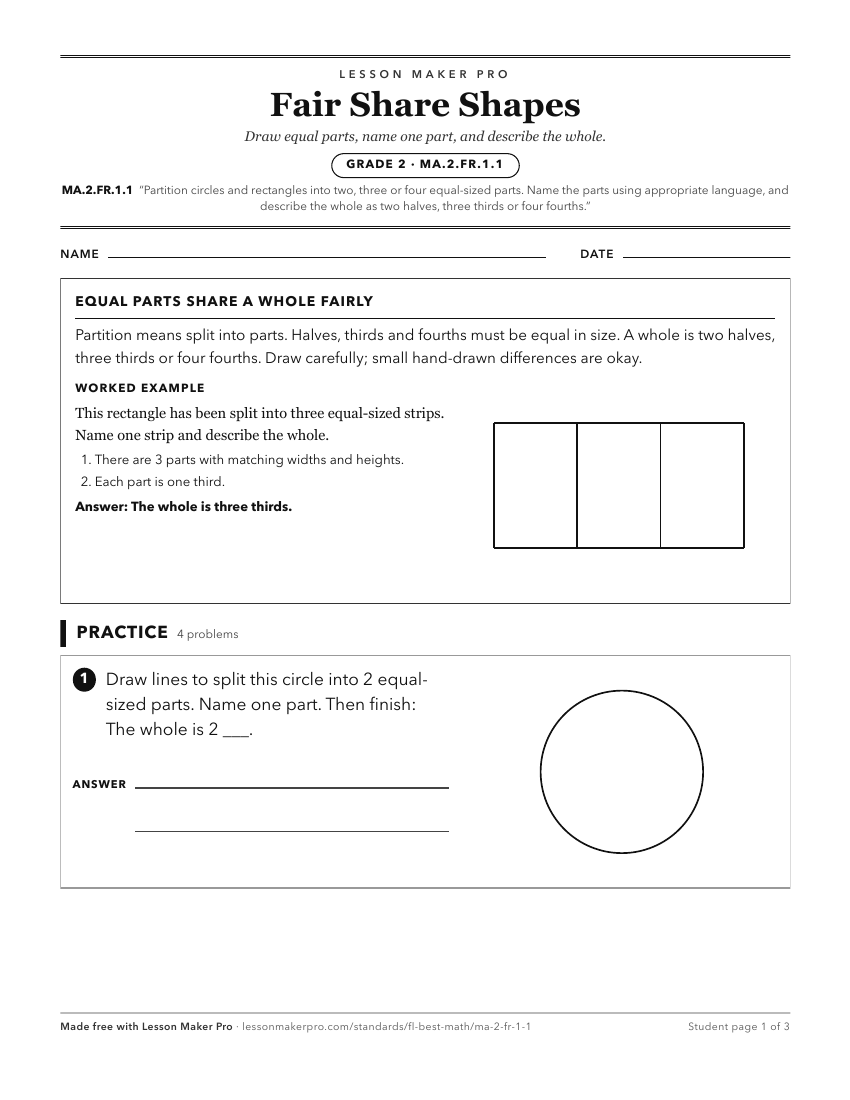
A ready-to-print activity worksheet aligned to MA.2.FR.1.1, with an answer key for the teacher on its own page. No account needed.
PDF, US Letter, prints cleanly in black and white.
Download the worksheetKeep exploring
Related Standards
- MA.1.FR.1.1
Partition circles and rectangles into two and four equal-sized parts. Name the parts of the whole using appropriate language including halves or fourths.
- MA.6.AR.3.3
Extend previous understanding of fractions and numerical patterns to generate or complete a two- or three-column table to display equivalent part-to-part ratios...
- MA.2.FR.1.2
Partition rectangles into two, three or four equal-sized parts in two different ways showing that equal-sized parts of the same whole may have different shapes.
- MA.1.FR.1
Develop an understanding of fractions by partitioning shapes into halves and fourths.
Turn this exact standard into a lesson
Grade, subject, topic, and the complete standard are prefilled. Create one free, no account needed.
Also for this standard:Make a WorksheetMake a QuizMake a Sub Lesson