CCSS.
The Standard
Look for and express regularity in repeated reasoning. Mathematically proficient students notice if calculations are repeated, and look both for general methods and for shortcuts. Upper elementary students might notice when dividing 25 by 11 that they are repeating the same calculations over and over again, and conclude they have a repeating decimal. By paying attention to the calculation of slope as they repeatedly check whether points are on the line through (1, 2) with slope 3, middle school students might abstract the equation ( y - 2)/( x - 1) = 3. Noticing the regularity in the way terms cancel when expanding ( x - 1)( x + 1), ( x - 1)( x² + x + 1), and ( x - 1)( x³ + x² + x + 1) might lead them to the general formula for the sum of a geometric series. As they work to solve a problem, mathematically proficient students maintain oversight of the process, while attending to the details. They continually evaluate the reasonableness of their intermediate results. Connecting the Standards for Mathematical Practice to the Standards for Mathematical Content The Standards for Mathematical Practice describe ways in which developing student practitioners of the discipline of mathematics increasingly ought to engage with the subject matter as they grow in mathematical maturity and expertise throughout the elementary, middle and high school years. Designers of curricula, assessments, and professional development should all attend to the need to connect the mathematical practices to mathematical content in mathematics instruction. The Standards for Mathematical Content are a balanced combination of procedure and understanding. Expectations that begin with the word "understand" are often especially good opportunities to connect the practices to the content. Students who lack understanding of a topic may rely on procedures too heavily. Without a flexible base from which to work, they may be less likely to consider analogous problems, represent problems coherently, justify conclusions, apply the mathematics to practical situations, use technology mindfully to work with the mathematics, explain the mathematics accurately to other students, step back for an overview, or deviate from a known procedure to find a shortcut. In short, a lack of understanding effectively prevents a student from engaging in the mathematical practices. In this respect, those content standards which set an expectation of understanding are potential "points of intersection" between the Standards for Mathematical Content and the Standards for Mathematical Practice. These points of intersection are intended to be weighted toward central and generative concepts in the school mathematics curriculum that most merit the time, resources, innovative energies, and focus necessary to qualitatively improve the curriculum, instruction, assessment, professional development, and student achievement in mathematics.
Common Core State Standards for Mathematics
Teacher's field guide
What This Standard Means
What Students Need to Do
- Students notice when the same calculation, step, or structure appears across several examples. They use that repetition to make predictions, create a rule or shortcut, and check whether results make sense.
What Mastery Looks Like
- Students spot repeated steps across related examples and use them to predict another result. They state a general rule or shortcut, test it, and check that each result is reasonable.
Common Misconceptions
- Students may claim a rule after checking only one or two cases. They may notice a surface pattern but miss the repeated operation, or use a shortcut where it does not apply.
How to Assess It
- Exit ticket: Give three related calculations from today’s lesson. Ask, “What repeats, what can you predict, and what rule works? Test your rule once.”
Lesson moves
Ways to Teach It
Build growing tile designs, record each total in a table, predict stage ten, and explain which repeated change supports the prediction.
Show three related solved problems and ask, “What step repeats, and how could that repetition become a general rule?”
Play Pattern Hunter with cards showing related calculations, awarding points for naming the pattern, predicting the next result, and checking it.
Use a weekly savings table to find the repeated increase, predict a later balance, and write a rule for any week.
Free download
Printable CCSS.Math.Practice.MP8 Worksheet
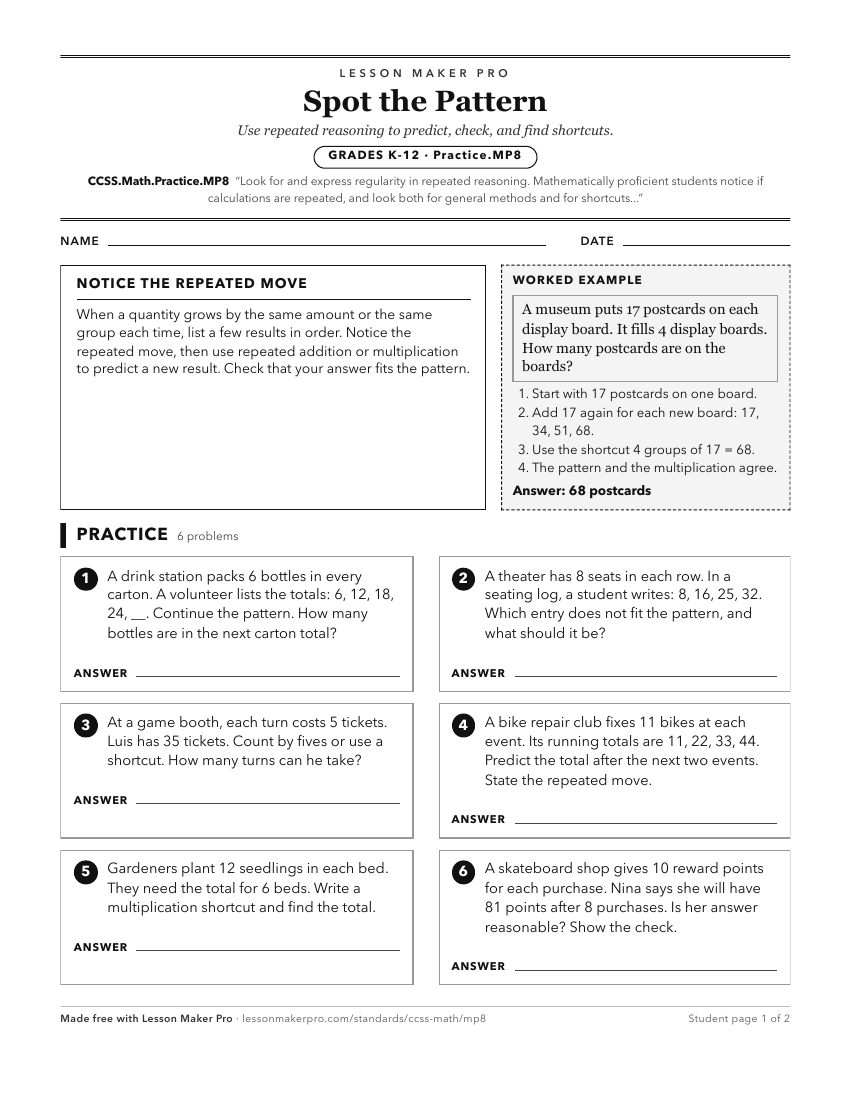
A ready-to-print activity worksheet aligned to CCSS.Math.Practice.MP8, with an answer key for the teacher on its own page. No account needed.
PDF, US Letter, prints cleanly in black and white.
Download the worksheetKeep exploring
Related Standards
- CCSS.Math.Practice.MP7
Look for and make use of structure.
- CCSS.Math.Content.6.RP.A.3
Use ratio and rate reasoning to solve real-world and mathematical problems, e.g., by reasoning about tables of equivalent ratios, tape diagrams, double number l...
- CCSS.Math.Content.HSA-REI.A
Understand solving equations as a process of reasoning and explain the reasoning
- CCSS.Math.Content.6.RP.A
Understand ratio concepts and use ratio reasoning to solve problems.
Turn this exact standard into a lesson
Grade, subject, topic, and the complete standard are prefilled. Create one free, no account needed.
Also for this standard:Make a WorksheetMake a QuizMake a Sub Lesson