CCSS.
The Standard
Look for and make use of structure. Mathematically proficient students look closely to discern a pattern or structure. Young students, for example, might notice that three and seven more is the same amount as seven and three more, or they may sort a collection of shapes according to how many sides the shapes have. Later, students will see 7 × 8 equals the well remembered 7 × 5 + 7 × 3, in preparation for learning about the distributive property. In the expression x² + 9 x + 14, older students can see the 14 as 2 × 7 and the 9 as 2 + 7. They recognize the significance of an existing line in a geometric figure and can use the strategy of drawing an auxiliary line for solving problems. They also can step back for an overview and shift perspective. They can see complicated things, such as some algebraic expressions, as single objects or as being composed of several objects. For example, they can see 5 - 3(x - y) 2 as 5 minus a positive number times a square and use that to realize that its value cannot be more than 5 for any real numbers x and y.
Common Core State Standards for Mathematics
Teacher's field guide
What This Standard Means
What Students Need to Do
- Students notice useful groupings, repeated parts, symmetry, and number relationships. They reorganize an expression, diagram, shape, or data display so the solution becomes easier. They explain which feature they used and why it works.
What Mastery Looks Like
- A student can mark useful chunks, repeated parts, symmetry, or factor pairs in a problem. They can rewrite an expression or add a line to a diagram without changing the mathematics. They use the new view to calculate, solve, or justify an answer.
Common Misconceptions
- Students may spot a visual pattern but not connect it to a calculation or proof. They may assume a pattern continues after checking only one or two cases. They may regroup terms incorrectly across subtraction, division, or exponents.
How to Assess It
- Exit ticket: Give one problem from the lesson. Ask students to mark a useful grouping or repeated part, then use it to solve and explain one step.
Lesson moves
Ways to Teach It
Give students tiles or pattern blocks to build two equivalent arrangements, then label the shared grouping or symmetry.
Post two solution methods and ask, "What structure does each method use, and which makes the work shorter?"
Play Structure Match: students pair expression, diagram, and rewritten form cards, then defend each match to a partner.
Use a grocery receipt or floor plan and have students group repeated costs or dimensions to calculate a total efficiently.
Free download
Printable CCSS.Math.Practice.MP7 Worksheet
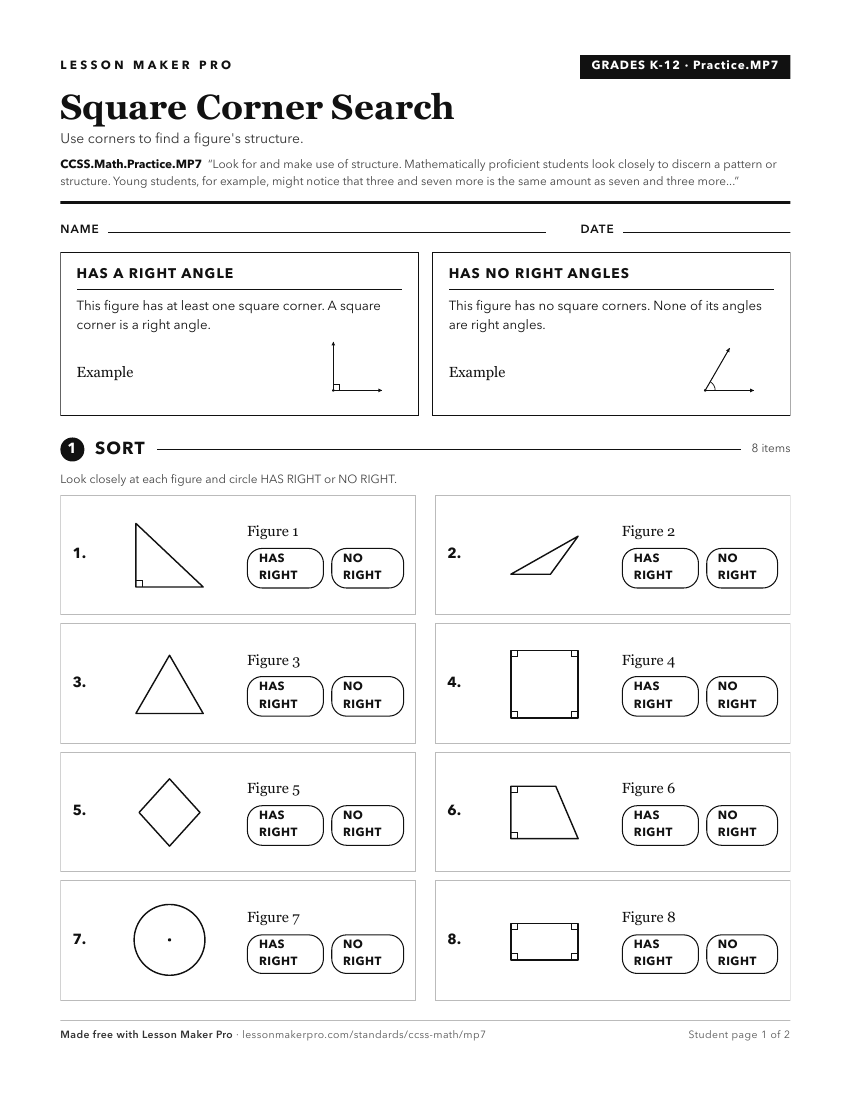
A ready-to-print activity worksheet aligned to CCSS.Math.Practice.MP7, with an answer key for the teacher on its own page. No account needed.
PDF, US Letter, prints cleanly in black and white.
Download the worksheetKeep exploring
Related Standards
Turn this exact standard into a lesson
Grade, subject, topic, and the complete standard are prefilled. Create one free, no account needed.
Also for this standard:Make a WorksheetMake a QuizMake a Sub Lesson