CCSS.
The Standard
Use appropriate tools strategically. Mathematically proficient students consider the available tools when solving a mathematical problem. These tools might include pencil and paper, concrete models, a ruler, a protractor, a calculator, a spreadsheet, a computer algebra system, a statistical package, or dynamic geometry software. Proficient students are sufficiently familiar with tools appropriate for their grade or course to make sound decisions about when each of these tools might be helpful, recognizing both the insight to be gained and their limitations. For example, mathematically proficient high school students analyze graphs of functions and solutions generated using a graphing calculator. They detect possible errors by strategically using estimation and other mathematical knowledge. When making mathematical models, they know that technology can enable them to visualize the results of varying assumptions, explore consequences, and compare predictions with data. Mathematically proficient students at various grade levels are able to identify relevant external mathematical resources, such as digital content located on a website, and use them to pose or solve problems. They are able to use technological tools to explore and deepen their understanding of concepts.
Common Core State Standards for Mathematics
Teacher's field guide
What This Standard Means
What Students Need to Do
- Students choose from tools such as models, measuring devices, graphs, calculators, and software based on the problem. They use the chosen tool correctly and check its output with estimation or another method.
What Mastery Looks Like
- Students select a tool that fits the problem and explain why it helps. They use it accurately, notice its limits, and check whether the result makes sense.
Common Misconceptions
- Students may choose the fastest or most familiar tool, even when it does not fit the problem. They may trust calculator or software output without checking entries, units, scale, or reasonableness.
How to Assess It
- Use this exit ticket: “A garden is 8.5 m by 3.2 m. Find its area, name your tool, explain your choice, and check the result another way.”
Lesson moves
Ways to Teach It
Measure a curved classroom object using a ruler, string, and measuring tape, then compare which tool gives the most useful result.
Show a calculator answer that conflicts with an estimate, then ask students to write which result they trust and why.
Play Tool Match: teams pair problem cards with tool cards, earning points for each sound choice and explanation.
Use grocery ads to compare unit prices with a calculator or spreadsheet, then check each result by rounding.
Free download
Printable CCSS.Math.Practice.MP5 Worksheet
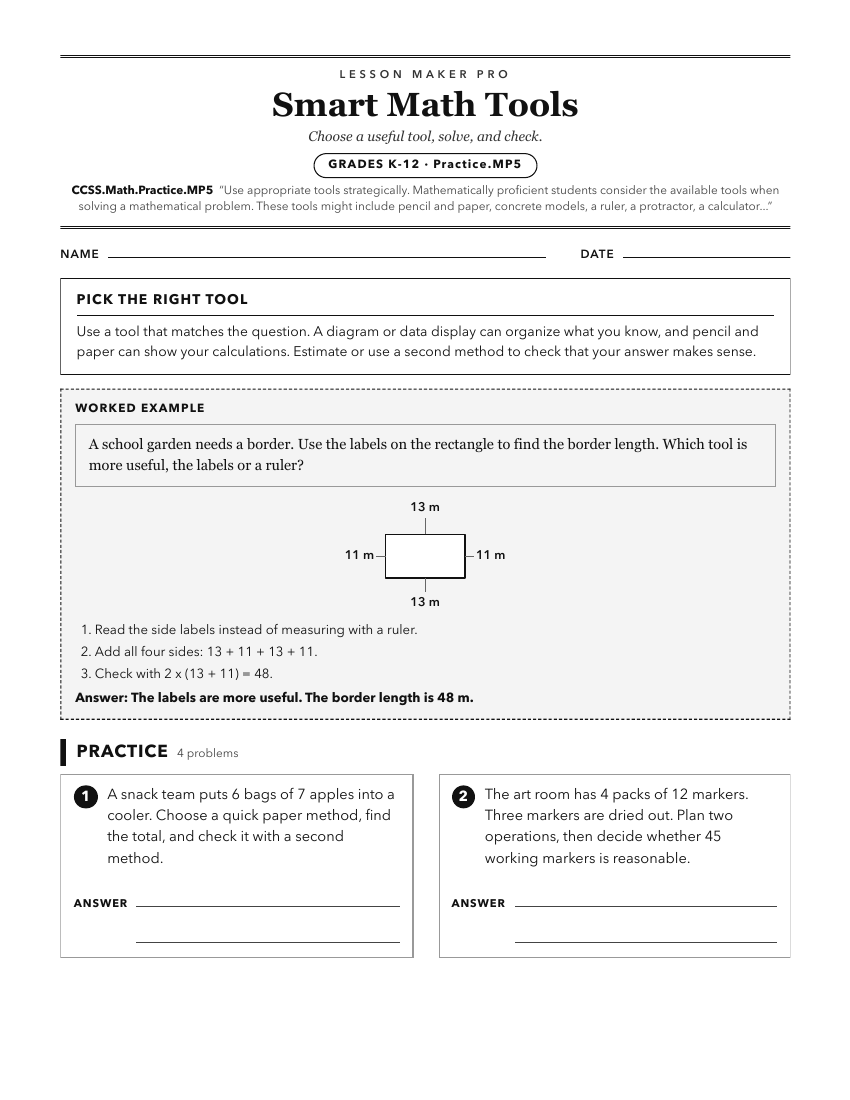
A ready-to-print activity worksheet aligned to CCSS.Math.Practice.MP5, with an answer key for the teacher on its own page. No account needed.
PDF, US Letter, prints cleanly in black and white.
Download the worksheetKeep exploring
Related Standards
- CCSS.Math.Practice.MP7
Look for and make use of structure.
- CCSS.Math.Practice.MP6
Attend to precision.
- CCSS.Math.Content.HSS-MD.B.5b
Evaluate and compare strategies on the basis of expected values.
- CCSS.Math.Content.2.MD.A.1
Measure the length of an object by selecting and using appropriate tools such as rulers, yardsticks, meter sticks, and measuring tapes.
Turn this exact standard into a lesson
Grade, subject, topic, and the complete standard are prefilled. Create one free, no account needed.
Also for this standard:Make a WorksheetMake a QuizMake a Sub Lesson