CCSS.
The Standard
Find all factor pairs for a whole number in the range 1—100. Recognize that a whole number is a multiple of each of its factors. Determine whether a given whole number in the range 1—100 is a multiple of a given one-digit number. Determine whether a given whole number in the range 1—100 is prime or composite.
Common Core State Standards for Mathematics · Operations and Algebraic Thinking
Teacher's field guide
What This Standard Means
What Students Need to Do
- Students find all pairs of whole numbers that multiply to make a number from 1 through 100. They identify multiples of one-digit numbers and decide whether numbers are prime, composite, or neither.
What Mastery Looks Like
- Students find every factor pair for any number through 100 without duplicates or omissions. They use those pairs to identify multiples and correctly classify numbers as prime or composite, including 1 as neither.
Common Misconceptions
- Students may list only one factor pair, reverse pairs as new pairs, or forget 1 and the number itself. They may think all odd numbers are prime, that 1 is prime, or confuse factors with multiples.
How to Assess It
- Give students the number 36. Ask them to list every factor pair, name two one-digit numbers for which 36 is a multiple, and classify 36 as prime or composite.
Lesson moves
Ways to Teach It
Give students 24 counters and have them build every possible rectangular array, recording each array as a factor pair.
Ask students to explain why 29 is prime and 30 is composite using factor pairs as evidence.
Play Factor Pair Match with number cards and factor-pair cards, having students match each number to all of its pairs.
Use equal rows of 36 chairs to decide which row sizes work, then connect each arrangement to factors and multiples.
Free download
Printable 4.OA.B.4 Worksheet
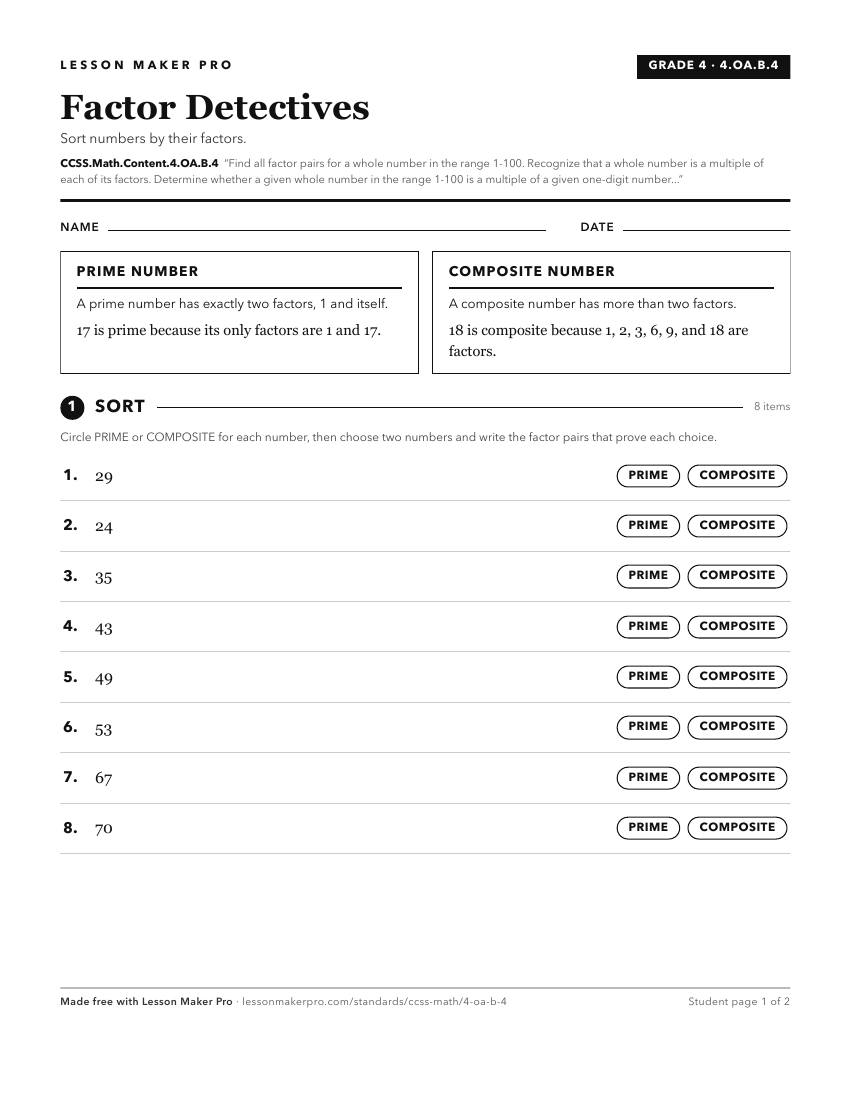
A ready-to-print activity worksheet aligned to CCSS.Math.Content.4.OA.B.4, with an answer key for the teacher on its own page. No account needed.
PDF, US Letter, prints cleanly in black and white.
Download the worksheetLearning progression
Where This Standard Sits
See the whole path on the Operations & Algebraic Thinking progression map.
Before This Standard
If students are struggling here, check these first.
- CCSS.Math.Content.3.OA.B.6
Seeing division as a missing factor helps students find factor pairs and test whether one number is a multiple of another.
- CCSS.Math.Content.3.OA.C.7
Multiplication and division fact fluency helps students test factor pairs, identify multiples, and distinguish prime from composite numbers within 100.
- CCSS.Math.Content.3.OA.A.1
Factor pairs, multiples, and composites depend on understanding multiplication as equal groups making a total product.
What This Unlocks
Mastery here sets students up for these next.
- CCSS.Math.Content.6.NS.B.4
Students use factor pairs and multiples to identify greatest common factors, least common multiples, and factor sums by common factors.
- CCSS.Math.Content.5.NF.A.1
Knowing factors and multiples helps students choose common denominators and make equivalent fractions for adding unlike denominators.
Keep exploring
Related Standards
- CCSS.Math.Content.5.NBT.B.6
Find whole-number quotients of whole numbers with up to four-digit dividends and two-digit divisors, using strategies based on place value, the properties of op...
- CCSS.Math.Content.6.NS.B
Compute fluently with multi-digit numbers and find common factors and multiples.
- CCSS.Math.Content.3.NBT.A.3
Multiply one-digit whole numbers by multiples of 10 in the range 10—90 (e.g., 9 × 80, 5 × 60) using strategies based on place value and properties of operations...
Turn this exact standard into a lesson
Grade, subject, topic, and the complete standard are prefilled. Create one free, no account needed.
Also for this standard:Make a WorksheetMake a QuizMake a Sub Lesson