CCSS.
The Standard
Apply properties of operations as strategies to multiply and divide.
Common Core State Standards for Mathematics · Operations and Algebraic Thinking
Teacher's field guide
What This Standard Means
What Students Need to Do
- Students use known multiplication facts to solve unfamiliar multiplication and division problems. They switch factor order, regroup three factors, or split one factor into easier parts and combine the partial products.
What Mastery Looks Like
- Students solve facts such as 7 × 8 by using known facts, such as 7 × 5 and 7 × 3. They record correct equations and explain why rearranging, regrouping, or splitting factors keeps the product equal.
Common Misconceptions
- Students may think switching numbers works for division because it works for multiplication. They may split 8 × 7 into 8 × 5 + 2 instead of 8 × 5 + 8 × 2.
How to Assess It
- Ask students to solve 8 × 7 by breaking apart 7, then use that result to solve 56 ÷ 8. Require equations for both steps.
Lesson moves
Ways to Teach It
Build a 6 by 8 tile array, rotate it, split it into 6 by 5 and 6 by 3, then record equations.
Compare (3 × 4) × 2 and 3 × (4 × 2), then explain in writing why both calculations give the same product.
Play Factor Flex by drawing three factor cards and finding two ways to group or reorder them for easier multiplication.
Solve a packing problem with seven boxes of eight markers by splitting eight into five and three, then connect the total to division.
Free download
Printable 3.OA.B.5 Worksheet
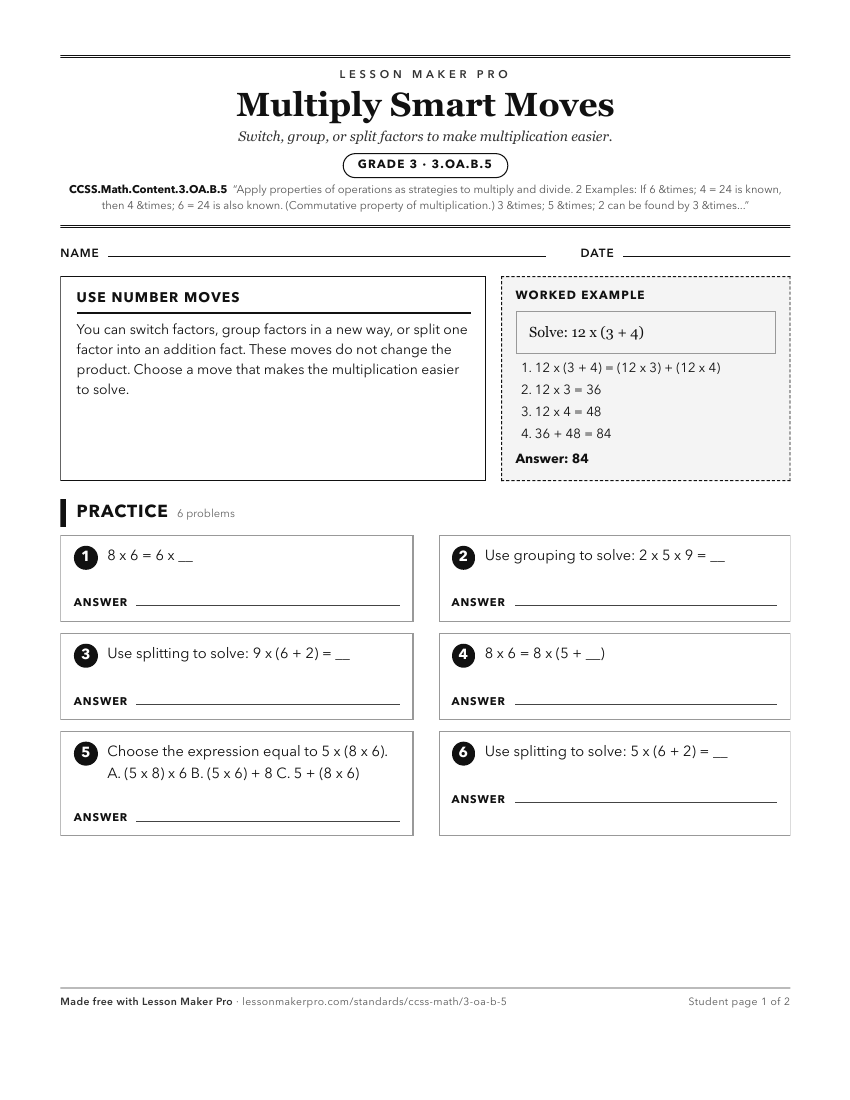
A ready-to-print activity worksheet aligned to CCSS.Math.Content.3.OA.B.5, with an answer key for the teacher on its own page. No account needed.
PDF, US Letter, prints cleanly in black and white.
Download the worksheetLearning progression
Where This Standard Sits
See the whole path on the Operations & Algebraic Thinking progression map.
Before This Standard
If students are struggling here, check these first.
- CCSS.Math.Content.3.OA.A.1
Understanding multiplication as equal groups gives meaning to changing factors and breaking products apart with operation properties.
- CCSS.Math.Content.3.OA.A.2
Understanding quotients as equal groups supports using multiplication and division properties to reason about unknown factors and related division facts.
- CCSS.Math.Content.1.OA.B.3
Using commutative and associative properties with addition prepares students to recognize and use the same structure in multiplication.
What This Unlocks
Mastery here sets students up for these next.
- CCSS.Math.Content.3.OA.D.9
Using commutative, associative, and distributive properties helps students explain why multiplication table patterns occur, not just notice them.
- CCSS.Math.Content.3.NBT.A.3
Using commutative and associative properties helps rewrite 9 × 80 as 9 × 8 × 10 for place value multiplication.
Keep exploring
Related Standards
- CCSS.Math.Content.7.EE.A.1
Apply properties of operations as strategies to add, subtract, factor, and expand linear expressions with rational coefficients.
- CCSS.Math.Content.7.NS.A.1d
Apply properties of operations as strategies to add and subtract rational numbers.
- CCSS.Math.Content.7.NS.A.2c
Apply properties of operations as strategies to multiply and divide rational numbers.
Turn this exact standard into a lesson
Grade, subject, topic, and the complete standard are prefilled. Create one free, no account needed.
Also for this standard:Make a WorksheetMake a QuizMake a Sub Lesson