CCSS.
The Standard
Apply properties of operations as strategies to add and subtract.
Common Core State Standards for Mathematics · Operations and Algebraic Thinking
Teacher's field guide
What This Standard Means
What Students Need to Do
- Students change the order or grouping of addends to make problems easier. They use known facts, including turnarounds and make-ten pairs, instead of counting every object.
What Mastery Looks Like
- A student can rewrite 3 + 8 as 8 + 3 and use a known fact to get 11. For 2 + 6 + 4, the student groups 6 + 4, makes 10, and gets 12. The student does not reverse numbers in subtraction.
Common Misconceptions
- Students may think changing the addend order changes the total. They may regroup by changing a number, such as turning 2 + 6 + 4 into 2 + 10 incorrectly. Some also try to reverse numbers in subtraction as they do in addition.
How to Assess It
- Exit ticket: Solve 3 + 7 + 4. Show a rewrite that makes the work easier, then explain why the total stays the same.
Lesson moves
Ways to Teach It
Build 6 + 4 + 3 with counters, then physically group 6 and 4 to make ten before finding the total.
Ask, "How can knowing 2 + 7 help you solve 7 + 2?" Have students draw and explain their thinking.
Play Make Ten Match: students pair number cards within three-addend expressions, then rewrite each expression with an easier grouping.
Use snack bags holding 3, 7, and 2 crackers; students choose which bags to combine first and explain their choice.
Free download
Printable 1.OA.B.3 Worksheet
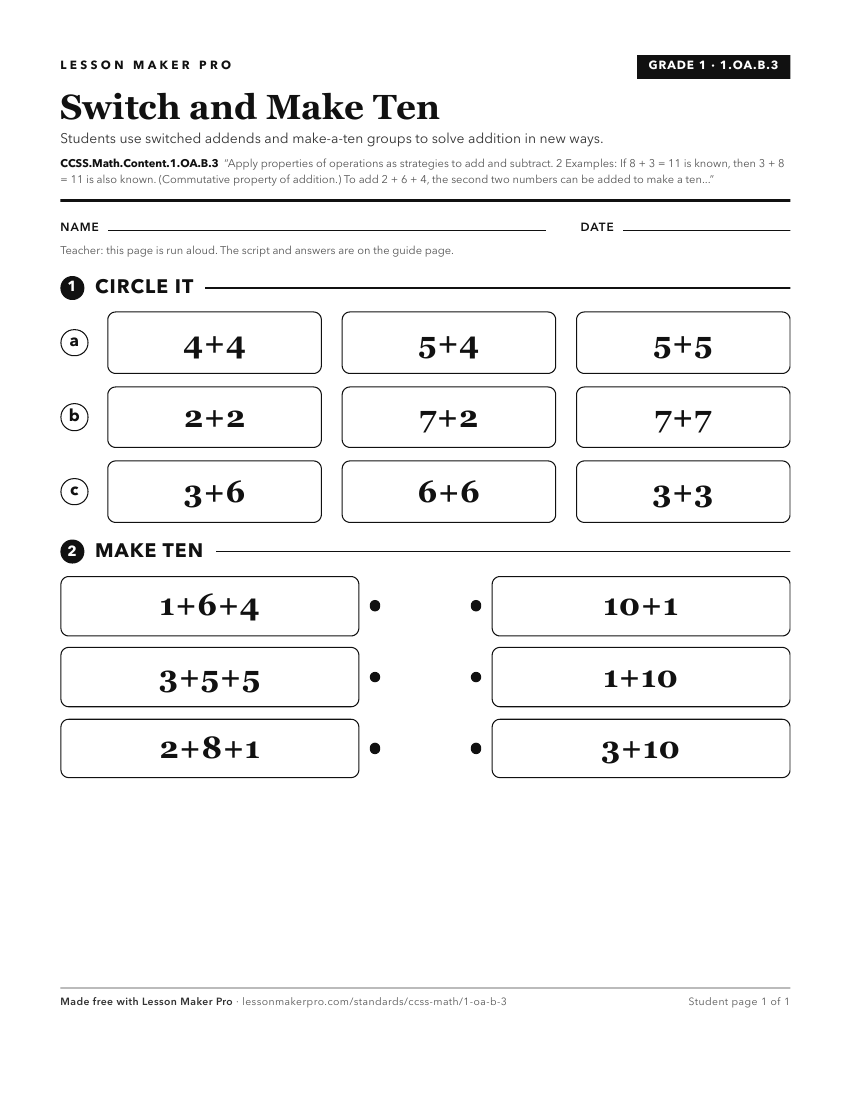
A ready-to-print activity worksheet aligned to CCSS.Math.Content.1.OA.B.3, with an answer key for the teacher on its own page. No account needed.
PDF, US Letter, prints cleanly in black and white.
Download the worksheetLearning progression
Where This Standard Sits
See the whole path on the Operations & Algebraic Thinking progression map.
Before This Standard
If students are struggling here, check these first.
- CCSS.Math.Content.K.OA.A.1
Representing addition and subtraction gives students concrete operation meanings they can rearrange when using commutative and associative strategies.
- CCSS.Math.Content.K.OA.A.5
Fluency with tiny sums and differences gives students known facts to test and use commutative and associative strategies.
- CCSS.Math.Content.K.OA.A.3
Decomposing numbers into pairs supports seeing addends as parts that can be rearranged or grouped in addition strategies.
What This Unlocks
Mastery here sets students up for these next.
- CCSS.Math.Content.2.NBT.B.9
Using commutative and associative properties for basic operations supports explaining why multi-digit addition and subtraction strategies work.
- CCSS.Math.Content.3.OA.B.5
Using commutative and associative properties with addition prepares students to recognize and use the same structure in multiplication.
Keep exploring
Related Standards
- CCSS.Math.Content.7.EE.A.1
Apply properties of operations as strategies to add, subtract, factor, and expand linear expressions with rational coefficients.
- CCSS.Math.Content.7.NS.A.1d
Apply properties of operations as strategies to add and subtract rational numbers.
- CCSS.Math.Content.7.NS.A.2c
Apply properties of operations as strategies to multiply and divide rational numbers.
Turn this exact standard into a lesson
Grade, subject, topic, and the complete standard are prefilled. Create one free, no account needed.
Also for this standard:Make a WorksheetMake a QuizMake a Sub Lesson