CCSS.
The Standard
Identify arithmetic patterns (including patterns in the addition table or multiplication table), and explain them using properties of operations.
Common Core State Standards for Mathematics · Operations and Algebraic Thinking
Teacher's field guide
What This Standard Means
What Students Need to Do
- Students find relationships that repeat across addition and multiplication facts. They describe each relationship and justify why it continues by using arrays, equal groups, or operation properties.
What Mastery Looks Like
- A student can spot that reversed factor pairs have the same product or that each entry in a row increases by a fixed amount. The student uses an array, equal groups, or an operation property to explain why the pattern continues.
Common Misconceptions
- Students may call any sequence a pattern without stating its rule. They may give the wrong amount of change or assume a pattern continues after checking only two facts. Some think switching the factors changes the product.
How to Assess It
- Exit ticket: Compare 3 × 7 with 7 × 3 and 4 × 6 with 6 × 4. State the pattern, then use an array or the commutative property to explain why it works.
Lesson moves
Ways to Teach It
Build arrays with tiles for 3 × 4 and 4 × 3, rotate them, and record what stays the same.
Writing prompt: Explain why products in the 2s row stay even, using pairs, drawings, and the distributive property.
Play Pattern Detective by covering five cells in a multiplication chart and having pairs predict each number and explain the row or column rule.
Plan chair rows for 24 guests, compare 3 rows of 8 with 8 rows of 3, and explain the matching totals.
Free download
Printable 3.OA.D.9 Worksheet
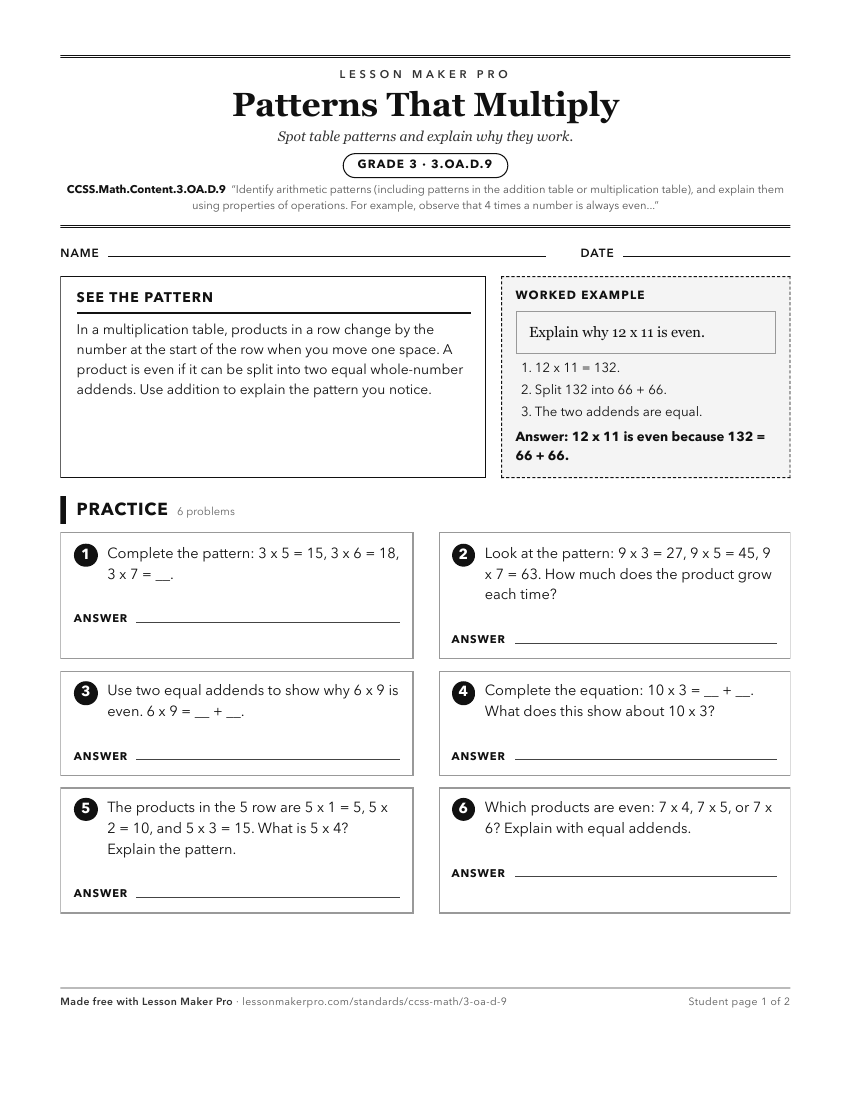
A ready-to-print activity worksheet aligned to CCSS.Math.Content.3.OA.D.9, with an answer key for the teacher on its own page. No account needed.
PDF, US Letter, prints cleanly in black and white.
Download the worksheetLearning progression
Where This Standard Sits
See the whole path on the Operations & Algebraic Thinking progression map.
Before This Standard
If students are struggling here, check these first.
- CCSS.Math.Content.3.OA.B.5
Using commutative, associative, and distributive properties helps students explain why multiplication table patterns occur, not just notice them.
- CCSS.Math.Content.3.OA.A.1
Understanding products as equal groups supports seeing and explaining multiplication table patterns like skip-counting and repeated addition.
- CCSS.Math.Content.2.NBT.A.2
Skip-counting gives students experience with regular number sequences that supports noticing rows, columns, and multiples in operation tables.
What This Unlocks
Mastery here sets students up for these next.
Keep exploring
Related Standards
- CCSS.Math.Content.1.OA.B
Understand and apply properties of operations and the relationship between addition and subtraction.
- CCSS.Math.Content.6.EE.A
Apply and extend previous understandings of arithmetic to algebraic expressions.
- CCSS.Math.Content.3.MD.C.7
Relate area to the operations of multiplication and addition.
- CCSS.Math.Content.3.OA.D
Solve problems involving the four operations, and identify and explain patterns in arithmetic.
Turn this exact standard into a lesson
Grade, subject, topic, and the complete standard are prefilled. Create one free, no account needed.
Also for this standard:Make a WorksheetMake a QuizMake a Sub Lesson