Alabama Social Studies SS24.WH.9
Standard Cluster
Summarize the conditions of the global Great Depression and explain how they led to the rise of totalitarian states and the weakening of democratic nations. 9a Describe how Joseph Stalin sought to consolidate his own rule and strengthen socialism in the Soviet Union from 1927 to 1939. 9b Trace Adolf Hitler’s rise to power, describing Nazi ideology and the use of propaganda to advance his political and racial goals. 9c Analyze the rise of militarism in Germany, Italy, and Japan in the 1930s and explain how it led to war.
2024 Alabama Course of Study: Social Studies
Cluster contents
Standards in This Cluster
SS24.WH.9 is a cluster heading. These are the individual standards under it.
- SS24.WH.9a
Describe how Joseph Stalin sought to consolidate his own rule and strengthen socialism in the Soviet Union from 1927 to 1939.
- SS24.WH.9b
Trace Adolf Hitler’s rise to power, describing Nazi ideology and the use of propaganda to advance his political and racial goals.
- SS24.WH.9c
Analyze the rise of militarism in Germany, Italy, and Japan in the 1930s and explain how it led to war.
Teacher's field guide
What This Cluster Means
What Students Need to Do
- Students connect mass unemployment and falling trade to weakened democratic governments. They explain Stalin’s Five-Year Plans and purges, and Hitler’s rise through elections, propaganda, and racist ideology. They trace how military expansion by Germany, Italy, and Japan led to war.
What Mastery Looks Like
- Students explain how forced collectivization and purges increased Stalin’s control while causing suffering. They show how Hitler used economic anger and propaganda to gain support and target Jews. They connect the invasions of Ethiopia, China, and Poland to the spread of war.
Common Misconceptions
- Students may think the Depression affected only the United States. They may think Hitler won an outright majority in a free election, or that Soviet industrial growth helped everyone. They may blame Germany alone for war, overlooking Italian and Japanese invasions.
How to Assess It
- Give students four events: Soviet purges, the Nazi Enabling Act, Italy’s invasion of Ethiopia, and Japan’s invasion of China. Have them sort the events into control at home or expansion abroad, then explain one way economic hardship weakened democracy.
Lesson moves
Ways to Teach It
Have pairs arrange dated cards for bank failures, Stalin’s purges, Hitler’s appointment, and invasions of Ethiopia, China, and Poland on a desk timeline.
Show a translated Nazi election poster and ask: What problem does it name, and how does it present Hitler as the answer?
Play a card sort: students match purges, forced collectivization, the Enabling Act, and foreign invasions to leaders and intended goals.
Write U.S. unemployment rates for 1933, about 25%, and April 2020, 14.7%, on the board; ask why joblessness can shake trust in government.
Free download
Printable SS24.WH.9 Worksheet
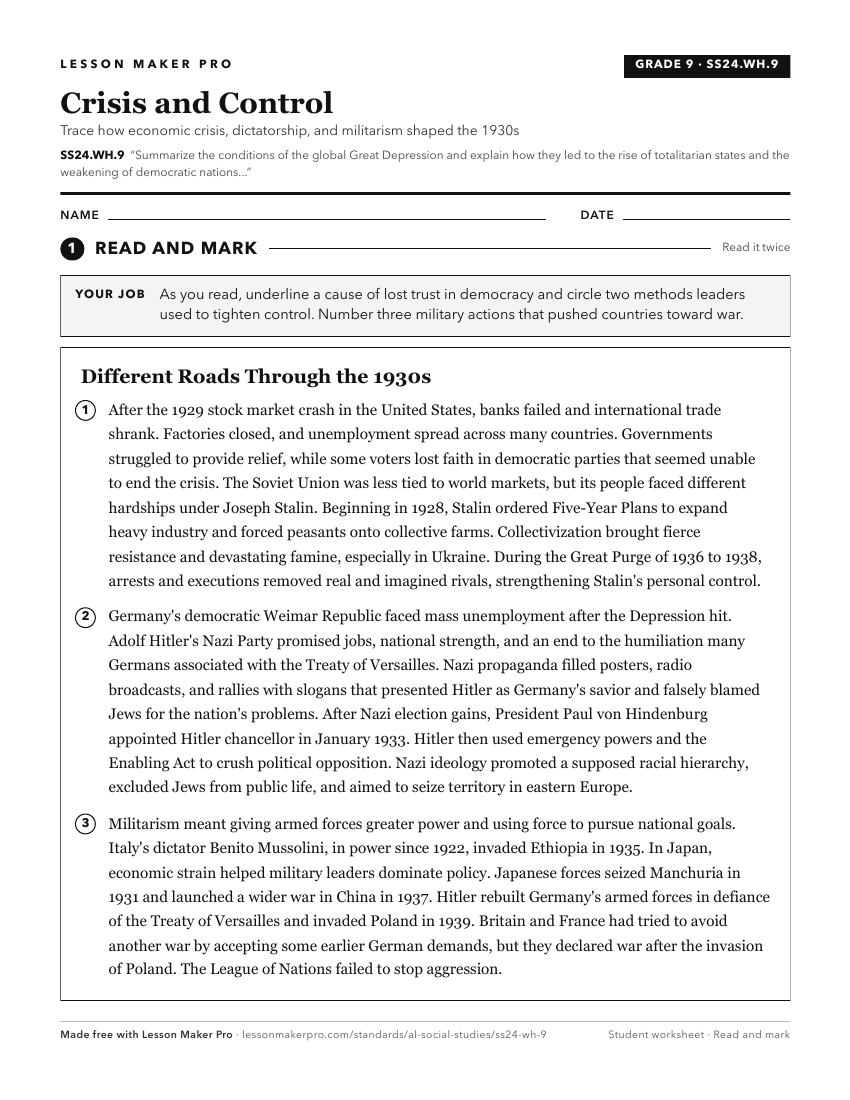
A ready-to-print activity worksheet aligned to SS24.WH.9, with an answer key for the teacher on its own page. No account needed.
PDF, US Letter, prints cleanly in black and white.
Download the worksheetKeep exploring
Related Standards
- SS24.WH.10
Evaluate the economic, global, political, and social consequences of World War II.
- SS24.5.9a
Compare totalitarianism and democracy as represented in the Axis and Allied powers prior to war in Europe.
- SS24.US2.4
Analyze the causes of the Great Depression, including the effects of overproduction, stock market speculation, buying on credit, international trade policy, and...
- SS24.HOS.4
Outline the historical events that allowed for the breakdown of democracy in Germany from 1929 to 1939.*
Turn this cluster into a lesson
Grade, subject, topic, and the complete cluster are prefilled. Create one free, no account needed.
Also for this cluster:Make a WorksheetMake a QuizMake a Sub Lesson