Alabama Social Studies SS24.WH.16
Standard Cluster
Analyze the causes and effects of both regional and internal conflicts in the late twentieth and early twenty-first centuries. 16a Critique the response of the world community to mass atrocities and violations of human rights and civil liberties in various nations and regions. 16b Trace the origin of the Arab-Israeli conflict following the establishment of the State of Israel and explain its impact on the global community. 16c Evaluate the causes of terrorist movements from the 1970s into the 2000s, including the September 11 attacks, and government responses to them. 16d Assess the consequences of modern conflicts on populations, including famine, refugee crises, and the use of child soldiers. 16e Describe the influence of internal conflict, nationalism, and factional enmity in various nations and regions.
2024 Alabama Course of Study: Social Studies
Cluster contents
Standards in This Cluster
SS24.WH.16 is a cluster heading. These are the individual standards under it.
- SS24.WH.16a
Critique the response of the world community to mass atrocities and violations of human rights and civil liberties in various nations and regions.
- SS24.WH.16b
Trace the origin of the Arab-Israeli conflict following the establishment of the State of Israel and explain its impact on the global community.
- SS24.WH.16c
Evaluate the causes of terrorist movements from the 1970s into the 2000s, including the September 11 attacks, and government responses to them.
- SS24.WH.16d
Assess the consequences of modern conflicts on populations, including famine, refugee crises, and the use of child soldiers.
- SS24.WH.16e
Describe the influence of internal conflict, nationalism, and factional enmity in various nations and regions.
Teacher's field guide
What This Cluster Means
What Students Need to Do
- Students explain how nationalism, rival factions, and competing land claims caused conflicts within and between countries. They trace the Arab-Israeli conflict from Israel's founding and examine terrorist movements from the 1970s through 9/11. They assess responses to atrocities and terrorism, and explain how conflicts led to displacement, famine, and child recruitment.
What Mastery Looks Like
- Using maps and dates, a student explains how the 1947 partition proposal, Israel's founding, and the 1948 war affected Palestinians, Israelis, and other countries. They link nationalism or factional rivalry to a civil war's effects on civilians. They compare motives behind two terrorist groups and use evidence to judge a response to violence, including its effect on civil liberties.
Common Misconceptions
- Students may think the Arab-Israeli conflict began in 1948, overlooking earlier competing national movements and British rule. They may assume all terrorist groups have the same motives or that security laws have no cost to civil liberties. They may mistake a UN condemnation for effective protection, or think famine and displacement happen only in wars between countries.
How to Assess It
- Give students a short timeline of the 1994 Rwanda genocide that includes the UN troop reduction and refugee flight. Ask: What fueled the violence, what happened to civilians, and how effective was the international response? Cite two timeline details.
Lesson moves
Ways to Teach It
Give pairs a 1947 partition map, a 1949 armistice map, and refugee figures; have them mark changes and write two effects on civilians.
Ask students: Did the United Nations' 1994 response to the Rwanda genocide protect civilians? Support your answer with two facts from a timeline.
Give groups six source cards on al-Qaeda, 9/11, and the Patriot Act; sort them into motives, actions, and government responses.
Use a current UNHCR refugee fact sheet to plan a 24-hour supply list for a family fleeing conflict, then explain two choices.
Free download
Printable SS24.WH.16 Worksheet
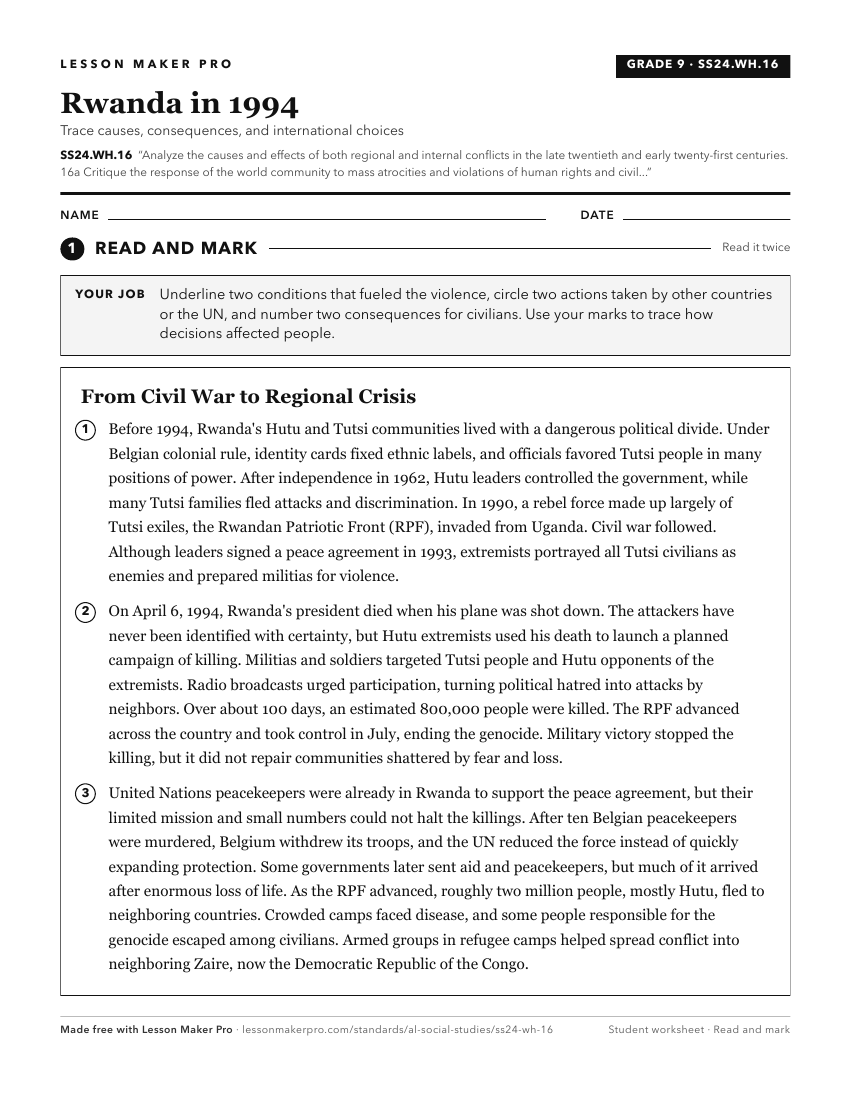
A ready-to-print activity worksheet aligned to SS24.WH.16, with an answer key for the teacher on its own page. No account needed.
PDF, US Letter, prints cleanly in black and white.
Download the worksheetKeep exploring
Related Standards
- SS24.CWI.7
Outline the causes and progressions of current conflicts around the world, including interstate, intrastate, and extrastate conflicts.
- SS24.US2.18
Analyze the shifts in United States foreign policy and challenges to it after the Cold War and into the twenty-first century.
- SS24.HOS.22a
Analyze the causes and effects of modern-day genocides, and identify the groups involved.
Turn this cluster into a lesson
Grade, subject, topic, and the complete cluster are prefilled. Create one free, no account needed.
Also for this cluster:Make a WorksheetMake a QuizMake a Sub Lesson