Alabama Social Studies SS24.USG.7
Standard Cluster
Analyze how the expansion of suffrage affected the political system of the United States, including the enfranchisement of non-property owners, women, Black Americans, and persons 18 to 20 years of age. 7a Explain how increases and shifts in political participation by minorities and other voting blocs shape political party coalitions, campaigns, and voter turnout. 7b Describe how Black Codes, Jim Crow laws, and the Selma-to-Montgomery March influenced the passage of the Voting Rights Act of 1965. 7c Analyze historic and current barriers to voting access and voter turnout, and weigh the benefits and consequences of possible solutions.
2024 Alabama Course of Study: Social Studies
Cluster contents
Standards in This Cluster
SS24.USG.7 is a cluster heading. These are the individual standards under it.
- SS24.USG.7a
Explain how increases and shifts in political participation by minorities and other voting blocs shape political party coalitions, campaigns, and voter turnout.
- SS24.USG.7b
Describe how Black Codes, Jim Crow laws, and the Selma-to-Montgomery March influenced the passage of the Voting Rights Act of 1965.
- SS24.USG.7c
Analyze historic and current barriers to voting access and voter turnout, and weigh the benefits and consequences of possible solutions.
Teacher's field guide
What This Cluster Means
What Students Need to Do
- Students trace when property rules ended and when women, Black Americans, and 18- to 20-year-olds gained voting rights. They explain how new voting blocs can change turnout, party coalitions, and campaigns. They connect Black Codes, Jim Crow voting restrictions, and the Selma march to the 1965 Voting Rights Act, then weigh current barriers and possible fixes.
What Mastery Looks Like
- A student can place voting expansions on a timeline and explain why a legal right did not always mean access to the ballot. They can use turnout figures to explain a change in a party's outreach and connect Selma to federal voting protections. They can weigh the access gained from longer voting hours against the cost of staffing them.
Common Misconceptions
- Some students think the Fifteenth Amendment let Black Americans vote without interference. Others treat Black Codes and later Jim Crow voting restrictions as identical laws. They may also assume that gaining the right to vote means everyone eligible will turn out.
How to Assess It
- Ask students to write four sentences: Why did Selma increase pressure for the 1965 Voting Rights Act, and how might removing one voting barrier change turnout and a party's campaign?
Lesson moves
Ways to Teach It
Hand pairs voter cards for landless white men, Black men, Black women, and 18-year-olds; have them mark voting rights and barriers on a dated timeline.
Ask students to write three sentences linking Black Codes, Jim Crow voting restrictions, the Selma march, and passage of the 1965 Voting Rights Act.
Give teams turnout figures by age and race; award points for a coalition prediction and a campaign message backed by one figure.
Have students check the state election website for registration deadlines and polling places, then name one barrier and weigh a fix's benefit and cost.
Free download
Printable SS24.USG.7 Worksheet
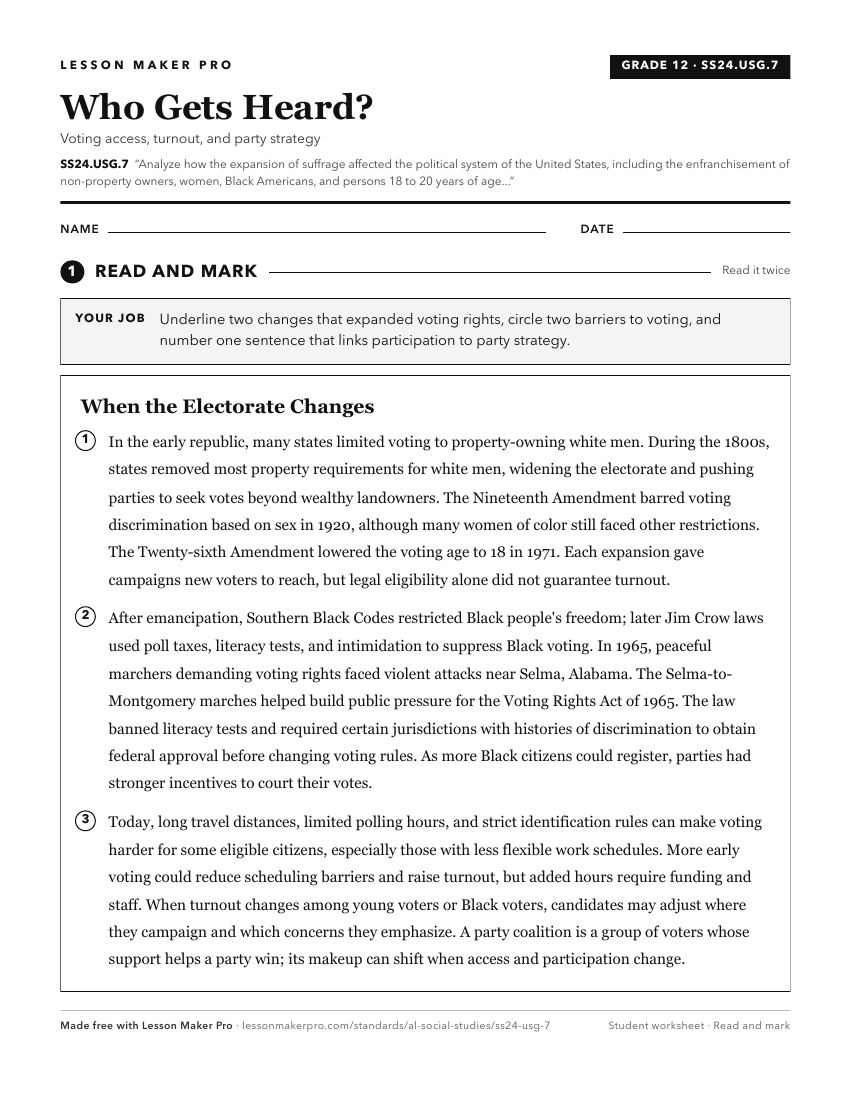
A ready-to-print activity worksheet aligned to SS24.USG.7, with an answer key for the teacher on its own page. No account needed.
PDF, US Letter, prints cleanly in black and white.
Download the worksheetKeep exploring
Related Standards
- SS24.6.13c
Analyze key elements of the Constitution that deal with citizenship and civic participation, including the path to citizenship and the process for amending the ...
- SS24.6.17c
Identify constitutional amendments that expanded political rights for citizens and describe the efforts of citizens to secure these rights.
- SS24.6.11c
Assess the arguments made by groups and individuals seeking greater inclusion and advancement of fundamental values in the late 1700s, including women and Black...
Turn this cluster into a lesson
Grade, subject, topic, and the complete cluster are prefilled. Create one free, no account needed.
Also for this cluster:Make a WorksheetMake a QuizMake a Sub Lesson